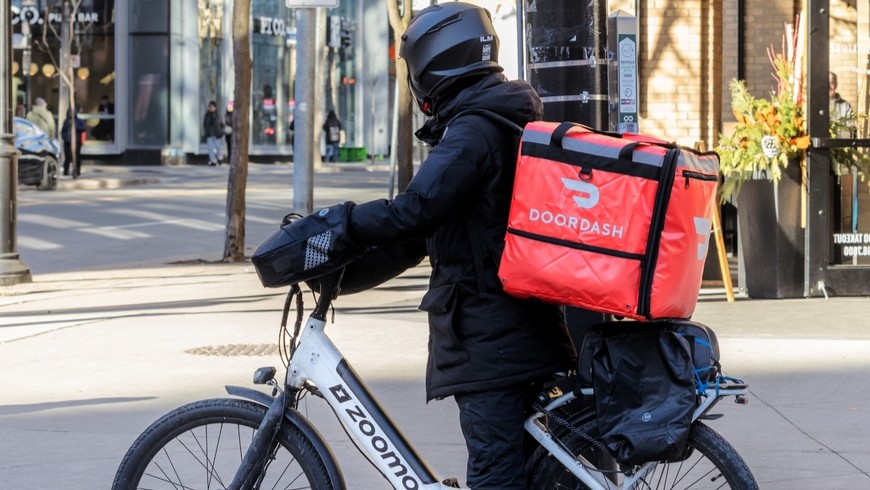

Delivery drivers and riders are set to receive a minimum rate of pay under a landmark, “world-first” agreement struck between the Transport Workers Union and food delivery giants Uber Eats and DoorDash.
The deal now awaits approval from the Fair Work Commission.
The union and the two platforms have agreed on minimum standards covering pay, insurance, and dispute resolution for the hundreds of thousands of gig workers who deliver food across Australia.
From mid-next year, delivery workers will earn at least $31.30 per hour for the time they are engaged on the platforms, marking the first time gig delivery work in Australia has come with a guaranteed minimum pay.
Uber Eats and DoorDash will also be responsible for paying for accident insurance for its workers and implementing dispute resolution processes, while workers will have the right to be represented by a union, under the deal.
The agreement has been jointly submitted by the parties to the Fair Work Commission, which is now likely to consult with other gig economy companies before deciding whether to approve the arrangement.
First time in the world
Transport Workers Union national secretary Michael Kaine said the deal is the first of its kind globally.
“Gig workers have campaigned for years for a better industry and, for the first time in the world, there could soon be a minimum floor that represents a life-changing increase to their pay,” Kaine said.
“After constructive discussions with Uber Eats and DoorDash, this is a significant step towards a fairer gig economy.”
The agreement follows recent federal laws enabling workers, unions, and employers to negotiate minimum standards in gig work.
Employment Minister Amanda Rishworth welcomed the move, saying delivery workers had “for too long… not been getting minimum standards”.
“Our laws encourage both companies and those who work for them to sit down and discuss how to set minimum standards in this country,” she said.
“Minimum standards are so important because they provide enough money for people to actually get by — a fair day’s pay for a fair day’s work.”
An emotional day
Food delivery worker Utsav Bhattarai said it was a “really emotional” moment for him, saying there is a huge amount of pressure on gig economy workers to work, even when sick or in unsafe conditions.
“You’re sick, you’ve got to go to work,” Bhattaria told the media.
“There’s a hail storm, there’s rain, you’ve got to go to work. You can’t stop. You’ve worked 60 hours? Just keep going. Just one more order, one more hour, just need to keep going. That’s the condition that these drivers were living under.”
The minimum rate of pay will operate differently to Australia’s minimum wage.
It will only apply when delivery workers are “engaged”, such as when they are delivering an order or waiting for one to be completed by a restaurant.
The pay rate will be at least $31.30 an hour and will increase from the start of 2027 and vary based on the vehicle used by the worker.
Australian Council of Trade Unions (ACTU) secretary Sally McManus said this would lead to “very significant pay increases” for the delivery drivers and riders, while Kaine said it would be “life-transforming”.
Alongside the pay rate, the platforms must provide and fund accident insurance offering a “reasonable minimum level of cover”.
The agreement is not guaranteed yet however, with the Fair Work Commission now required to sign off on it.
As the deal would apply to other food delivery companies, the commission is now likely to consult with these platforms before making its decision.
The deal comes on the back of an agreement the TWU reached with DoorDash in 2022 around safety and fairness.
This included six core principles, including that workers shouldn’t be blocked from accessing appropriate work rights and entitlements; should have access to dispute resolution processes; and have the opportunity to contribute to a collective voice.
Earlier this year the federal government’s new rules around gig economy worker deactivations also came into effect, providing protections to “employee-like” workers who have worked regularly for at least six months on a platform such as Uber.
Soon after, in a first-of-its-kind case, Uber was ordered to pay lost wages to a driver the Fair Work Commission ruled to have been unfairly removed from the platform.