
Devin, a new software developer at one of the world’s biggest investment banks, is a tireless and dedicated worker.
They're so dedicated, in fact, that they will work 24x7, and not even be paid the six-figure salaries commanded by their teammates.
That’s because Devin is not a human at all, but an artificial intelligence software engineer.
Investment bank Goldman Sachs has become one of the largest organisations in the world to begin employing the AI worker, which goes far beyond the regular use of AI to automate certain tasks for workers and can complete complicated, multi-step tasks.
Goldman chief information officer Marco Argenti confirmed this week that Devin will be joining the bank’s 12,000 human developers, and that this is expected to take grunt work off the hands of these humans and boost productivity across the board.
“We’re going to start augmenting our workforce with Devin, which is going to be like our new employee who’s going to start doing stuff on the behalf of our developers,” Argenti told CNBC.
At first, hundreds of the AI engineers will be unleashed at Goldman Sachs, with the potential for this to jump to thousands “depending on the use cases”, Argenti said.
A tireless teammate
Devin was unveiled by AI startup Cognition and is touted as the world’s first AI software engineer.
The company’s website says that Devin is a “tireless, skilled teammate, equally ready to build alongside you or independently complete tasks for you to review”.
“With Devin, engineers can focus on more interesting problems and engineering teams can strive for more ambitious goals,” it said.
Cognition said that the tool can plan and execute complex engineering tasks, recall relevant context, learn over time and fix mistakes.
At Goldman Sachs, Devin will be supervised by human employees and will handle tasks such as updating internal code to newer programming languages.
A new look workforce
Argenti said that he envisions a “hybrid workforce” in the future, with humans working in conjunction with AI.
“It’s really about people and AIs working side by side,” he said.
“Engineers are going to be expected to have the ability to really describe problems in a coherent way and turn it into prompts…and then be able to supervise the work of these agents.
“These models are basically just as good as any developer, it’s really cool.
“So, I think that will serve as a proof point also to expand it to other places.”

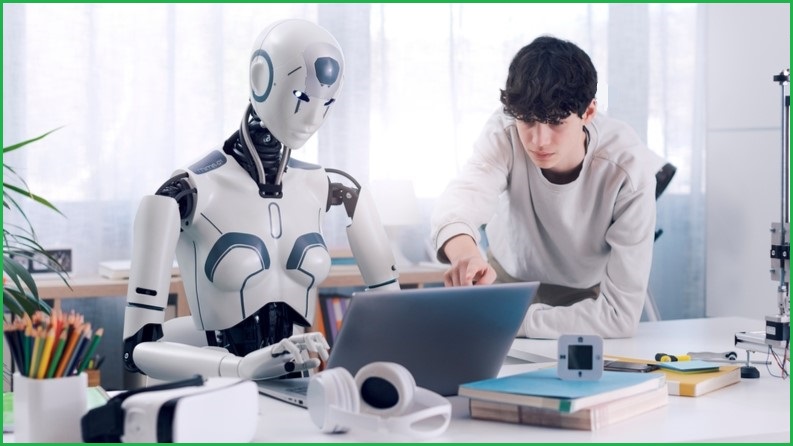
They may be working side by side now but the AI could one day replace humans. Photo: Shutterstock
According to University of Sydney Business School Associate Professor Sandra Peter, who is also the director of Sydney Executive Plus, education holds the key to helping workers adapt to this new world.
“There’s never been a more important time to learn,” Peter told Information Age.
“Learn to speak the language of tech, upskill yourself around AI and embrace the idea of lifelong learning.
“Think of AI as something that augments work rather than replaces it, as a tool that enhances what you do or enables you to do things you weren’t able to do before.”
For companies, AI should be thought of as much more than just a tool to enhance productivity, she said.
“When it comes to AI, companies should be thinking about efficiency but also about transformation – not only about how AI can help them do something faster or cheaper, but also how they can set up the organisation so it can make use of AI, in terms of how they create value, what data they collect and so on,” Peter said.
Companies around the world are grappling with how to utilise and implement AI, with some going all in and shedding workers to use automated systems, and others adopting a more cautious approach.
Duolingo recently unveiled a new policy preventing its teams from hiring new people unless they can prove the work cannot be done through automation as part of an “AI-first mandate”.
Amazon CEO Andy Jassy also recently predicted the tech giant’s corporate workforce to decline “in the next few years” due to “efficiency gains from using AI”.
“We will need fewer people doing some of the jobs that are being done today, and more people doing other types of jobs,” Jassy said.
While many companies are cutting jobs thanks to AI, some are being forced to re-hire the staff it had let go after realising human workers were still needed.