
The United States will scale back perceived “red tape” such as environmental regulations and copyright protections as it seeks "global dominance” in artificial intelligence, according to an ‘AI Action Plan’ unveiled by President Donald Trump on Thursday, Australian time.
The 23-page plan has proposed speeding up the construction of AI data centres in the US, while also increasing US sales of AI hardware and software overseas, and removing what Trump described as “woke Marxist lunacy” from some AI models.
“From now on, the US government will deal only with AI that pursues truth, fairness, and strict impartiality,” Trump said as he announced the plan at a government AI summit in Washington DC.
The plan recommended removing “references to misinformation, diversity, equity, and inclusion [DEI], and climate change” from the US government’s voluntary AI risk management framework.
Trump told the crowd the US was in “a fast-paced competition to build and define this groundbreaking technology that will determine so much about the future of civilisation itself”.
He said the nation “can’t be expected to have a successful AI program” if groups building AI systems were also expected to pay for copyrighted works such as articles or books which were used to train AI models.
“China’s not doing it,” he said.
White House pledges ‘rapid buildout’ of data centres
Trump's ‘AI Action Plan’ proposed speeding up environmental permits “by streamlining or reducing regulations” including America’s Clean Air Act and Clean Water Act — and even using AI to more quickly process environmental approvals — in a push to build more data centres.
“America’s environmental permitting system and other regulations make it almost impossible to build this infrastructure in the United States with the speed that is required,” the plan stated.
To keep up with the significant electricity demands of AI data centres, Trump’s plan also signalled a greater reliance on “new energy generation sources” such as geothermal and nuclear technologies.
“America needs new data centres, new semiconductor and chip manufacturing facilities, new power plants and transmission lines,” said Trump, who argued there would still be some environmental protections.
“… Every company will be given the right to build their own power plants,” he said.
KD Chavez, executive director of climate advocacy group Climate Justice Alliance, said Trump’s AI plan “unhinges and removes any and all doors” to greater collaboration between Big Tech and Big Oil.
“With tech and oil’s track records on human rights and their role in the climate crisis, and what they are already doing now to force AI dominance, we need more corporate and environmental oversight, not less,” she said.
UN secretary general António Guterres on Tuesday urged tech companies to power their data centres with 100 per cent renewable energy by 2030, amid increasing AI-based emissions.
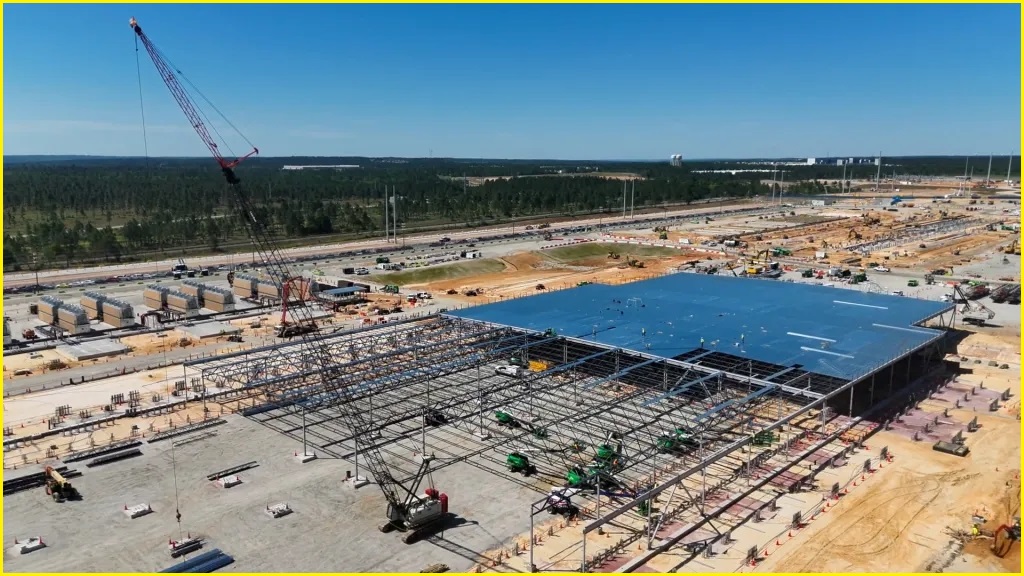
Meta's Aiken data centre is under construction in South Carolina. Image: Meta
Big Tech reps in the room for Trump speech
After removing former US president Joe Biden’s AI export controls and safeguards on his first day back in office in January, Trump gave his advisors six months to create new AI policies — many of which have been guided by tech industry lobbyists and companies.
The ‘AI Action Plan’ contained several policies pushed by members of the tech lobby, including making it easier to build AI data centres and allowing greater international sales of US AI technologies.
Representatives from several tech companies were in attendance for Trump’s speech, including US chipmakers Nvidia and AMD, and controversial defence and intelligence software firm Palantir.
Nvidia CEO Jensen Huang, whose company recently became the first public firm to reach a $US4 trillion ($6 trillion) market value, was directly praised in Trump’s speech.
Huang had pushed Trump to repeal restrictions which had prevented Nvidia from selling some its advanced chips in China, over fears they could be used by the country's military.
The chipmaker said it now planned to resume sales of its H20 chips to China, with US government approval.
Trump suggested during his speech that he had considered breaking up Nvidia to “get them a little bit of competition”, before he learned it was “not easy in that business”.
He also used the speech to suggest the name “artificial intelligence” be changed.
“We should change the name — I actually mean that, I don’t like the name artificial anything,” Trump said.
“Because it’s not artificial, it’s genius, it’s pure genius.”