

An Australian cyber CEO says he was mistakenly referring to himself as an Adjunct Professor due to an “administrative oversight”, after the university involved asked him to stop using the title.
Gridware CEO Ahmed Khanji said he was invited to the honorary role in 2018, but an administrative error meant the appointment paperwork was never completed.
Khanji told Information Age that once he was made aware of the issue, he promptly removed references to being an Adjunct Professor from his company website and LinkedIn profile.
Gridware is a Sydney-based cybersecurity consultancy firm.
The company offers services and consulting around offensive cybersecurity, virtual CISOs, managed detection and response, cyber advisory and digital forensics and incident response.
Uni says appointment not completed
Until recently, the Gridware website said that its CEO, Khanji, was an “Adjunct Professor at Western Sydney University”, while a separate article authored by Khanji several years ago said he was an “Adjunct Professor of Cyber Security and Behaviour at Western Sydney University”.
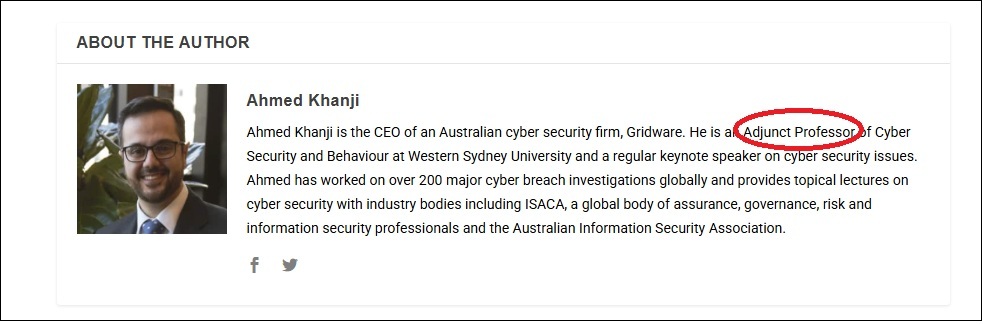
A biography on an unrelated third-party site still referenced the title earlier this week. Mr Khanji says he had no editorial control over that website and had already updated his own official profiles. Source: Australian Muslim Times
Khanji is a regular commentator in the media on cybersecurity, fraud, hacking and security risks.
An Adjunct Professor is a part-time, non-tenured faculty member at a university who is typically hired on a contractual basis for a specific course or academic term.
Khanji maintains he was "given written permission by Western Sydney University to use the title" and that he used the Adjunt Professor title "based entirely on that authorisation."
The university did not respond to repeat requests for comment regarding Khanji being given "written permission" saying only that he had not been officially appointed as an Adjunct Professor.
“Based on a search of university records, no appointment of Mr Khanji as Adjunct Professor was completed,” the spokesperson told Information Age.
“Once the university became aware of this claim, it promptly undertook the appropriate enquiries, which led to the individual being directed to remove the claim.
"Western Sydney University takes the integrity and accuracy of academic titles and affiliations seriously, and was concerned to learn of this incorrect representation.”

Western Sydney University said Khanji was not appointed as an Adjunct Professor. Photo: Shutterstock
Khanji said he had been invited to the role by Western Sydney University in 2018 as part of its “industry engagement program”.
“It’s a guest position designed to help students build employment-ready skills and connect academic learning with real-world cybersecurity experience, something I’ve been proud to contribute to over the years and continue to do through guest lectures and student engagement with my company,” he said.
“I used the title in good faith, on the understanding that all the relevant paperwork had been completed.
“It now appears there was an administrative oversight, and as soon as I became aware of that, I promptly removed the title to comply with university policy.”
Khanji is still a NSW Cyber Ambassador for Investment NSW, where he volunteers to run workshops with students, parents and teachers on cybersecurity.
His biography on the Gridware website now says that he is “recognised for his insights into offensive security and emerging technologies such as blockchain and often contributes to broader cybersecurity conversations across the country”.
“With an extensive background as a security advisor to major Australian enterprises, Ahmed helps organisations navigate the evolving threat landscape with clarity and confidence,” it said.
No allegation of dishonesty has been made against Khanji.
The importance of titles
Robert Half director Tom Ward said that in general, it's important to get your credentials right, especially when looking for a new role.
"Maintaining precision in how professionals present their identities is crucial to upholding credibility and trust," Ward told Information Age.
"Accurate job titles and credentials convey an individual's qualifications, responsibilities and achievements, allowing others to clearly understand their role and expertise.
"Conversely, misrepresentation or inaccuracies can create misunderstanding and lead to misalignment with potential roles or job opportunities."
While there is no allegation that Khanji deliberately misled anyone about the position, a report from earlier this year found that nearly half of all Australians had included misleading information on a job application.
The report, based on a survey of Australian workers, found that the most common job application lies were exaggerations and fake references, along with fake university degrees and covering up the real reason they left a previous role.
A report from 2022 found that just one in five hiring managers said they consider the candidates’ credentials when they are deciding whether they are qualified or not, while just over a quarter require their cybersecurity hires to have university degrees.