



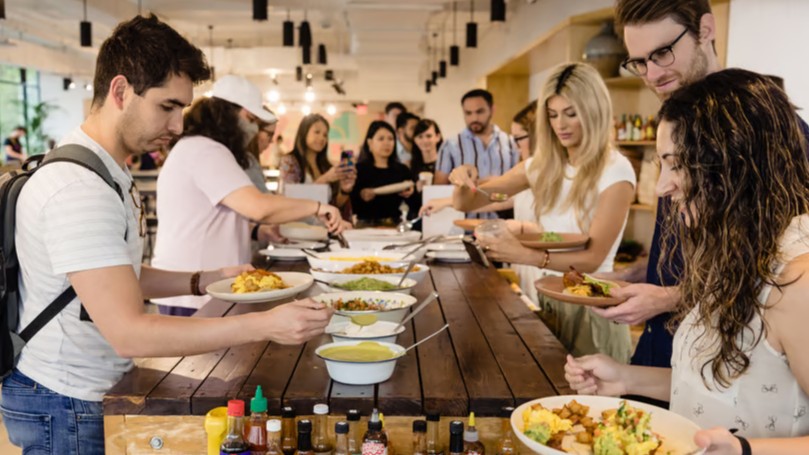

Back when Canva’s team was small enough to fit around one table, co-founder Cliff Obrecht would cook lunch – often toasties – for all his employees every day.
Even though Canva is a giant of the Australian tech scene, with more than 5,000 employees across eight countries, the company has retained its focus on culture through food and communal eating.
It still provides chef-made breakfast and lunch to all employees throughout its offices.
“That one table became many, and eventually a full kitchen program, but the spirit behind it has never shifted,” Canva head of vibe Chris Low told Information Age.
“It’s always been about bringing people together, and it always will be.”
Canva is one of many Australian tech companies to offer their employees free food, mainly for lunch.
For some, it’s an effort to lure workers back into the office.
For others, it’s entirely about improving culture and fostering a sense of team and togetherness.
The oldest perk in the books
It’s one of the oldest workplace perks in the books, with the likes of Google and Facebook gaining prominence for hiring chefs and providing meals to their workers.
And it’s one that’s still among the most effective, according to the research.
New research by workplace food platform ezCater found nearly four out of five hybrid workers would be more likely to stay at the company following a return-to-office mandate if free lunch was offered.
The findings are based on a survey of more than 2,300 participants, including more than 1,000 employees, 700 workplace food buyers and 600 restaurants.
More than 90 per cent of workplaces said they will spend the same or more on food this year, up from just over 80 per cent in 2024.
A further one in five organisations said they would boost spending on food for employees by more than 25 per cent.
The research also found that daily or weekly meal programs have increased by more than a quarter year-on-year, and the vast majority of these are completely free for workers.
“Food has evolved from a perk to a strategic lever for workplace productivity and culture,” ezCater chief growth officer Cindy Klein Roche said.
“Employee meal programs are now core to organisations’ strategy to bring employees together.”
And the perk of free food in the office has become even more important in recent years with the huge growth in the cost of living.
Maintaining a strong culture
Australian cryptocurrency exchange Swyftx provides free catered lunches at its Brisbane office.
As soon as lunch for the day is unveiled, a queue quickly forms in the office, Swyftx Director of People & Culture Kristen Born said.
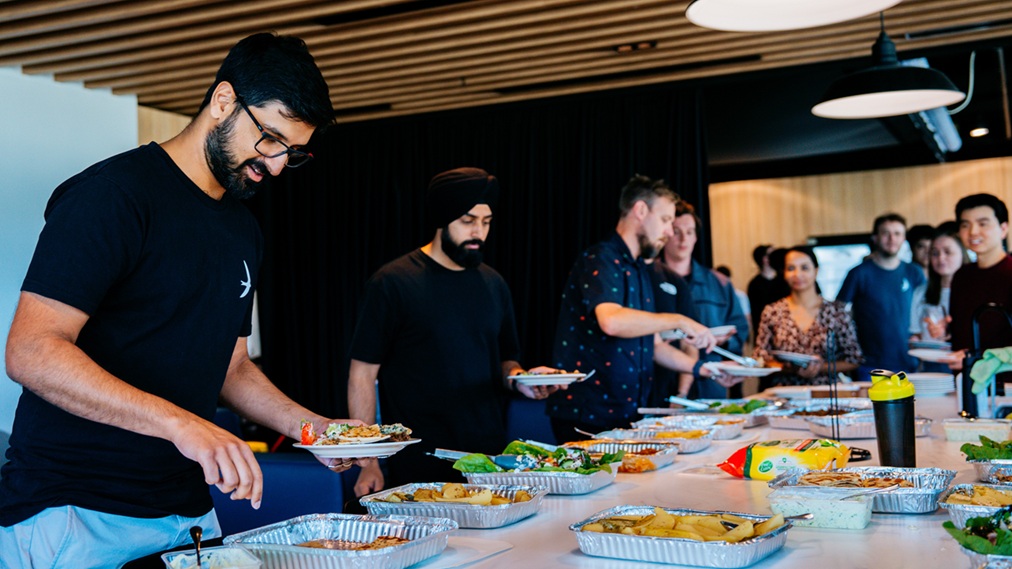
The team at Swyftx enjoys a meal together. Photo: Supplied
“Swyftx has a close-knit team and providing lunches is an important part of how we maintain a strong culture,” Born told Information Age.
“It’s a popular perk and a really important part of our culture.
“Lunches give people a reason to come together, connect with colleagues they might not normally work with, and have conversations that simply don’t happen over Slack or video calls.”
Providing lunches can also be a good way to ease workers back into the office, Robert Half director Huzefa Soni said.
“Free lunch can help remove some of the cost and inconvenience associated with coming into the office and create a more social and collaborative workplace experience,” Soni told Information Age.
But Soni said that while food programs can help companies stand apart from rivals, it is rarely a must-have for workers.
“It is a positive differentiator, but it is rarely a top priority on its own,” he said.
“Jobseekers, especially those in technology, are still more focused on competitive pay, flexibility, career progression and a supportive culture.
“Employers are most likely to see an impact when benefits such as free meals form part of a broader, genuinely compelling reason for employees to spend time in the office.”
Born said providing ways for employees to connect, such as through free lunches, is crucial.
“We know remote work has an important place, but there’s real value in spending time together in person,” she said.
“Our founders Alex and Angus have worked hard from day one to support the team and keep them engaged.
“We have a golf simulator, pool table and a ping pong table in the office, plus extended parental leave, and menopause and menstruation leave.”
A sacred hour
At Canva, its food and beverage programme is known as the Communal Table.
It now involves several professional chefs, cooking classes, catering, Friday night drinks and a Food for Change scheme.
Workers can also win a golden ticket, which allows them to select a menu item that their whole office will have.
For the tech giant, the food program is not about getting workers back into the office as it remains a hybrid-first workplace.
“Our team has always had the flexibility to work in the way that works best for them,” Low said.
“What draws people to our campuses is each other. The Communal Table is an international space for that.”
Every day at midday, Canva employees have a “sacred lunch hour”, where everyone stops working and shares a meal in a communal space.
“It’s where Canvanauts quickly get a feel for who we are, where ideas and perspectives are shared across teams, and where we learn from one another in ways that simply don’t happen in meetings,” Low said.
“It’s a daily reminder that you’re part of something bigger than your immediate team, helping people build a culture that fuels big ideas and empowers people to do the best work of their lives.”
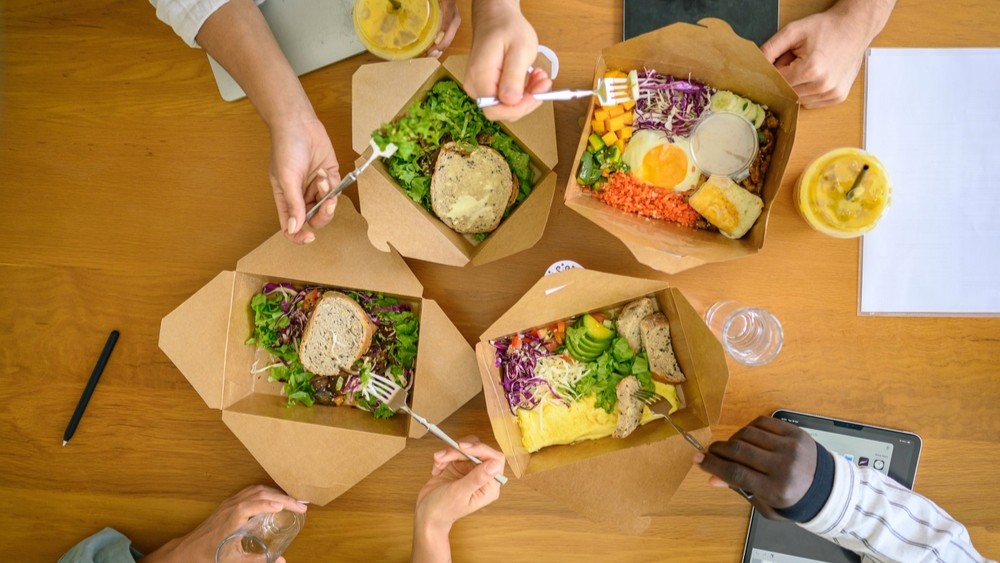
Research shows sharing a meal with work colleagues makes workers more productive. Photo: Shutterstock
Researchers from the University of South Florida studied five types of company perks – food, social, physical, mindfulness and health – and found that food “clearly” had the strongest impact.
It found that offering free food improved employees’ sense of value, boosted feelings of workplace loyalty and had “stronger direct effects on customer responsiveness”.
Pony up, bosses – it’s worth it
According to a survey conducted by online grocery startup Peabod, nearly 70 per cent of respondents who are provided with free food were “extremely” or “very happy” with their current job, leading to increased productivity as well.
Similarly, a study from Cornell University in 2023 found workers who eat lunch together may be more productive and urged employers to provide catering.
“Although the costs that organisations invest to support onsite eating are clearly measured as direct expenses, our research highlights the opportunity that exists to start measuring and optimising less direct organisational benefits that can be obtained through institutional support for commensality among coworkers,” the study said.
“This area of investigation carries significant potential as a mechanism to increase workgroup performance within organisations by leveraging natural needs to eat when compared with less mundane activities that would require more complicated employer interventions.”
There has been a surge in Australian companies offering perks such as free lunches in recent years to entice workers back into the office and ease annoyance at return-to-office mandates.
Many other Australian tech companies offer free lunches, including Atlassian and Finder.
At Atlassian, employees enjoy catered breakfasts, lunches and barista-made coffee every day, along with stocked snack areas.
Finder employees also get free daily breakfast and catered lunches, along with snacks and drinks every Friday.