

Closing digital skills gaps could create a $25 billion economic boost over the next decade for Australia according to the 11th Australia’s Digital Pulse report, released on Wednesday by the Australian Computer Society (ACS) — the professional association of the nation's technology professionals and the publisher of Information Age.
A survey commissioned for the report and carried out by consultancy firm Deloitte found 77 per cent of nearly 800 technology workers who were surveyed believed they had insufficient skills in at least one digital capability required for their role.
The most prevalent deficiencies among technology workers were found to be in artificial intelligence, cybersecurity, robotics automation, and augmented and virtual reality.
Just over half (51 per cent) of the more than 400 workers surveyed from other industries cited insufficient capacity in at least one digital skill needed in their work — predominantly in using AI to analyse data and write content, cybersecurity, and digital dashboards.
A separate survey of more than 300 Australian C-suite executives from various industries found 15 per cent were experiencing digital skills shortages in their business, suggesting around 150,000 Australian businesses could be facing similar issues, ACS said.
Fixing these gaps could improve Australia’s productivity with a $25 billion economic uplift by 2035, according to ACS’s analysis, including by helping to mitigate costs from cyberattacks.
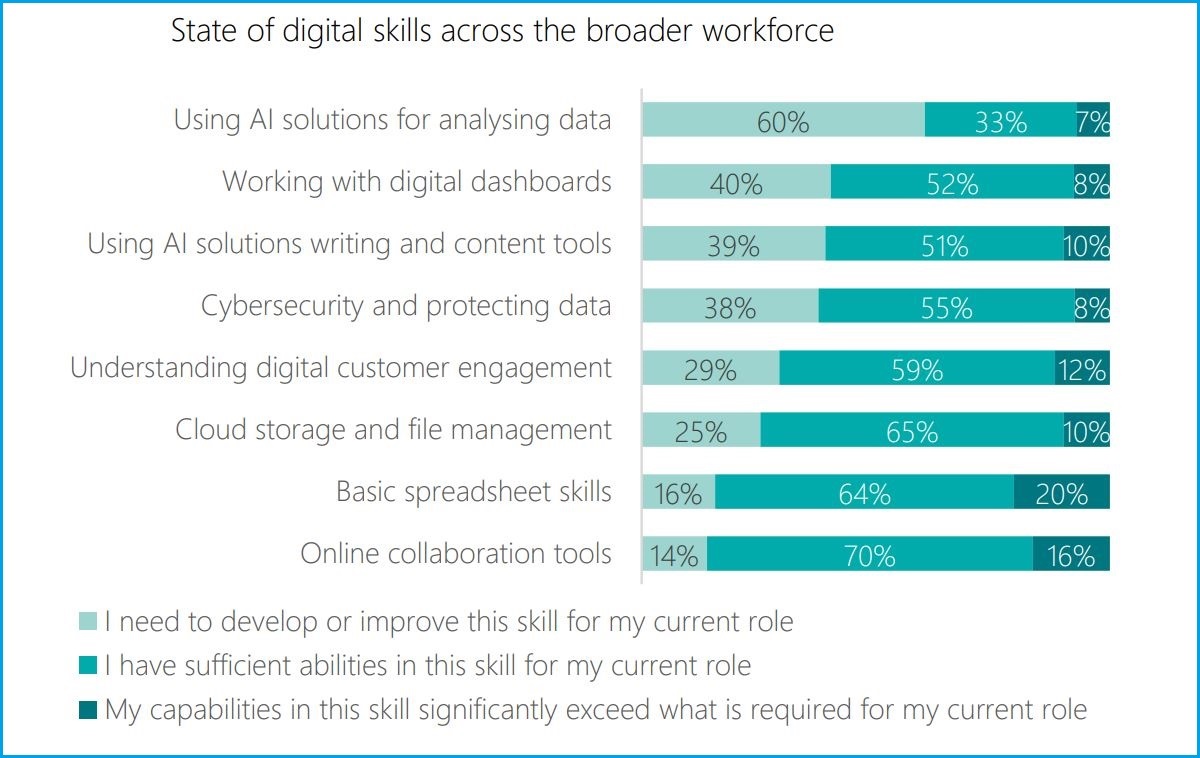
Image: Australia's Digital Pulse 2025
ACS CEO Josh Griggs said Australia needed to make sure every worker had “the capabilities to work with and lead digital transformation” so the country could compete globally.
“If we close these gaps, Australia stands to unlock billions in economic growth, improve cyber resilience, and position itself as a global tech leader,” he said.
“Our plan is not just about fixing today’s problems — it’s about creating a future-ready nation.”
Australia fell from 13th to 18th place in the latest World Competitiveness Rankings, released in June by the International Institute for Management Development (IMD) — after averaging 19th between 2023 and 2018.
Deputy Prime Minister Richard Marles, who spoke at the launch of this year's Digital Pulse in Canberra on Wednesday, said the report was "at the centre of our national productivity challenge" as more Australians began to use AI to improve their efficiency at work.
Uplifting digital skills from graduates to CEOs
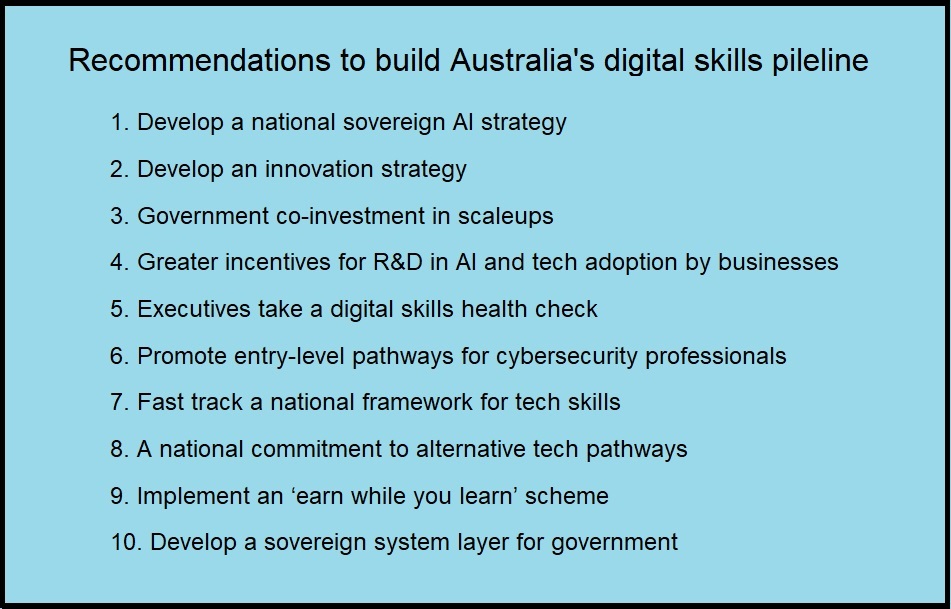
Among 10 recommendations made in the latest Digital Pulse report, ACS argued C-suite executives should take a “digital skills health check”, after its survey found nearly half (45 per cent) of 310 executives who responded only had ‘basic’ capabilities in one of five digital skills required for their role.
“The health check would include understanding their own digital capabilities to help identify any blind spots, the digital capabilities and gaps within their team and how the use of digital technologies fits within their current business strategy,” ACS said.
“Building the health check into planning would also strengthen organisation’s future strategy, technology governance, and security.”

ACS says C-suite executives should take a 'digital skills health check' to help identify blind spots. Image: Shutterstock
ACS reiterated its calls for the government to fast-track the National Skills Taxonomy being developed by Jobs and Skills Australia and align it to frameworks such as the global Skills Framework for the Information Age (SFIA), to minimise gaps between workers’ skills and available jobs.
The society also called for the government to implement an ‘earn while you learn’ scheme to encourage more mid-career workers to reskill and upskill in technology.
The 2024 Australia’s Digital Pulse report suggested one million workers could be reskilled for jobs in tech, which needed more people with the right skills in fields such as AI and cybersecurity.
Workers had already begun responding to increasing digital skills requirements in the economy, ACS said in its new report, with 96 per cent of surveyed technology workers and 70 per cent of other workers having undertaken training to maintain or improve their digital skills in the past year.
“Realising the $25 billion benefit requires addressing the digital skills gaps right across the Australian economy, from entry level roles to C-suite executives,” the report stated.
“Addressing this challenge will require us to think differently about the pathways we use to source technology talent and how we upskill all workers across the economy.”
Vocational training vs university degree
C-suite executives saw vocational education and training (VET) qualifications and industry certificates as more useful indicators of tech workers’ capabilities than university degrees, according to the survey.
While 41 per cent of surveyed executives said relevant VET qualifications and industry certificates were effective indicators of likely performance, only 34 per cent said the same for university degrees.
Despite their preference for industry certifications and VET qualifications, 88 per cent of the surveyed executives said their business required workers in technology roles to have a university degree.
This mismatch was “likely preventing businesses from accessing the talent they need”, said ACS, which urged federal, state, and territory governments to push companies to allow more entry-level hires to come from alternative, non-university pathways.
The federal government’s fee-free TAFE program, introduced in 2023, likely contributed to a recorded increase in enrolments in VET IT courses that year, ACS said.
The society’s 10 recommendations also urged the government to develop formal strategies in sovereign AI and innovation, while also investing in local scaleup companies and providing greater incentives to improve Australia’s research and development (R&D) environment.
The 2025 edition of Australia’s Digital Pulse can be downloaded from the ACS website.