





Apple and Google have removed mobile apps designed to record sightings of United States Immigration and Customs Enforcement (ICE) agents from their respective app stores, following pressure from US President Donald Trump’s administration.
The technology giants removed the apps earlier this month after US Attorney General Pam Bondi said such services had “put ICE agents at risk" of violence from members of the public.
“Violence against law enforcement is an intolerable red line that cannot be crossed,” Bondi told US media.
“This Department of Justice will continue making every effort to protect our brave federal law enforcement officers, who risk their lives every day to keep Americans safe."
Downloads of ICE-tracking apps have risen this year amid Trump’s crackdown on illegal immigration, which has seen National Guard troops sent into major cities and ICE agents carry out immigration raids while deporting tens of thousands of people.
App users and developers have maintained they have the right under the US Constitution to capture the actions of ICE and Homeland Security agents, and to attempt to keep each other safe.
Apple pulls ICEBlock, DEICER, Eyes Up, and more
Bondi said her office had demanded Apple remove ICEBlock, the most widely used ICE-tracking app.
The company reportedly complied within hours, sending an email to the app’s creator, Joshua Aaron, in which it said further downloads would be blocked because new information “provided to Apple by law enforcement” showed the app broke App Store rules, despite Apple previously approving the app for release.
Apple told Aaron the app breached the company’s policies “because its purpose is to provide location information about law enforcement officers that can be used to harm such officers individually or as a group”, according to the Associated Press.
Google and Apple have removed ICE-tracking apps from their respective Play Store and App Store. Image: Shutterstock
In a statement posted to the ICEBlock website, Aaron said he was “incredibly disappointed by Apple’s actions”, which he said followed “pressure from the Trump administration”.
“Capitulating to an authoritarian regime is never the right move,” he said.
“Apple has claimed they received information from law enforcement that ICEBlock served to harm law enforcement officers. This is patently false.
“ICEBlock is no different from crowd sourcing speed traps, which every notable mapping application, including Apple's own Maps app, implements as part of its core services.
“This is protected speech under the first amendment of the United States Constitution.
“We are determined to fight this with everything we have.”
Alejandra Caraballo, a civil rights attorney and instructor at Harvard University’s Cyberlaw Clinic, commented on social media, “There's nothing illegal about ICEBlock.
“This is solely about Apple appeasing the Trump regime.
“… The US government is now dictating what apps you can have on your phone.
“The underlying threat here is if Apple didn't comply, they'd slap billions in tariffs on Apple products.”
Apple did not respond to a request for comment from Information Age, but reportedly confirmed to US media that it had removed ICEBlock and several “similar apps”, which included the likes of Red Dot, DEICER, and Eyes Up.
People who had already downloaded the removed apps would be able to keep using them, but would not be able to re-download them from the App Store if they had deleted them.
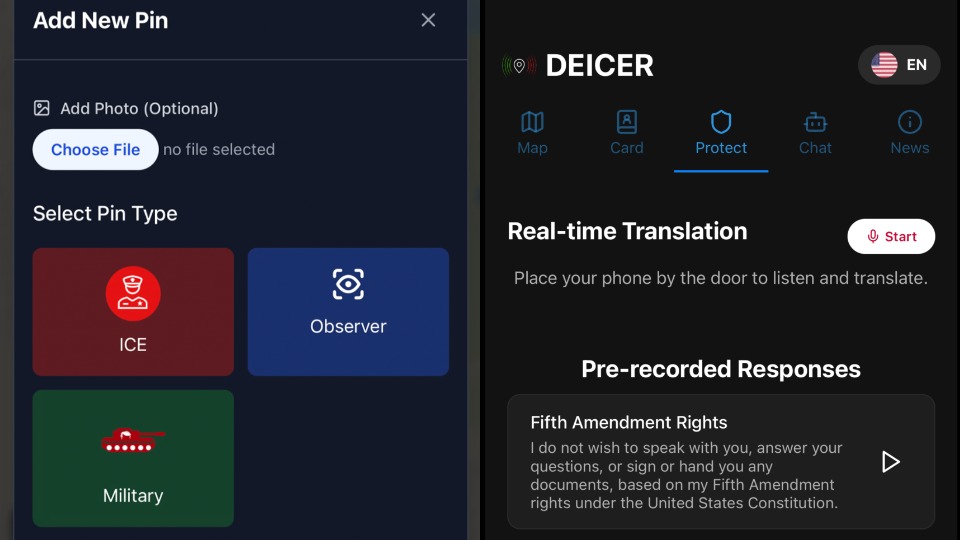
Apps such as DEICER can allow users to record sightings of ICE agents or US military assets. Images: DEICER
DEICER developer Rafael Concepcion said he wished Apple had “pushed back” against the Trump administration’s demands.
“But in the era where universities and organisations are capitulating to the administration, this was expected,” he said in a video statement on social media.
Apple allegedly sent Concepcion a very similar email to the one received by Aaron from ICEBlock.
The email also stated the company was removing such apps due to a guideline which prohibited “defamatory, discriminatory, or mean-spirited content” related to “religion, race, sexual orientation, gender, national/ethnic origin, or other targeted groups”.
DEICER was still available on web browsers, Concepcion said.
Yesterday the gov reached out to Apple and took down DEICER as well as other ICE apps. While disheartened at Apples capitulation, I was prepared for this. Here's how you can install the app on your phone -without- the app store. It's up to us to protect our rights. #DEICER pic.twitter.com/Z2QWCc4ld9
— RC Concepcion (@aboutrc) October 3, 2025
Apple's removal of Eyes Up, which allowed users to preserve videos and news reports of ICE agents’ actions from the likes of Instagram reels and TikTok posts, was confirmed by 404 Media on Wednesday.
The creator of Eyes Up, which also allowed users to tag a location on their videos, reportedly told the publication their goal was “government accountability”.
“I think the [Trump] admin is just embarrassed by how many incriminating videos we have,” they said.
Google removes apps ‘for violations of our policies’
Like Apple, Google also removed Red Dot — an app which allowed users to report the time and location of ICE activity, as well as to notify nearby members of ICE’s presence in that area.
While ICEBlock was never published on Google Play, Google told US media it had removed similar apps “for violations of our policies”.
The company did not respond to a request for comment from Information Age.
This is not the first time Apple and Google have removed apps from their app stores following pressure from a federal government.
Apple removed an app called HKmap.live from its App Store in 2019 following pressure from the Chinese Communist Party, as the app allowed protesters in Hong Kong to track the movements of police.
At the time, Google also removed a mobile game called The Revolution of Our Times, which took its name from a Hong Kong protest slogan and let users play as protesters.
The company said it pulled the app because it violated a policy related to “capitalising on sensitive events such as attempting to make money from serious ongoing conflicts or tragedies through a game”.




,%20john%20ternus%20(right)%20hello%20apple%20instagram.jpg.transform/320x180/img.jpg)