


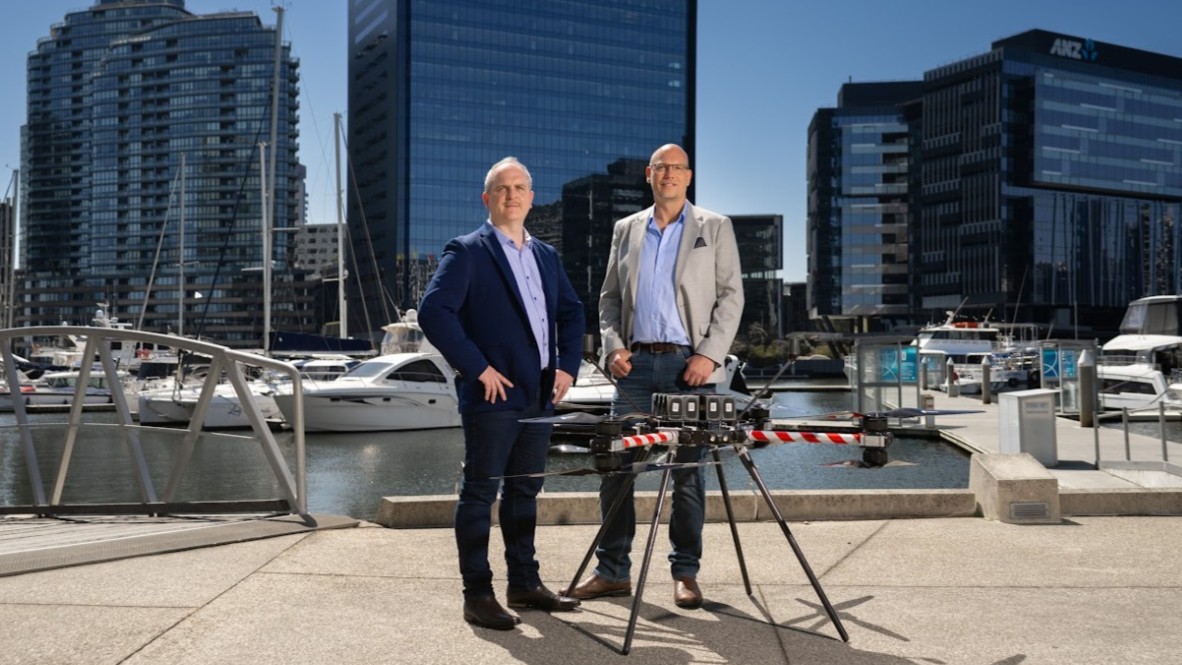

Teams of drones could soon be bringing you equipment, packages, grocery orders – or even, theoretically, people – after Melbourne drone developer Freespace Operations successfully developed a world-first capability that lets four drones lift and deliver loads of up to 100kg.
Using the firm’s new ‘Cooperative Lift’ technology, four of the company’s Callisto 50 multi-rotor drones – which can each carry 26kg of weight and include eight propellers so they keep aloft if one or two fail – can work together to move the equivalent of five bags of concrete at once.
The ability to lift that much weight simultaneously and carry it into remote areas at speeds of up to 60km/h, opens up new promise for specialised tasks like ship-to-ship logistics and emergency services, which have traditionally required helicopters or airplane drops for heavy deliveries.
The Callisto 50 drones proved their value supporting relief efforts during recent Canadian bushfires and floods – including bringing spare parts for infrastructure repairs to areas inaccessible by roads – but Cooperative Lift takes this to the next level by quadrupling the carry capacity.
“The Callisto is my best effort to create a peer-to-none aircraft in that particular application and weight category,” Freespace Operations co-founder and chief technology officer Leonard Hall told Information Age, adding that it has been highly optimised to maximise lift and battery life.
“Multi-rotors are tugboats and they tend to be disproportionately powerful for their size – with absolute attitude control [the ability to stay level even in strong winds] that is absolutely a level above on a well-built multi-rotor aircraft.”
Getting autonomous drones to work together
Getting Cooperative lift to work required solving a longstanding engineering problem: while drone control software continuously adjusts the motors’ power to level and steer the drones, the aircraft haven’t generally been designed to sense and respond to the movements of other drones.
Cooperative Lift accomplishes this by building a communications channel between the machines so that changes to the movement of one drone – for example, from strong headwinds or crosswinds buffeting the deck of a ship – are sensed and compensated for by the others.
This allows the drones to keep loads flat while pulling them through the air and prevents loads from swinging as the drones accelerate and decelerate.
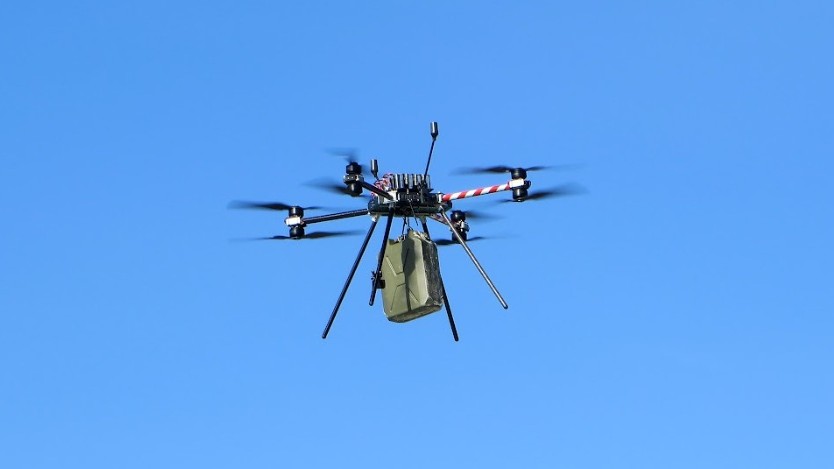
The drones can assist in carrying essential supplies to the stranded. Photo: Supplied
By adding a Cooperative Lift sensor to the deck of a ship, the ship effectively becomes another team member – letting the drones measure the rocking of a ship in big waves and compensate, so they can lower their loads flat onto a swinging deck rather than dropping them hard.
“Multi-rotors are very good matches for craning applications,” Hall said, noting that the drones are nearly as stable in strong crosswinds as Chinook cargo helicopters because they have a “ridiculous power to weight ratio at maximum payload.”
“We’ve got huge amounts of control authority” that provides fine control over the drones’ movements, he added, “and you need that very high level of control to make multiple aircraft fly within spitting distance of each other.”
Building a logistics game-changer
Cooperative Lift is now starting to be incorporated into commercial applications – where Hall envisions teams of automated drones providing a “very significant increase in capability” and taking over logistics tasks that previously required manned helicopters.
Automated logistics means that teams of Cooperative Lift drones could, for example, be programmed to pick up loads from a dock, carry them and deliver them to the deck of a ship, then return to the aircraft until all of the goods had been moved – without any human intervention.
They could also, for example, ferry food and medical supplies from disaster recovery authorities to homes and rooftops where people are cut off by flood waters – and, potentially, even carry some people to safety.
For a career engineer like Hall, realisation of the technology is a major step in a career arc that, he said, began years ago “because it’s fun to play with flying robots”.
An early user of the open-source ArduPilot platform, Hall became a key programmer of industrial drone solutions before joining fellow drone enthusiast and racer Ken King to co-found Freespace Operations in Melbourne in 2019, and develop a bespoke multi-rotor drone for a defence contract.
In a market hungry for autonomous logistics tools, Hall said the ability to move so much weight at once could be a game-changer “as people understand how to use them effectively – and not just how to try and apply a drone to their situation but apply the right drone to the right situation.”
“That's where we'll see potentially huge amounts of growth as industry understands how to use this tool that they've got access to.”