
App developers including Spotify and Fortnite creator Epic Games are celebrating after a US judge found Apple violated a court order and must now stop charging commissions on purchases made by US users outside of its App Store.
Wednesday’s decision threatens to put a dent in the tens of billions of dollars generated annually by Apple through its 15 to 30 per cent commissions on in-app purchases.
Epic is vowing to have Fortnite reinstated on the US App Store this week after the popular game was removed by Apple in 2020 for bypassing its payment system, while Spotify has updated its app and pushed American users to subscribe outside of Apple’s walled garden.
US District Judge Yvonne Gonzalez Rogers found Apple had not complied with her 2021 order in the long-running case brought by Epic Games, in which she directed Apple to allow developers to display clear links and buttons to third-party payment options inside their apps.
While Apple was still allowed to collect commissions on those payments under the 2021 order, Gonzalez Rogers found the company had not justified its decision to collect a 27 per cent fee and had made it difficult for developers to direct users to alternative payment options.
Now, Apple has been ordered to allow developers wider use of buttons and links to make sales over the web, and the tech giant cannot charge a commission.
Gonzalez Rogers has also referred the case to federal prosecutors to investigate whether Apple could be held in criminal contempt for defying her previous ruling.
Apple filed a notice of appeal in the case on Monday, but said it would comply with the latest court order in the meantime.
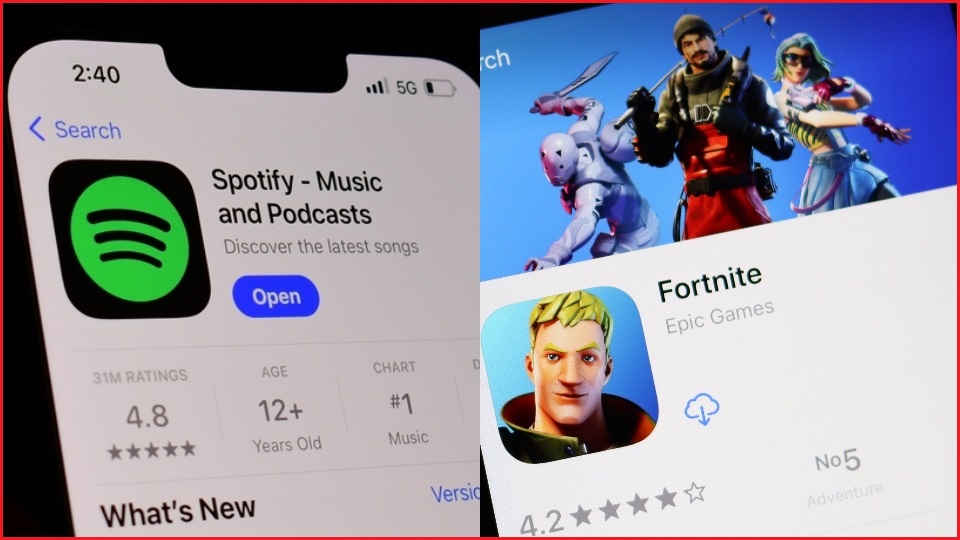
Fortnite could return to iOS devices in the US, while Spotify has updated its app following Apple's court loss. Images: Shutterstock
Judge accuses Apple of ‘a gross miscalculation’
Gonzalez Rogers argued internal Apple documents showed the company knew it was being anticompetitive, that its vice president of finance Alex Roman lied under oath, and its CEO Tim Cook “chose poorly”.
Apple “willfully chose not to comply” with the 2021 injunction so it could maintain “a revenue stream previously found to be anticompetitive”, the judge wrote in her lengthy decision.
“That it thought this court would tolerate such insubordination was a gross miscalculation,” she said.
“As always, the coverup made it worse.
“For this court, there is no second bite at the apple.”
Mockups created by Apple and cited in the judge’s decision showed the company evaluated "warning options" to display to users in the months after her 2021 ruling.
“Apple chose the most anticompetitive option, namely the full screen takeover,” Gonzalez Rogers said.
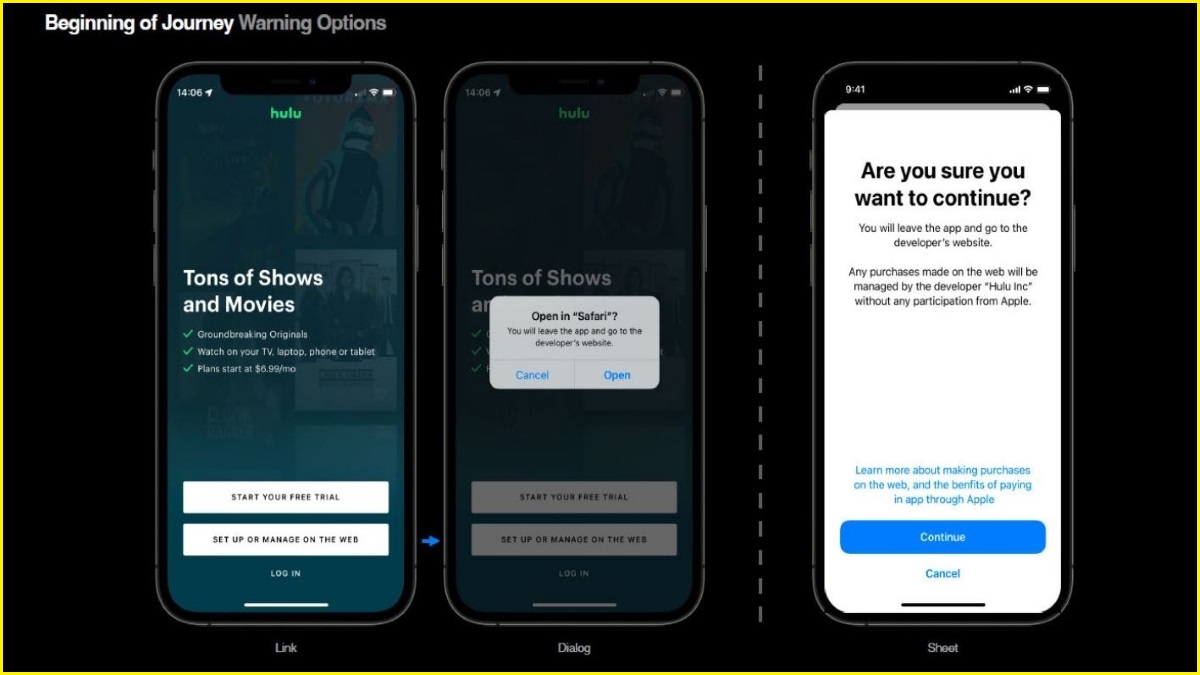
Internal Apple mockups showing 'warning options' it designed following the 2021 court ruling. Image: Apple via court documents
The judge found Apple, “in stark contrast to [the company’s] initial in-court testimony”, knew what it was doing and “at every turn chose the most anticompetitive option”.
“Internally, [Apple executive] Phillip Schiller had advocated that Apple comply with the [2021] injunction, but Tim Cook ignored Schiller and instead allowed chief financial officer Luca Maestri and his finance team to convince him otherwise,” Gonzalez Rogers wrote.
“Cook chose poorly."
Fortnite, Spotify, other developers celebrate
Epic Games said it would now return Fortnite to the App Store in the US, and potentially across the world.
The company's CEO, Tim Sweeney, said the developer had put forward “a peace proposal” to Apple.
“If Apple extends the court's friction-free, Apple-tax-free framework worldwide, we'll return Fortnite to the App Store worldwide and drop current and future litigation on the topic,” he said on social media.
“Epic Games Store will take 0% on the first $1,000,000 of payments we process per game per year (vs 15% for Apple), and 12% after that (vs 30% for Apple).”
Soon after the judge’s decision, Spotify submitted to Apple an updated version of its app which allowed US users to open an external link to make purchases without any Apple commission.
"The fact that we haven't been able to deliver these basic services, which were permitted by the judge's order four years ago, is absurd," the company said in a blog post.
After the app update was approved by Apple, Spotify added, “After nearly a decade, this will finally allow us to freely show clear pricing information and links to purchase, fostering transparency and choice for US consumers.”
Other app developers such as Proton and Stripe also moved quickly to update their apps to allow US-based users to avoid Apple’s fees.
In response to the recent court ruling in the US against Apple's illegal in-app purchase monopoly, @ProtonPrivacy will finally be allowed to let iOS users purchase subscriptions outside of the app store. No Apple tax means we will lower prices for users by up to 30%.
— Andy Yen (@andyyen) May 1, 2025
Epic Games’ Australian case against Apple and Google
In Australia, Epic Games also brought app store competition cases against Apple and Google in 2020, after Fortnite was kicked off the App Store and Google Play store for offering its own in-app payment system.
The separate cases were combined into one and were heard — along with an associated class action lawsuit — in Melbourne’s federal court by Justice Jonathan Beach in a 16-week trial in 2024.
Final arguments were made in July, but a decision by Justice Beach has yet to be handed down.
If Epic Games and the developers in the class action win, the court could order Apple and Google to open their app stores to third-party payment options in Australia.
Apple has already been forced to relax its hold on the App Store in the European Union, where consumers can use alternative app stores and payment methods.
Australia’s Labor government detailed plans for new digital competition regulations in December, which could mandate the opening up of app stores and mobile payments.
Apple reported its second-quarter earnings on Thursday, slightly beating Wall Street’s expectations.
CEO Cook said while US President Donald Trump’s tariffs had “limited impact” in the March quarter, the company expected the taxes to add around $1.4 billion ($US900 million) to its costs for the current quarter.