

Successful Australian startup founders donate money at more than twice the rate of other taxpayers and have already committed to giving away more than $19 billion, according to new research into local philanthropy.
The arc from founder to funding and then foundation is detailed in the Australian Tech Giving Report by StartGiving and the University of Western Australia’s Centre for Social Impact.
It is the first comprehensive benchmark of philanthropy in the local tech sector —which is projected to contribute $250 billion a year to national GDP by 2030 — and included interviews with tech founders and executives, as well as surveys of their peers.
Notable findings included almost 70 per cent of survey respondents saying they donate money, compared to almost 30 per cent of Australian taxpayers.
In just a few years, philanthropy by tech founders has grown from one per cent to 21 per cent of total grants made by Australia’s Top 50 givers, the survey found.
More than half (57.7 per cent) of those who responded said they expected to increase their giving next year, with around 20 per cent planning to establish foundations.
The report comes as the global philanthropic movement Pledge 1% marks its 10th anniversary, with Atlassian cofounder Scott Farquhar, a founding member, stepping into the role of chair.
More than 19,000 companies in 130 countries have pledged to set aside one per cent of equity, profit, product, and/or employee time to drive social impact.
Australia has produced several tech startups with philanthropy at their heart, including Humanitix, which donates its profits to charity, and Daniel Flynn’s Thankyou.
Since selling Envato for $373 million last year, co-founders Collis and Cyan Ta’eed have also been focused on philanthropic work with their family in the Northern Territory.
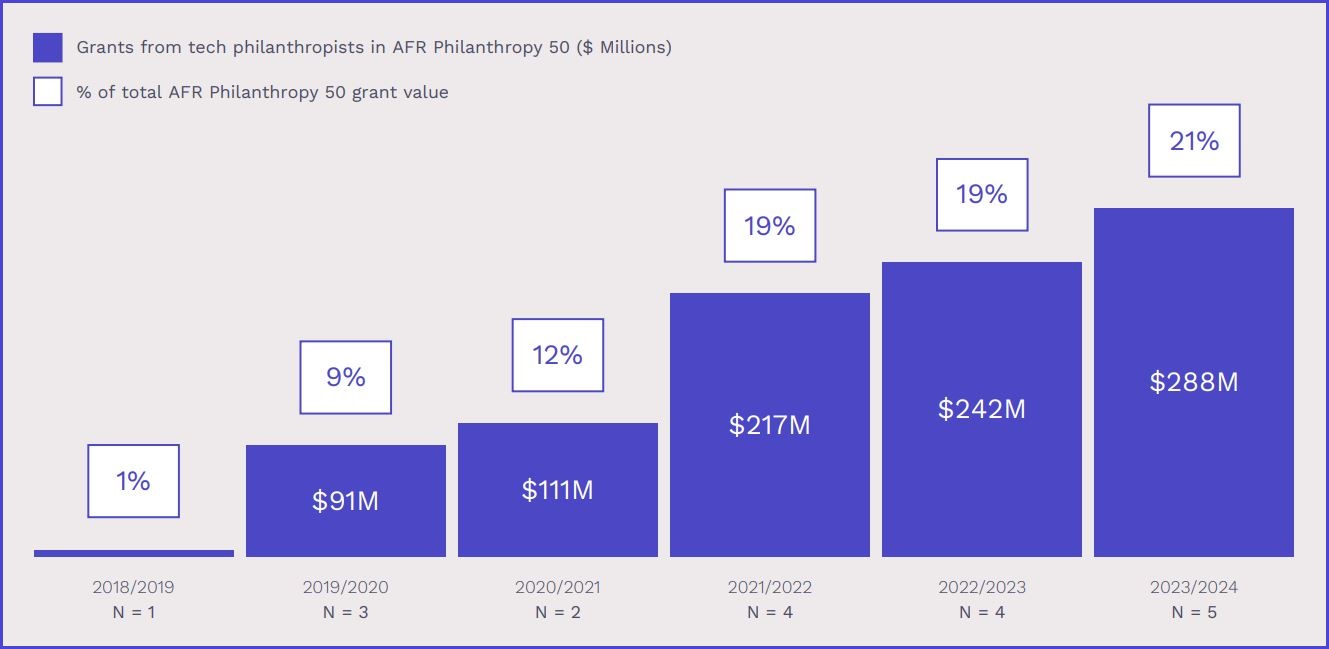
Source: Australian Tech Giving Report by StartGiving and the Centre for Social Impact
‘Untapped potential for more and greater giving’
StartGiving, founded by Airtree cofounder Daniel Petre in 2022, has one of the world’s biggest tech philanthropists, Bill Gates, on its advisory board.
The not-for-profit organisation said it aimed to inspire a new culture of giving in the Australian innovation community, while providing advice and financial support to make it happen.
“Australia’s growing tech sector has clear, untapped potential for more and greater giving, driven by a new generation of self-made tech founders,” Petre said.
“Impact-driven, comfortable with risk, people-oriented, and highly collaborative, tech givers’ contemporary giving styles could revolutionise what it means to be a philanthropist in Australia.”
The researchers interviewed several founders who had successful exits, including Go1’s Andrew Barnes and Aconex’s Leigh Jasper, as well as emerging founders such as Dimitry Tran from Harrison.ai, plus several venture capitalists.
‘I felt almost guilt for the amount of money that it was’
The survey found tech founders exhibited a different relationship with wealth than those in traditional sectors.
Many interviewees cited luck as a significant factor in their success and expressed discomfort with their wealth compared to equally hardworking peers.
“I sold my business for a lot of money, and I felt almost guilt for the amount of money that it was,” an anonymous tech founder said.
“I mean, I worked hard, obviously, but it wasn’t commensurate with the amount of work I did… there’s people who work a lot harder than I do.
“So, I felt it was a duty of mine to give back to the community.”
Tech founders have brought an entrepreneurial mindset to philanthropy — backing people over projects, offering flexible multi-year funding, and prioritising impact over recognition — said Arminé Nalbandian, CEO of the Centre for Social Impact.
“This shift in approach has the potential to fundamentally rebalance the power dynamics of giving.”
StartGiving CEO Antonia Ruffell said tech givers were action-oriented.
“Often with the means to give earlier in life, they’re motivated to start their philanthropy earlier, not decades down the track,” she said.
“We hope this report will inspire and encourage more tech founders with the means to start giving now.”
Petre said she believed the 30 wealthiest people in Australian tech could contribute well over $25 billion to philanthropy, with nearly $19 billion already committed by a handful of them.
Canva co-founders Melanie Perkins, Cliff Obrecht, and Cameron Adams have pledged to give much of their multi-billion-dollar fortunes away, and have previously been named Australia’s second most generous philanthropists.
More recently, AirTrunk billionaire Robin Khuda also made a $100 million donation to support women in STEM.
This article is republished with permission from Startup Daily. You can read the original here.