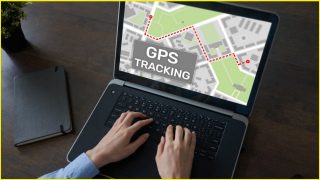





Toyota, the Royal Automobile Club of Queensland (RACQ), and Queensland’s Department of Transport and Main Roads (TMR) have begun field tests of an Australian-developed navigation system designed to work in tunnels, buildings, and other places where conventional GPS does not work well.
The new Local Positioning System (LPS) is tested by attaching sensors to cars and e-scooters, then using custom software to gauge performance in “degraded road environments” such as tunnels and business districts where ‘urban canyons’ disrupt GPS signals.
It’s the culmination of over two decades’ worth of Queensland University of Technology (QUT) research work to build patented algorithms and hardware sensors, which have been tested for over two years with government transport bodies and the likes of Ford.
The LPS project reflected growing efforts to work around weaknesses in satellite-based GPS that “has inextricably made it into just about every process in modern society”, QUT Centre for Robotics director Professor Michael Milford told Information Age.
“We’re critically reliant on it,” he added – which is proving to be a problem amidst growing international tensions that have included GPS jamming, in which combatants saturate an area with radio signals that confuse GPS receivers.
Russia, in particular, has been accused of jamming Baltic Sea airspace, the EU head’s plane, and other targets with GPS signals using interference so powerful it’s affecting satellites over 1,900 kilometres above Earth’s surface.
“As recent international events have shown, GPS and GNSS [Global Navigation Satellite System] in general can drop out and be jammed,” Milford said.
“They’re not the reliable systems that people assumed they would be, so they’re interested in alternatives.”
To go where no GPS has gone before
LPS was designed as a complement to GPS and GNSS such as the networks operated by Russia (GLONASS), China (BeiDou), the EU (Galileo), Japan (QZSS and IRNSS), and India (NavIC).
Described as a “map-based positioning system”, Milford said LPS is based on a “positioning layer” – a map of the relevant area – that can be used to track millions of sensor-equipped moving assets.
“It is not a technology that primarily relies on networking and active emissions into the environment,” said Milford, who noted the “self-maintaining” core positioning layer was continually updated with the last known locations of tracked devices.
“Very cheap, very compact” low-power transmitters – “think [Apple’s] AirTags,” Milford said – only need to transmit small blocks of data sporadically and could use low-powered Internet of Things (IoT) networks.
“A lot of people are not interested in millisecond tracking of devices or assets”, he explained, adding that “people only want to know where it was the last time it moved or stopped”.
“The big picture goal is that it will work everywhere you need it to work – and if people or robots or drones or assets are regularly venturing into these environments you want to track them in, you’ll be able to create and maintain the positioning service in that area.”
%202025%20supplied.jpg)
Professor Michael Milford (centre) says the Local Positioning System (LPS) has 'a number of key technical and market advantages'. Image: QUT / Supplied
The latest testing is supported by iMOVE, Australia’s national centre for transport and smart mobility research and development (R&D), which supports transport-related technology projects and recently announced its latest cohort of eight projects that will receive a combined $2.7 million.
LPS isn’t the only project trying to build navigation systems that can reach where GPS doesn’t; another iMOVE-funded project, conducted by Transport for NSW and the University of Sydney, is testing C-ITS systems in more than 50km of Sydney tunnels.
Redefining the way we navigate
Some 47 years after GPS was introduced, 31 years after it was offered for public use, and 25 years after high-accuracy services were made universally available, new positioning, navigation, and timing (PNT) technologies are rapidly emerging.
US company L3Harris, for one, recently launched the Navigation Technology Satellite-3 (NTS-3) it specifically designed to deflect GPS attacks, with features an autonomous mode allowing it to navigate even if GPS systems are taken out.
Sydney company Q-CTRL, for its part, was recently awarded $38 million ($US24.4 million) by US military technology body DARPA after the firm completed successful technology validation testing with the Royal Australian Navy.
Using Q-CTRL’s quantum sensors – which measure movement based on tiny changes in the sensor’s position in relation to Earth’s gravitational field – the Navy’s MV Sycamore training ship was able to measure its position for 144 hours despite simulated GPS jamming.
The market is changing quickly with so many options in play, but “we think we have a number of key technical and market advantages”, Milford from QUT said, “and we’re grateful to have funding to really explore those possibilities across a number of sectors”.