As Australia rolls out its unprecedented youth social media ban for under-16s, many non-complying teenagers are about to discover the hard way that virtual private networks (VPNs) won’t be enough to trick the system.
One of the most prominent concerns of the Australian government's ban has been whether teenagers would simply bypass it by flicking on a VPN to appear as though they were connecting from an offshore location.
Indeed, after the UK implemented its similar Online Safety Act to prevent youth from accessing online adult content in July, the country’s VPN usage surged 6,430 per cent as teens tried to avoid age checks on social platforms and pornography sites.
Australia’s eSafety Commissioner Julie Inman Grant, has confirmed, however, that affected social media entities are expected to “try to stop under-16s from using VPNs to pretend to be outside Australia”.
With the social media ban now in effect, Information Age spoke with some of the ban’s biggest targets to determine how they intend to catch teens connecting via a VPN.
Big Tech is prepared for VPNs
Speaking with Information Age, a spokesperson for social media company Snap confirmed using a VPN won’t change existing users' “ability to access Snapchat”.
“Snapchat determines eligibility based on where your account has been active over the past month, not just your current network connection,” they said.
“If your account is locked because you’re under 16 in Australia, it will stay locked until you turn 16 and complete age verification."
Social media giant Meta – which owns Facebook, Instagram and Threads – also confirmed it is prepared to adhere to the ban despite VPN usage.
“While VPNs allow users to change their IP address, we also consider signals beyond just IP when determining a user’s location," a spokesperson said.
Reddit did not explain precisely how it plans to block underage VPN users, but a spokesperson confirmed it is “taking steps to comply with Australia’s Social Media Minimum Age Law, including suspending accounts of users confirmed to be under 16 and requiring new users to be at least 16 to create accounts”.
YouTube’s parent company Google did not respond prior to publication, while a TikTok representative pointed Information Age to an existing statement that did not mention VPNs.
Many ways to track your location
Hammond Pearce, senior lecturer at UNSW’s School of Computer Science and Engineering, said although VPNs can “assist someone who is attempting to circumvent the social media ban”, they were not “foolproof”.
“Popular, commercial VPNs often have ‘known’ endpoints, meaning the platform providers can tell if you're using one of those services,” said Pearce.
“Even if it's not possible to detect if someone is using a VPN directly, it would still be easy enough to tell that a user is operating in Australia – for instance, if they're geotagging their photos, or if the app is uploading their location directly.”
Indeed, eSafety guidance from September states “location information can help determine if an end-user is ordinarily physically present in Australia”.
The commissioner also encouraged the use of existing data and “additional signals” – including photos, tags, connections, engagement and activity.
.jpg)
eSafety listed 'signals' that may be used to infer Australian residency and age. Source: eSafety Social Media Minimum Age Regulatory Guidance (v 16 Sep 2025)
Providers were further told they could handle attempted circumvention of the ban by “integrating VPN detection services and IP intelligence APIs to flag and restrict high-risk IP ranges”.
Greens Senator David Shoebridge told Information Age the party was “deeply concerned” about privacy risks posed by the social media age ban, particularly given “it's not just young people who will need to verify their age”.
“The precedent being set here, of allowing tech companies who are already so data hungry to take and keep even more sensitive information, is appalling,” said Shoebridge.
Privacy concerns as kids turn to free VPNs
A lesser-spoken issue arising from global age assurance requirements is the proliferation of free VPNs.
Unlike their paid counterparts, free VPNs are often inclined to monetise their products through excessive data collection, or in some cases, malicious spyware.
For example, a popular, free VPN extension with over 100,000 downloads was found in August to have silently taken and exfiltrated screenshots of pages its users visited.
Louis Hourany, networks lecturer and expert at Charles Sturt University, added “many free VPN providers operate by monetising user data, injecting advertising, or harvesting telemetry across apps.”
“This may include browsing history, app usage, advertising data, or device information,” he said.
“Parents often assume VPN equals privacy, but in some cases, the operator of the VPN may see far more than the social media platform ever could.”
At the time of writing, two free VPN services reached Australia’s top 30 most popular free apps on the Apple App Store, while alternative social media apps Lemon8, Yope and Coverstar occupied the top three.
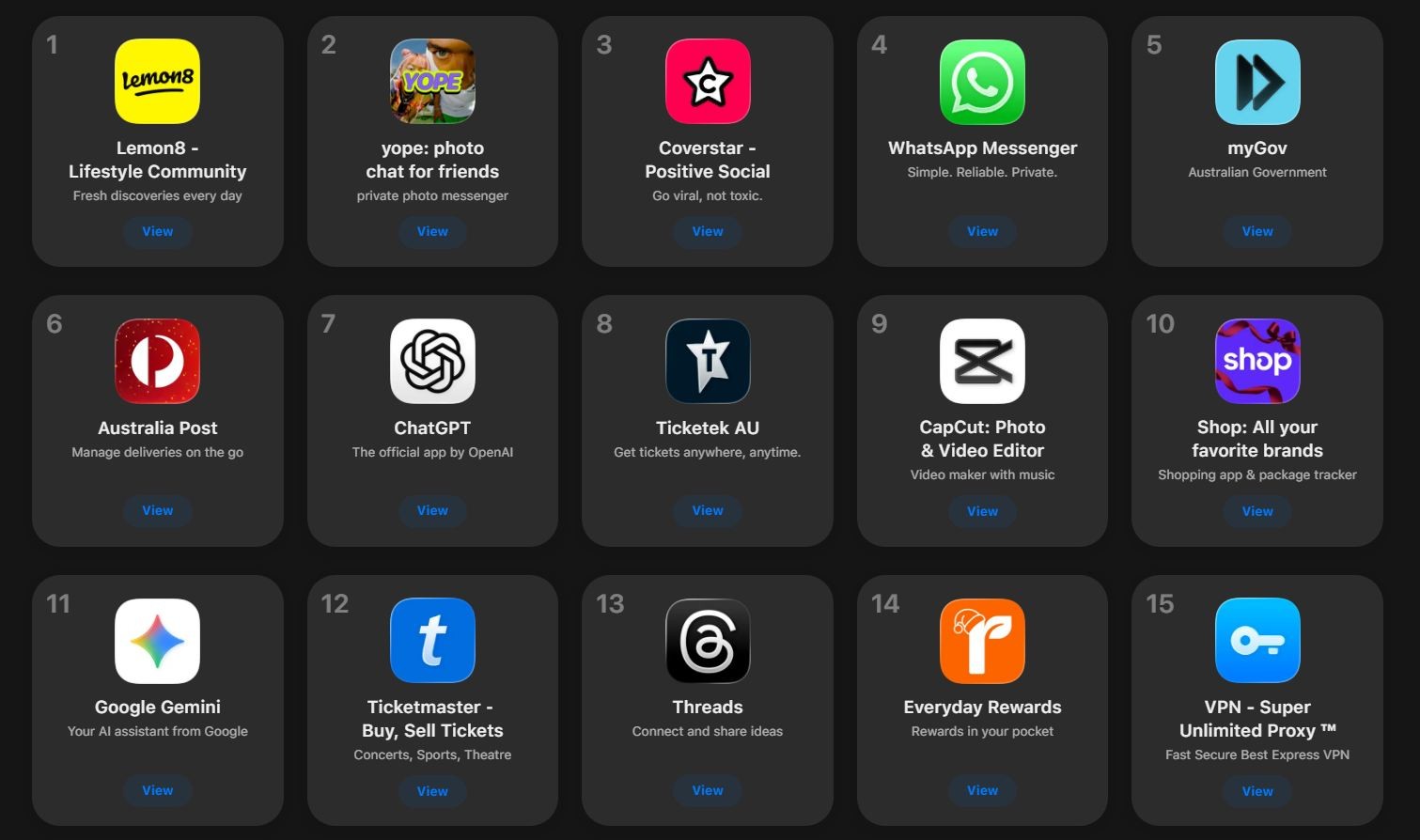
Teens are flocking to free VPNs and alternative social media. Image: Apple
Tom Finnigan, co-founder of cybersecurity business consultancy Murfin Group, said although his 15-year-old son had already passed facial recognition tests on Snapchat – which falsely assumed he was 17 – he was concerned banned teens would inevitably turn to free VPNs.
“We talked a lot about the ban over the last several months,” said Finnigan.
“My son cited VPNs as the workaround that he and his friends would use if they got banned.
“I pointed out that there are data and privacy risks but access was what they cared about the most.”
Finnigan said the “blanket” youth social media ban further “risks pushing some kids towards riskier behaviour, including free VPN apps and other workarounds”.
“Kids don’t read privacy policies or permissions screens; they click ‘allow’ to get back to their friends,” said Finnigan.
“We’re likely to see some young people driven into much less regulated, higher-risk parts of the internet.”