
The “frenzied” rollout of data centres around Australia risks derailing the nation’s energy transition and should be paused until stronger safeguards are in place, according to a new report.
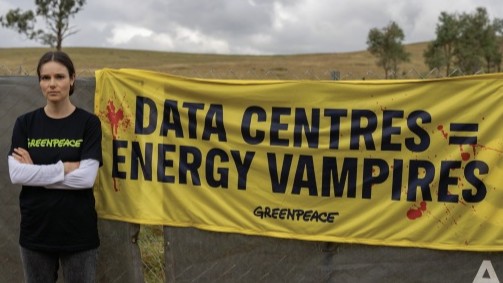
The Energy vampires: the AI data centres draining Australia report produced by Greenpeace Australia and independent expert Ketan Joshi, labels data centres “energy vampires”, and examines the impact of a growing number of proposed and approved projects around the country.
State governments, particularly in New South Wales and Victoria, have approved large numbers of major data centre developments in recent years, in some cases through specialised fast-track processes.
However, these projects have been met with backlash, particularly over their potential environmental impact and what they could mean for Australia's net-zero ambitions.
‘Prolonged’ fossil fuel use
The report argues the rapid expansion of data centres risks jeopardising Australia’s transition to renewable energy.
“The rushed ‘race’ to overbuild data centres is a burst of new energy for a fossil fuel industry that was beginning to teeter on the edge of its first ever global decline,” the report said.
It found the uptick in data centre projects in Australia could lead to prolonged use of fossil fuels.
The Clean Energy Finance Corporation recently reported that grid-connected data centres built without new, additional renewable energy would raise emissions by 5.86 million tonnes per year by 2035.
According to the Australian Energy Market Operator’s latest projections, data centres would double their share of total electricity demand by 2040 under the lowest growth scenario, rising from 3 per cent to 6 per cent.
Under the highest growth scenario, they would account for 13 per cent of total demand.
“The chances of data centres prolonging fossil fuel use on Australia’s power grid is very high indeed,” the report said.
Data Centres Australia CEO Belinda Dennett rejected the report’s findings last week, saying that it “mischaracterises both the scale and the causal relationship” between data centres and emissions.
She argued that the report’s logic could also be applied to electric vehicle charging, household electrification and manufacturing, all of which increase demand on the electricity grid.
“Data centres are the most energy efficient way to run a digital economy,” Dennett posted on LinkedIn.
“To not build data centres means Australia either puts compute back into the basements of buildings, which is 67 per cent less energy efficient, or we abort the digitisation of our economy.”
Emissions equal to all domestic flights
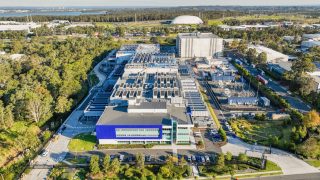
According to the report, AirTrunk’s proposed 1-gigawatt Mamre Road Data Centre Campus in Western Sydney would generate peak annual grid emissions equivalent to all domestic flights in New South Wales.
The project was endorsed by the NSW government earlier this year under the Investment Delivery Authority fast-tracking process.
The report also claimed a proposed data centre project in the Northern Territory would effectively double the territory’s emissions, while the Cloud Carrier gas-fired project in NSW could wipe out the state’s entire projected emissions reductions for 2028.
Many data centre operators have said their facilities will run on “100 per cent renewable energy”, typically through renewable energy certificates or power purchase agreements.
The report said such claims are “questionable at the very least”.
“Even the most ambitious scenarios for data-centre-driven renewable growth does little more than mitigate emissions impact; a far cry from the vision of data centres as ‘enablers’ of broader fossil fuel phase-out and energy transition,” the report said.
While some have argued that growth in data centres could accelerate the energy transition, the report said operators would need to build enough renewable generation not only to meet their own demand but also to create a substantial surplus.
“’Accelerating the energy transition’ by encouraging data centre growth is akin to trying to inspire faster runners in a race by moving the finish line further away,” it said.
“Even if it works, because you have changed the distance, the race will still take more time.”
‘Urgent’ moratorium
The report calls for an “urgent” moratorium on data centre development until stronger safeguards are legislated.
Among its recommendations are requirements for operators to source electricity from genuinely new renewable energy projects and to disclose the services being provided through their facilities, along with projected energy use and financial arrangements.
“No AI data centre is worth the destruction of human lives, ecosystems and our climate,” the report said.
“It is vital the government takes action to ringfence and right-size an industry that is fundamentally, systemically motivated to take resources and energy to increase private benefit.”
Dennett described the recommendation as an “extreme position” that would “halt critical digital infrastructure investment in Australia [and] drive capital to other markets where AI will be developed using fossil fuels”.