
Residents and schools near the proposed Western Sydney site of what would be Australia’s most power-hungry data centre have raised concern over potential health and environmental impacts of the planned development, which is expected to cost data centre giant AirTrunk more than $5 billion to build.
The proposed 52-hectare data centre campus on Mamre Road in the suburb of Kemps Creek would have a 1.2 gigawatt (GW) power capacity, according to proposal documents – and would be the first in Australia to surpass the 1GW mark.
It would also use an estimated 22.4 million litres of water per year – around the volume of nine Olympic swimming pools.
The development would feature six four-storey data centre buildings, including 728 cooling units, 846 diesel back-up generators, more than 18,000 kilolitres of diesel storage, and numerous lithium-ion batteries, according to planning documents.
The project is estimated to create around 500 construction jobs and 500 operational jobs, according to its proposal as a ‘State Significant Development’.
The site, known as Summit, is owned by Australian firm IFM Investors, and is understood to be called SYD4 by AirTrunk.
'Concerns regarding the impacts’
Submissions made to the New South Wales Department of Planning, Housing, and Infrastructure, published online this month, voiced concern over potential impacts of the Mamre Road data centre campus on the environment and the health of nearby residents and school students.
Ross Whelan, principal of Mamre Anglican School across the road from the Summit site, said the institution had “concerns regarding the impacts” of the proposed data centre, including on air quality and noise both during and after its construction.
“Whilst the demand for data centres is becoming more prevalent, knowledge and understanding of their impact on adjoining communities has not had time to be reliably informed,” Whelan told the state government.
He argued “the location and proximity” of infrastructure such as power generation and diesel storage should be reviewed in relation to their closeness to Mamre Anglican School.
“In the extreme circumstance of a critical emergency incident of fire on the site, the impact will be significant,” he suggested.
Whelan also said the Anglican Schools Corporation had “identified a new site” for a possible relocation of the school, and had made submissions to the NSW government for help to relocate.
The Catholic Schools Parramatta Diocese, which represents the nearby Emmaus Catholic College and Trinity Catholic Primary School, said in its submission that while it did not object to the proposed data centre “in principle”, it wanted the project to minimise potential impacts.
The diocese raised concerns about air quality and requested that testing of the data centre’s diesel backup generators be done outside of school hours and “peak outdoor activity periods”.
It also urged the state government to make sure impacts associated with noise, construction traffic, and the storage of fuel and batteries would be limited.
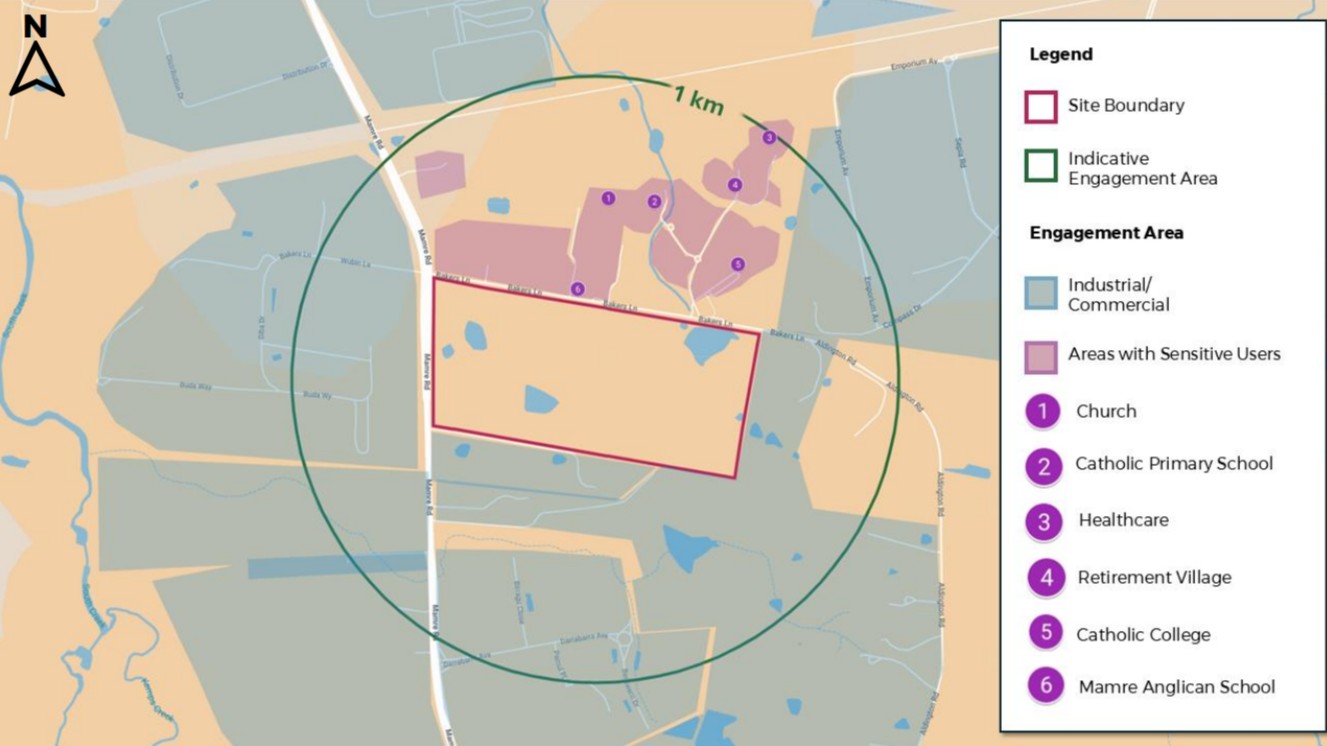
A map of the Mamre Road site, showing a nearby church, schools, and a retirement village. Image: Willowtree Planning EIS
The Catholic Church of the Diocese of Parramatta explicitly objected to the data centre proposal, and raised concerns about potential impacts to the water and electricity supply of the nearby Emmaus Retirement Village, operated by Catholic Healthcare.
“The [proposal] fails to adequately address cumulative impacts, emergency access, servicing resilience and stormwater feasibility, and places unacceptable and unresolved risk on existing community critical land uses under the care of the Diocese of Parramatta,” the organisation said through its consultants, BBC.
Three local residents shared concerns over potential impacts on the environment and their own health and wellbeing due to noise and the proposed site’s energy and water use.
Some also worried the project may negatively impact property values in the area.
Penrith City Council told the NSW government it objected to the proposal, and argued the site was “not suitable for a proposed development of this scale”.
Australian-founded AirTrunk, which is now majority owned by American investment firm Blackstone, did not respond by deadline to a request for comment.
Following this story's publication, an AirTrunk spokesperson told Information Age that while the company would not comment on potential developments, it takes "a proactive and responsible approach working with local communities to understand concerns and minimise impacts like noise, traffic and environmental effects".
"Beyond that, we aim to deliver positive outcomes where we operate through local job creation and community investment, while investing in our own energy and water infrastructure to improve efficiency, support renewables, and reduce pressure on shared networks," they said.
Environmental statement ‘does not provide’ required info
An Environmental Impact Statement (EIS) prepared for the proposed development by Willowtree Planning, finalised in February, found the proposal “is justified on environmental, social and economic grounds and is compatible with the locality in which it is proposed”.
“The proposal would enhance the site from an otherwise vacant landholding to a productive employment generating facility,” it found.
The development would also commit to running solely on electricity generated from renewable sources by 2030, according to the statement.
The NSW Environmental Protection Authority (EPA) told the state government on 10 April that it had reviewed the EIS and found “it does not provide the information required to allow us to complete our assessment”.
The authority requested the government seek additional information regarding air quality, noise, greenhouse gas emissions, and waste storage.
The EPA said it is “important to ensure likely impacts from the proposal are clearly identified, especially given the potential for significant air quality and noise impacts and proximity to sensitive receivers including schools, aged care facilities and existing residences”.
NSW last year approved the construction of the largest data centre in the southern hemisphere, but that $3.1 billion development for CDC Data Centres is expected to have a 504-megawatt capacity – less than half of the expected capacity of AirTrunk’s Mamre Road development.
The AirTrunk project is one of 15 data centres the NSW government endorsed in March through its Investment Delivery Authority (IDA), which is designed to fast-track major investment projects.
Other forthcoming data centres in NSW include a $7 billion NextDC hyperscale AI facility in Western Sydney with a capacity of around 550 megawatts, of which ChatGPT-maker OpenAI will be the first major customer.
A NSW parliamentary inquiry into data centres, chaired by Greens MP Abigail Boyd, begins on Friday, with three hearings expected to take place throughout May.
The federal government revealed new data centre expectations earlier this month, which it said would help accelerate project approvals – and the terms have already been agreed to by the likes of Anthropic and Microsoft.