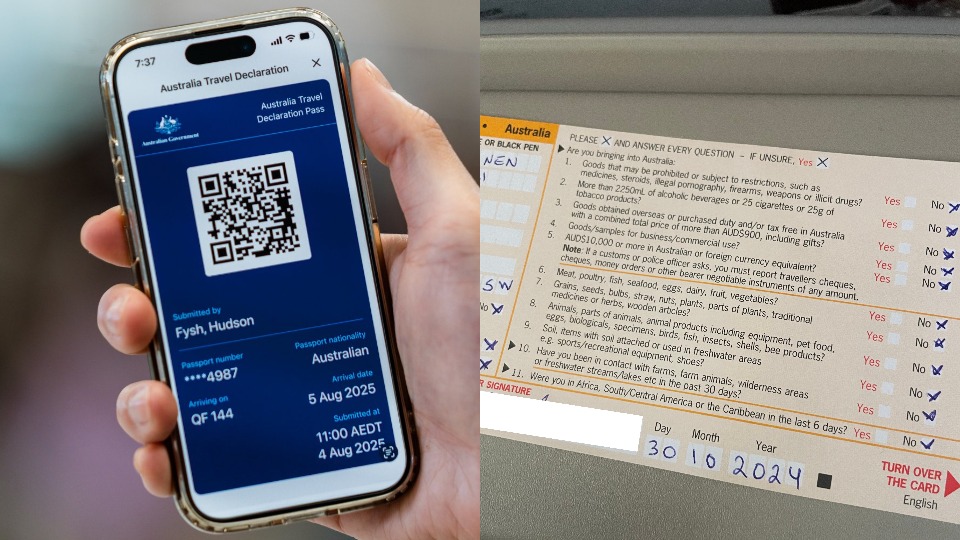

A much-anticipated digital version of Australia’s Incoming Passenger Card for international arrivals will be rolled out nationally over the next 18 months, the federal government announced on Sunday after the technology was trialled on numerous Qantas flights.
People arriving in Australia by air or sea are currently required to complete Incoming Passenger Cards by hand – often during their journey or before undergoing immigration checks.
Its digital replacement – the Australia Travel Declaration – is expected to roll out across the country’s international airports and seaports “in a phased approach” over the next 12 to 18 months, according to the government.
A trial of the new system, first announced in 2024, has seen more than 450,000 Qantas passengers test the platform through the airline’s mobile app, in what the government said had been “a significant success”.
Initially tested on selected Qantas flights into Brisbane, Sydney, and Melbourne, the airline's pilot program will expand to other capital cities including Perth and Adelaide by the end of 2026, before the wider national rollout with other carriers.
How the digital Australia Travel Declaration works
The digital Australia Travel Declaration allows users aged 18 and over to fill in their personal and travel details online – typically from 72 hours before their departure to Australia.
This declaration can also be updated if things change during their travel, or if details need to be corrected.
The system then creates a digital pass with a unique QR code – accessible even if a person’s phone is offline – which border officers will scan on a passenger’s arrival into Australia.
The national system will initially be accessed through an online form while a mobile app version is being built, government officials said, and paper versions will still be available for those who require it.
The federal government will also spend $56.1 million over four years on “traveller modernisation” at airports across Australia to help introduce the new system.
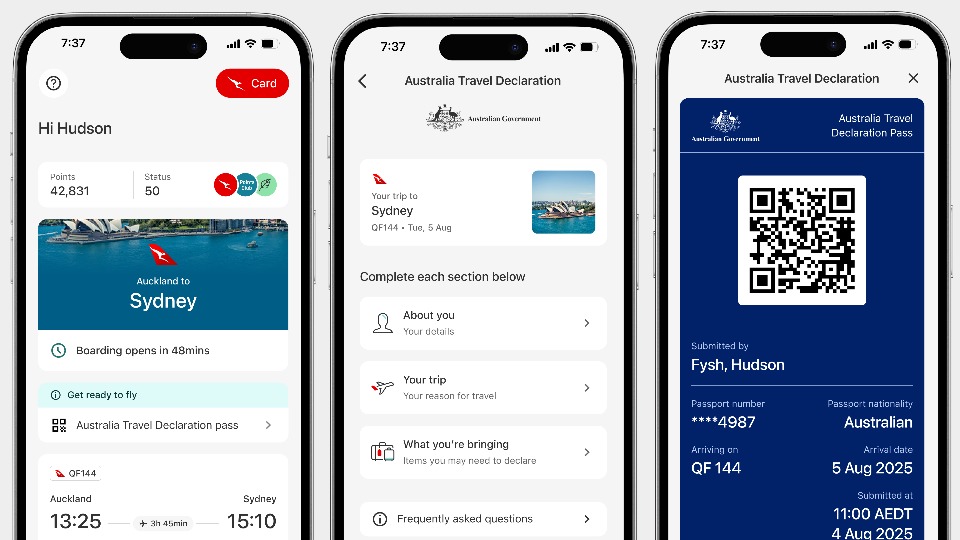
How the trial Australia Travel Declaration process has looked within Qantas's mobile app. Images: Supplied
Introducing the Australia Travel Declaration is expected to bring the country into line with other developed nations which already have digital arrival forms, such as New Zealand, Singapore, Canada, and South Korea.
Australia’s previous attempts to replace paper forms saw it launch a Digital Passenger Declaration app in 2022, which was later scrapped following negative user feedback.
Prior to that, the ‘Seamless Traveller’ program announced by the Liberal-National government in 2015 planned to trial digital arrival cards in 2018, but it never eventuated.
Simon Westaway, chief executive of the Australian Airports Association, said the nation’s airports thanked the Albanese Labor government “for taking action to modernise a process that has remained largely unchanged for decades”.
Implications for national security and tourism
Aside from speeding up travellers’ entry into Australia, the transition to a digital travel declaration will also provide benefits for border security and tourism, the government suggested.
This will include creating more accurate data for risk assessments, and allowing for “rapid updates and management of global risks and events, such as biosecurity outbreaks”, officials said.
Minister for Home Affairs, Tony Burke, told ABC News on Monday that the changes would improve national security and the government’s ability to handle security incidents.
“It means if we need to get data quickly, we're searching rather than telling somebody, 'There's a box containing a card on the third shelf in the fourth corridor of some shed somewhere,’” he said.
Minister for Agriculture, Fisheries, and Forestry, Julie Collins, said the Australia Travel Declaration will help the nation “identify and respond to potential biosecurity risks before they reach our shores”.
“This investment ensures Australia’s border keeps pace with growing traveller numbers and emerging global biosecurity threats, helping protect our world-leading biosecurity system while delivering a better experience for international travellers,” she said in a statement.
Rolling out the new system ahead of the 2032 Brisbane Olympic and Paralympic Games is “a win for tourists and a win for our tourism operators”, said Minister for Trade and Tourism, Don Farrell.
Margy Osmond, chief executive of industry advocacy group Tourism & Transport Forum, added the wider rollout “brings Australia's border into the digital age”.
"Australia is competing with destinations around the world that have already embraced digital borders,” she said.
“First impressions matter and the arrival experience shapes how international visitors feel about Australia before they've even left the airport.
“The easier we make that journey, the stronger our reputation as a world-class destination.”