

OPINION
I tried to work up a spoof short story.
A person trains their personal agentic generative artificial intelligence (genAI) to draft curmudgeonly responses to every message that they receive.
When the person goes on holidays, they take the human-out-of-the-loop by switching on auto-response.
Their plane crashes.
Their ISP has been paid five years ahead. The executor can't find the password.
The ISP has its own agent running and hence ignores all attempts to close the account.
Variations of patterns like this are repeated many times over.
Inter-agent drivel proliferates.
Humans soon get overwhelmed by the flood of generated traffic and cede the messaging services to the robots.
Inter-human communication skills wither away.
The species goes extinct – not through a robot apocalypse but with a whimper.
But then I realised that what I actually need to do is to train my personal agentic genAI to create a spoof short story that ...
Not all AI invites the species to self-destruct.
Several mature forms have escaped the albatross that is the 'AI' tag.
Logic programming, rule-based expert systems and multiple forms of pattern recognition have wrinkles, but can be managed and deliver value.
Natural language processing is workable, but hamstrung by the vagaries of humans' use of language and the absence of any real semantic capability.
Natural language generation is a standout performer, as evidenced by the beguiling text it delivers from the trivially simplistic grammatical model embedded in large language models (LLMs).
The last couple of decades have seen a game-changer.
To some extent that's been because of progress in AI tech.
But to a large degree the situation has changed because of the laziness, gullibility, and willingness to suspend disbelief, of us humans.
Both AI/machine learning (ML) data analytics tools based on artificial neural nets (ANNs), and LLM-based genAI, are empirically-based.
They use obscure forms of correlation to generate new inferences, or new content, for which no rationale exists.
In this field, the notion of explainable AI (XAI) is merely an aspiration, not a deliverable.
Dependence on ANNs involves the abandonment of half of the cycle on which 500 years of science has been based.
The basic cycle comprises observation, ad hoc theory, prediction from that theory, observation designed to test the prediction, refinement of theory, rinse-and-repeat.
But AI/ML and genAI have hollowed out that cycle.
There is no theory. And without a theory, systemic reasoning isn't possible.
And without an understanding of the rationale underlying decisions and actions, no reviewer, regulator or court can assign accountability.
The abandonment of science undermines millennia of social patterns.
One way to look at it is that spruikers are again selling us 'strong AI' notions.
AI began in 1955-1970 with the declared intention of creating artificial forms of human intelligence.
AI practitioners have long since stopped aspiring to deliver Artificial General Intelligence.
Instead, they see human intelligence as an inspiration. An interpretation of AI that reflects its practitioners' views is:
Intelligence is exhibited by an artefact if it:
(1) evidences perception and cognition of relevant aspects of its environment ('world-awareness')
(2) has goals; and
(3) formulates actions towards the achievement of those goals
(which together represent 'apparent intentionality');
but also, for some commentators at least:
(4) implements those actions (i.e. it has some degree of 'artefact autonomy').
There is another way.
Its basis has been known for decades. It would be a good idea for us to act like a mature species, by harnessing tech, thereby avoiding being harnessed by it.
Ashby's 1956 idea of intelligence amplification and Engelbart's 1962 proposals about augmenting human intellect led to the term 'Augmented Intelligence'.
That describes the combination of human intelligence with artefact intelligence that's expressly designed to be complementary to human intelligence.
Soon after that, the concept of decision support systems emerged.
Combining those ideas, 'Complementary Artefact Intelligence' has the following key attributes:
• Effective performance of intellectual functions that humans do poorly or not at all;
• Performance of those intellectual functions within systems that include both humans and artefacts; and
• Effective, efficient and adaptable interactions with both humans and other artefacts.
Meanwhile, in the parallel world of robotics, it was quickly appreciated that artefact autonomy isn't absolute.
We can delegate to devices in qualified and controlled ways.
To address those issues, we can apply the same notions of complementariness and augmentation that demonstrably work for intelligence, to the capacity to act as well.
Here's a depiction of the alternative conception of artefactual intelligence and capability that puts the notions of 'a singularity' and 'a robot apocalypse' back where they belong, in pop sci-fi:
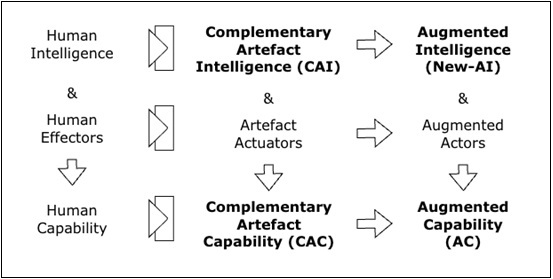
We need to design both artefactual software and hardware as tools convenient for humans.
Robots are out; cobots are in.
Socio-technical combinations then deliver inferences, decisions and actions with human capabilities in the loop, and accountability is sustained.
Short stories can continue to be written, by humans utilising and controlling genAI tools.
Roger Clarke serves as ACS’s vice president of Membership Boards and previously spent a decade as chair of the ACS Economic, Legal and Social Implications Committee (ELSIC). The interpretations and arguments expressed here draw on decades of consultancy practice in strategic and policy implications of disruptive ICT, supplemented by research into robotics and AI. Fuller versions of the argument can be found in refereed research articles here and here.