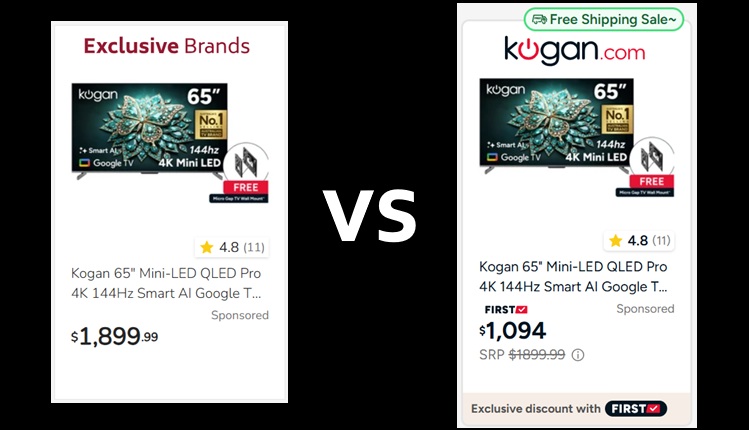

Online retailer Kogan has been quietly operating a "clone" website that lists many of the same products at significantly higher prices, prompting calls for Australia's competition watchdog to investigate whether the site has been used to create misleading discount claims.
An ABC News investigation revealed on Monday that the technology retailer has been running a separate website called Exclusive Brands, which carries no Kogan branding but sells Kogan-branded products, often at much higher prices than those listed on Kogan.com.
The report has raised questions about whether Kogan has used the website to justify "standard retail prices" (SRPs) and advertise inflated discounts on its main retail platform.
Kogan has denied using Exclusive Brands to set its advertised discounts and rejected any suggestion it has acted improperly.
Price comparisons under scrutiny
Kogan.com regularly promotes products with discounts based on a "standard retail price".
A disclaimer on its website says the SRP is the "standard retail price at which this exclusive product is offered for sale by Kogan through one or more channels".
The company has denied that these prices are based solely on listings on the Exclusive Brands website.
At the time of the ABC's reporting, Kogan.com was advertising a 65-inch mini-LED smart TV for $1,094 alongside a promoted SRP of $1,899.99.
The same television was listed on Exclusive Brands for $1,899.
The ABC found similar examples across the two websites, with some products on Exclusive Brands priced thousands of dollars higher than on Kogan.com.
The site sells a wide range of products, including televisions, sofas, washing machines and bicycles.
"Kogan.com only advertises an SRP as a reference price where that price has been offered on Kogan.com itself for a reasonable time and within a recent period of time," a Kogan spokesperson told the ABC.
"Standard Retail Pricing may also apply to the same product on other Kogan Group channels."
Calls for ACCC investigation
Former Australian Competition and Consumer Commission (ACCC) chair Rod Sims said the existence of the ‘clone’ website was of "great concern".
"If that Exclusive Brands website is not a real comparator this would be extremely concerning, and I would have thought extremely important for the ACCC to investigate, because it matters to consumers," Sims said.
"If that alternative website is not the normal way of transacting things, if it's just there to be there, then it could very well be misleading because you're not getting a bargain.
“Price advertising and discount representation methodologies are carefully reviewed by independent external lawyers to ensure compliance with relevant laws.”
The ABC analysed more than 1,000 products listed on both websites and found the median price difference was $100.
Among the examples highlighted was a Brosa sofa bed listed on Exclusive Brands for almost $4,000, while the same item was available on Kogan.com for $1,229, with a claimed discount of more than $2,770 from the SRP.
The investigation also found a 100-inch Kogan-branded 4K television selling for $6,999.99 on Exclusive Brands but advertised on Kogan.com for $3,199, with a stated saving of nearly $4,000.
In a statement provided to the ABC, ACCC declined to comment on the specific case but said Australian law prohibits businesses from "making false or misleading statements about prices, including about savings and discounts".
"This is important to ensure both that consumers can make informed purchasing decisions, and that businesses who are doing the right thing are not unfairly disadvantaged," an ACCC spokesperson said.
Previous legal action
Kogan, an ASX-listed company with a market capitalisation of just under $400 million, was founded by Ruslan Kogan in 2006.
It acquired Dick Smith's online business in 2016 and furniture retailer Brosa for $1.5 million in 2022.
The retailer has previously faced regulatory action over its sales and marketing practices.
In 2020, the Federal Court fined Kogan $350,000 after finding it had misled consumers during a tax-time promotion by increasing prices immediately before offering a 10 per cent discount, then reducing them again once the sale ended.
In early 2021, the company was fined more than $300,000 for repeatedly breaching Australia's spam laws after sending more than 42 million marketing emails that made it difficult for recipients to unsubscribe.