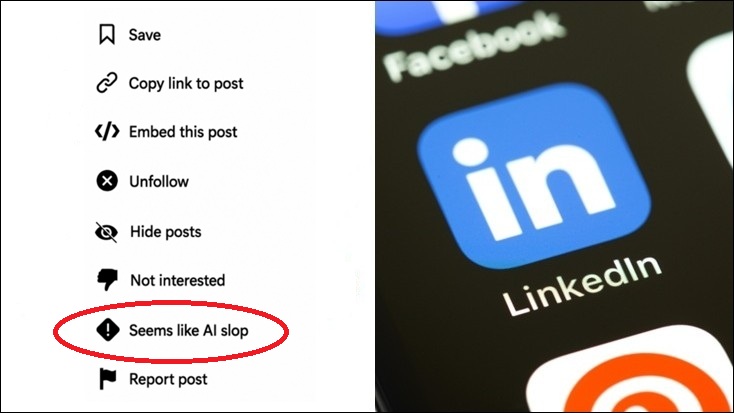

Inspiration-posting business influencers beware – LinkedIn has introduced a new button allowing users to report a post that “seems like AI slop”.
Rolled out this week, the button allows users to flag content they suspect has been generated by AI.
Once a report is submitted, LinkedIn displays a message saying, “Thanks for letting us know. Your feedback helps improve the feed” and hides the post from that user’s feed.
The move comes as LinkedIn faces growing criticism over the volume of AI-generated content on the platform and ramps up efforts to detect and curb low-quality automated posts.
LinkedIn chief product officer Hari Srinivasan confirmed the new feature, saying the platform was focused on addressing low quality, AI-generated content.
“AI slop is a top priority for all of us,” he said.
“We really care about this. People come to LinkedIn to connect with real people and share their real perspectives, ideas and expertise.”
The content users flag as AI-generated will be used to help train LinkedIn’s tools to block automated content.
“Slop is hard to define and the definition changes; this lets us tune our models and make better feeds,” Srinivasan said.
According to a report by AI detection platform Pangram, nearly a third of all short-form content on LinkedIn is AI-generated, and more than 40 per cent of long-form content is.
Pangram found LinkedIn had the highest proportion of AI-generated content among all the social media platforms it analysed.
“People are overwhelmingly willing to use AI to speak on their behalf in professional settings that are associated with their real identity, and less likely to use it on casual and anonymous platforms,” the report said.
Improving the defences
Srinivasan said LinkedIn was continuing to invest and improve its automation defences, which he said had blocked hundreds of thousands of automated comment attempts and billions of other automated activities over the past few months.
The professional networking platform is also testing a way to privately notify a user when their posts have reported a post as inauthentic or as heavily AI-generated.
LinkedIn has also introduced a series of “new and improved” classifiers designed to distinguish between AI-generated content and posts that are simply low quality.
LinkedIn currently offers premium subscribers an AI-powered writing assistant to help generate profile headlines and ‘About’ sections, as well as a “Rewrite with AI’ tool.
Srinivasan said the Rewrite with AI tool would now be removed and replaced with a proofreading tool that corrects grammar and spelling without changing a user's writing style.
“We asked ourselves, why do people post with AI anyway?” he said.
“The answer is LinkedIn isn’t a one-word kind of place and they feel more confident running their posts through AI.
“We’re taking this learning, removing the ‘enhance your post’ feature you see when you write a post or message and replacing it with a feature that proofreads your words, but does not change your voice.”
Legal troubles
At the start of last year, a class action lawsuit was filed against LinkedIn alleging it used data from premium subscribers to train third-party AI systems.
The lawsuit alleged that LinkedIn tried to “cover its track” over this issue, and that it had violated the US Stored Communications Act.
In 2024 LinkedIn turned on by default a setting which allowed user data to be used to train some AI systems.
In 2024, the company also enabled by default a setting allowing user data to be used to train some AI systems, prompting criticism from privacy advocates.
LinkedIn is not the only platform to announce a crackdown on AI slop, with similar announcements from Snap, YouTube and Substack in recent days.