




Australians lost more than $250,000 to scams on LinkedIn in just two months this year, as cost-of-living pressures lead to risks being taken on offers that are too good to be true.
The Australian Competition and Consumer Competition (ACCC) received 138 reports of LinkedIn scams in July and August, with total losses of more than $250,000, ABC News reported.
These scams can involve fraudulent job advertisements posted on the jobs platform, fake “cloned” profiles of real recruiters, and the offering of help with CV writing for significant amounts of money.
Such scams have reportedly increase in volume once a LinkedIn user changes their profile to indicate they are looking for employment, and often involve information and messages personalised to the user.
According to LinkedIn’s Job Search Safety Pulse report, just over 15 per cent of Australian survey respondents said they had fallen victim to a job scam, but that rose to a quarter for Gen Z jobseekers.
The report found nearly half of the Australians surveyed said they were more likely to take risks when looking for work because of ongoing cost-of-living pressures, and more than a third said they would likely let their guard down.
Nearly two-thirds of respondents had seen a job ad they suspected was fake, and more than a quarter said they had come close to falling for a scam.
Too good to be true
Mark Hopcroft, now the managing director at Contract Services Australia, posted on LinkedIn earlier this year detailing how he was almost caught by such a scam.
“Rarely do I get caught by scams on the internet, but this one on LinkedIn almost got me,” he posted.
Hopcroft said he was messaged by a profile appearing to be a recruiter from chemical company Dow, with an “excellent offer for a very exciting role based in Australia”.
He was asked to provide his CV and was then told it didn’t meet the company’s “keyword” tracing, and that if he still wanted the role he would need to update it by the next morning.
Hopcroft then got an Australian HR expert to update his CV, but was told by the alleged recruiter it was still not up to standard.
The person then told him that they could get their own HR specialist to help, at a cost of $8,600 ($US6,000).
“Although I consider myself a smart person, the job offer I received, if it was real, would have been worth spending the $US6,000 which I very nearly did,” Hopcroft posted.
“My salvation was that a search of Dow’s own online jobs list did not advertise the job I was supposedly offered.”
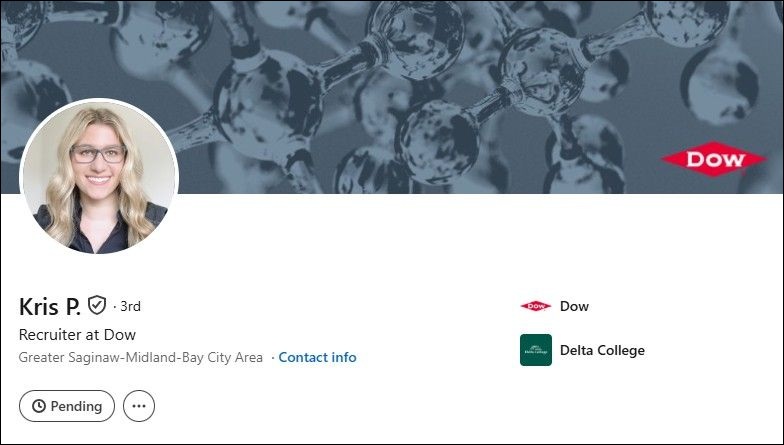
Mark Hopcroft says he was messaged by this LinkedIn profile, claiming to be a recruiter. Image: Mark Hopcroft / LinkedIn
Another LinkedIn user who commented on Hopcroft’s post said when they were looking for a job they were contacted by three recruiters, who all ended up offering up a contact of theirs to rewrite his CV to meet a job application’s keyword requirements.
“Seems they scan your profile, invent a position they know will sound appealing, introduce some urgency, and offer to rewrite your CV,” they posted.
‘A giant database’
Social media users mentioned similar LinkedIn scams in a Reddit post last year, with one user saying that changing your profile to say you are ‘open to work’ has “turned into a magnet for scam messages”.
“I get that LinkedIn is supposed to be public for networking, but it feels like scammers are using it as a giant database,” another user commented.
According to LinkedIn, warning signs for job scams include offers that seem too good to be true, messages that contain spelling or grammar mistakes, messages that are not personalised, and messages asking for personal or financial information.
Major bank ANZ warned last month that “sophisticated and highly realistic job scams have become a common form of impersonation scam”.
“These scams involve criminals posing as recruiters or representatives from legitimate organisations to gain trust and engage with potential victims,” the bank said.