




Sydney’s Macquarie University has denied replacing two in-person classes with an artificial intelligence chatbot, after a media report claimed the institution had done so.
The Guardian reported on Wednesday that Macquarie University had “swapped in-person classes with an AI chatbot, online quizzes, and optional online tutorials” for two mandatory units taken by psychology students.
The report suggested Macquarie University’s AI companion, Virtual Peer – which it created with Microsoft and first trialled with students in 2024 – had become a core part of learning for the two classes.
A university spokesperson told Information Age, “Macquarie University has not replaced teaching with an AI chatbot.
“Students continue to learn through the units’ teaching materials and online modules, with support from academic staff and tutors.”
The spokesperson described Virtual Peer as “an optional supplementary tool that allows students to ask questions and, in some units, undertake interactive activities to reinforce their learning”.
“It does not deliver or replace the teaching of the units,” they said.
“The units are offered both online and in person, allowing students to choose the format that best suits their study needs and preferences.”
The online versions of the two mandatory psychology classes are not largely delivered by AI, but mostly through online readings, modules, and optional video conferencing drop-in sessions with tutors, Information Age understands.
The report in The Guardian was updated on Wednesday afternoon to remove suggestions that Macquarie University had directly swapped in-person classes with its AI chatbot.
Virtual Peer use accelerates
While Virtual Peer is not available in all Macquarie University classes, the institution said its use has increased.
The AI responded to almost 80,000 student questions in 2025, and nearly just as many in the first half of 2026 alone, the university's spokesperson confirmed.
Designed to handle both academic and administrative queries, Virtual Peer allows educators to upload learning materials for the AI to directly reference in its responses.
Macquarie University said in 2025 that this would reduce the likelihood of so-called AI hallucinations – when an AI system makes up or provides false information – and had helped to improve the grades from students who trialled it.
Virtual Peer also allows educators to review anonymised versions of its chat logs, which the university has previously said can help teachers improve their work.
In an unrelated case involving AI, a Macquarie University IT lecturer recently used a different chatbot to win a historic legal proceeding at the Fair Work Commission.
Sydney University workers strike ‘to safeguard real teaching’
Numerous Australian universities have introduced AI tools for both staff and students, which has raised concerns from some industry bodies – not only about its effects on student learning given the rise of AI-based cheating, but on the future of teaching jobs.
Thousands of staff at the University of Sydney began a 24-hour strike on Wednesday morning over job security, pay, workloads, and to demand “protections against unchecked AI, to safeguard real teaching”.
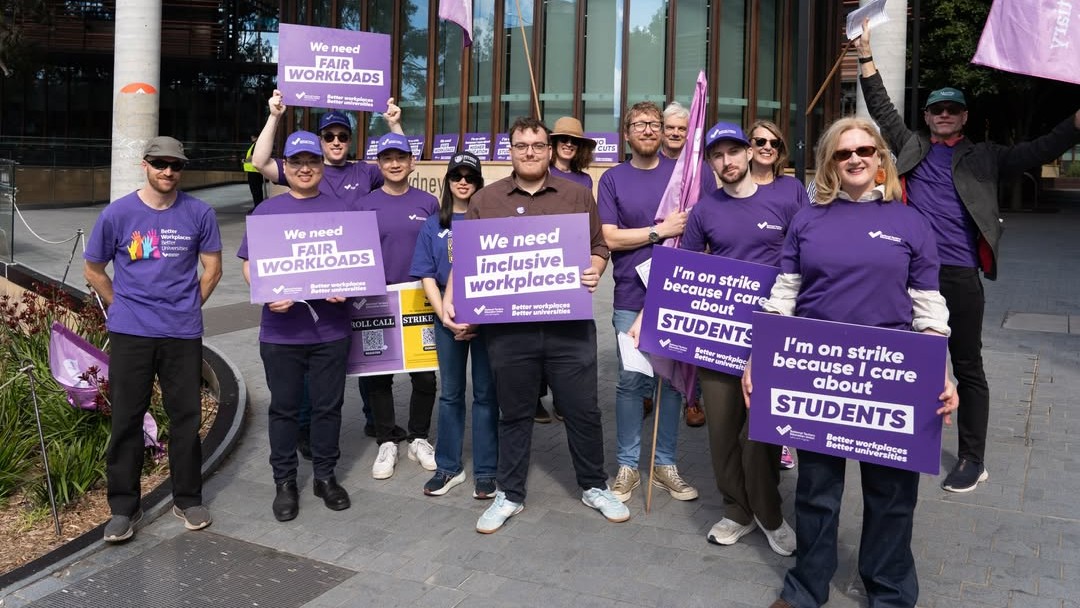
Union members striking at the University of Sydney on Wednesday. Image: NTEU NSW Instagram
Members of the National Tertiary Education Union (NTEC) voted to stop work while they negotiate a new enterprise bargaining agreement with the university, leaving many classes rescheduled, held online, or cancelled.
The union’s NSW Division Secretary, Vince Caughley, reportedly told Nine, “We want enforceable protections against AI being used to cut jobs, intensify workloads, undermine academic and professional judgement, or replace work and human interaction that are fundamental to a university.”
NTEU general secretary Damien Cahill said in a promotional video in July that management at “a lot” of Australian universities were “really strongly” resisting the union’s campaign to regulate AI use in local tertiary institutions.