





AI market leader Anthropic – which is preparing for an IPO on the Nasdaq – recently recorded $US81 billion in losses.
Which has me asking: Is AI really the new oil?
Even though 90 per cent of that loss was apparently an accounting write down, it wasn’t so long ago that $8 billion in operating losses was considered real money.
The future of AI has been hailed as the new oil. Oil made a lot of people rich. But it’s not cheap to drill, nor to ship. It then has to be refined and distributed. Meaning, there is never an economic case for providing it to customers for free.
What if AI is more like news than oil? Something can be expensive to produce, but lot of firms find it makes sense to give it away. It could become a product many people are very pleased to never pay for, while a few pay top dollar for highly focused, top-quality services.
How prices are set
Marginal costs matter. The extreme case is a product that the economists call ‘non-rival’, like a radio broadcast. My consumption does not reduce yours at all, nor cost the producer anything. The costs to the producer of someone tuning in are zero (even though the cost of installing the radio antenna was not zero!). The market price is zero.
The other end of the spectrum is something that is ‘rival’. Fifty litres of unleaded fuel, if not sold to you, may be sold to me. It has a cost to make, a cost to distribute, and can be consumed only once. The market price is set slightly above the cost of getting the last litre of oil in place.
The internet has made a lot of things extremely cheap to consume because of the way it can deliver a copy of something to just one more consumer, then just one more, then just one more, basically for free, for ever.
Take news-producing organisations. Even those with a brand, a powerful value proposition and a moat are surprisingly keen to give their product away. Metered models, free trials, gift subscriptions, student prices – these are all things you don’t tend to find in the world of physical products.
Is AI more like oil or news?
The big question is about compute. Is it rival? For heavy users the answer is definitely yes. US defence organisations scouring satellite images or scanning intercepted communication for concerning patterns? That uses enough circuits to warrant its own pricing system.
But your cousin asking ChatGPT the caffeine content of Coke Zero? (A question I posed to AI just yesterday). I think we already know the answer. That kind of use is already free.
And the data centre build out is far from done, models are getting better. The 80:20 rule will apply. Mass-market AI use will almost certainly be free. And what counts as mass-market will probably get more sophisticated.
Just like news. People get their news from the ABC and free, mass-market commercial alternatives.
The next image shows the audience of Australian news sites in the most recent month: only one of the top ten has a paywall.
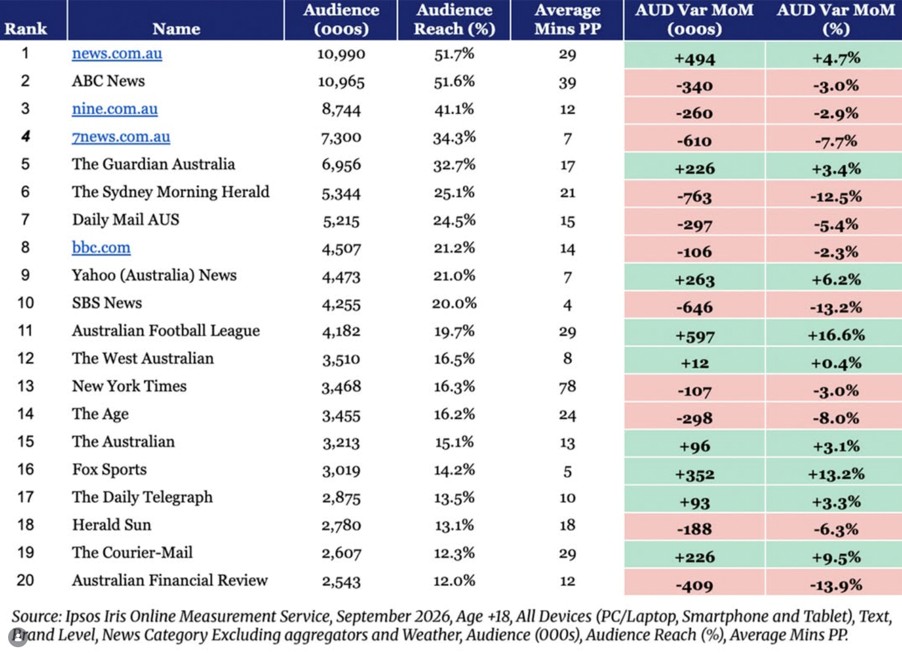
This does not mean that heavy users won’t pay big bucks for extremely high-quality service. Bloomberg is the archetype here. His eponymous newswire and financial information hub costs a fortune to subscribe to ($30,000 a year, per user). But for the money that can be made using it, the outlay is worth it for some.
Equivalent usage cases may well be found in AI. Now, the median coder building a mobile app may not need to pay for a top-notch AI service. They just need to be good. Free Chinese AI models like DeepSeek can already help a person write code.
But there are industries where success depends not on absolute quality of information, but relative quality.
Winners need better info, faster. Workers in finance and defence and possibly even gambling. Anywhere where money depends on a real-time advantage. Those will be big spenders. The rest of us may be weighing up using AI that is supported by ads.
Consolidation, public options
The great railway boom of the late 19th century ended in plunging prices for passenger and freight; in collapses and in consolidation. The dynamics are beautifully captured in the following excerpt – a snippet of a single column in the New York Times:
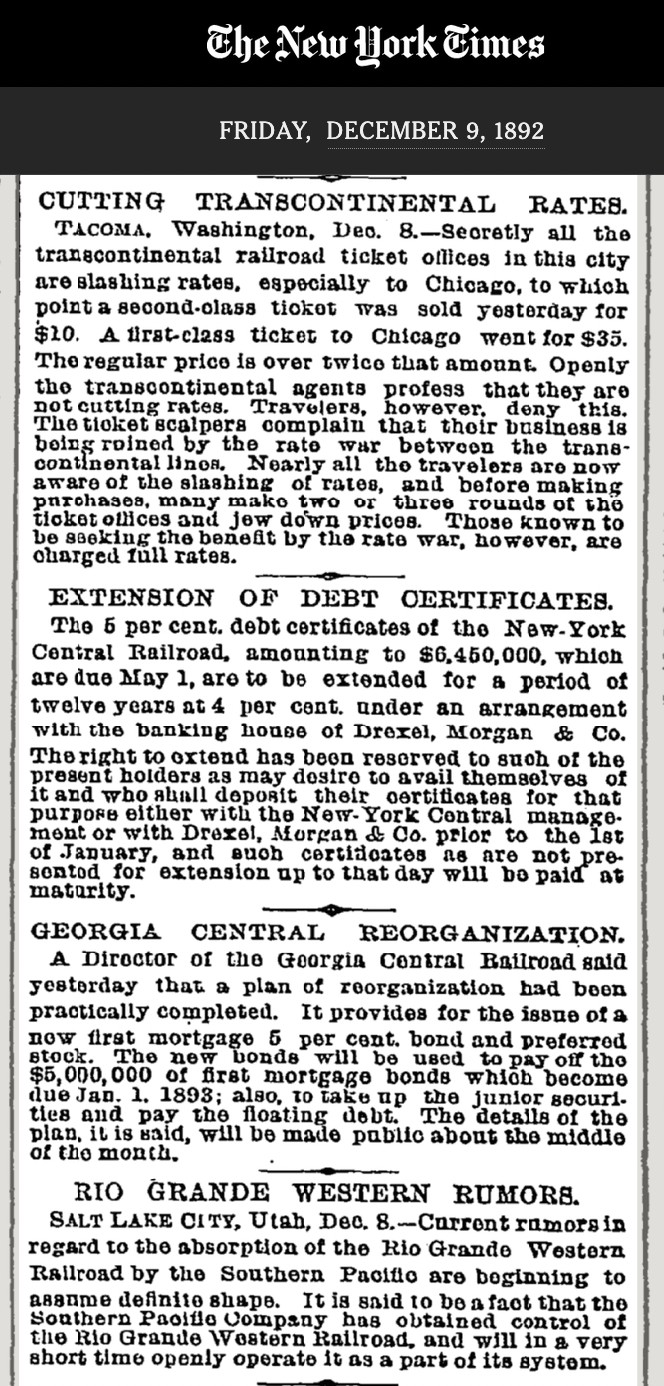
Consolidation marked the railway sector after the great railway buildout.
News has also gone through enormous consolidation as the internet ravaged it.
Similar dynamics are possible in AI. Indeed, despite the youth of the industry, OpenAI and Anthropic appear already to be engaged in a price war.
The data centre industry that underpins AI is under even more pressure – its output is business-to-business and commoditised.
Various end points are possible for consolidation.
One is nationalisation. In the UK, all trains were nationalised between the 1940s and 1990s. Nationalised oil industries and Government-run news services are also commonplace around the world.
Could the ABC one day offer a mass-market AI, free of commercial or foreign influence, to Australians?
It is far from impossible – which is a clue that AI may be more like news than oil.