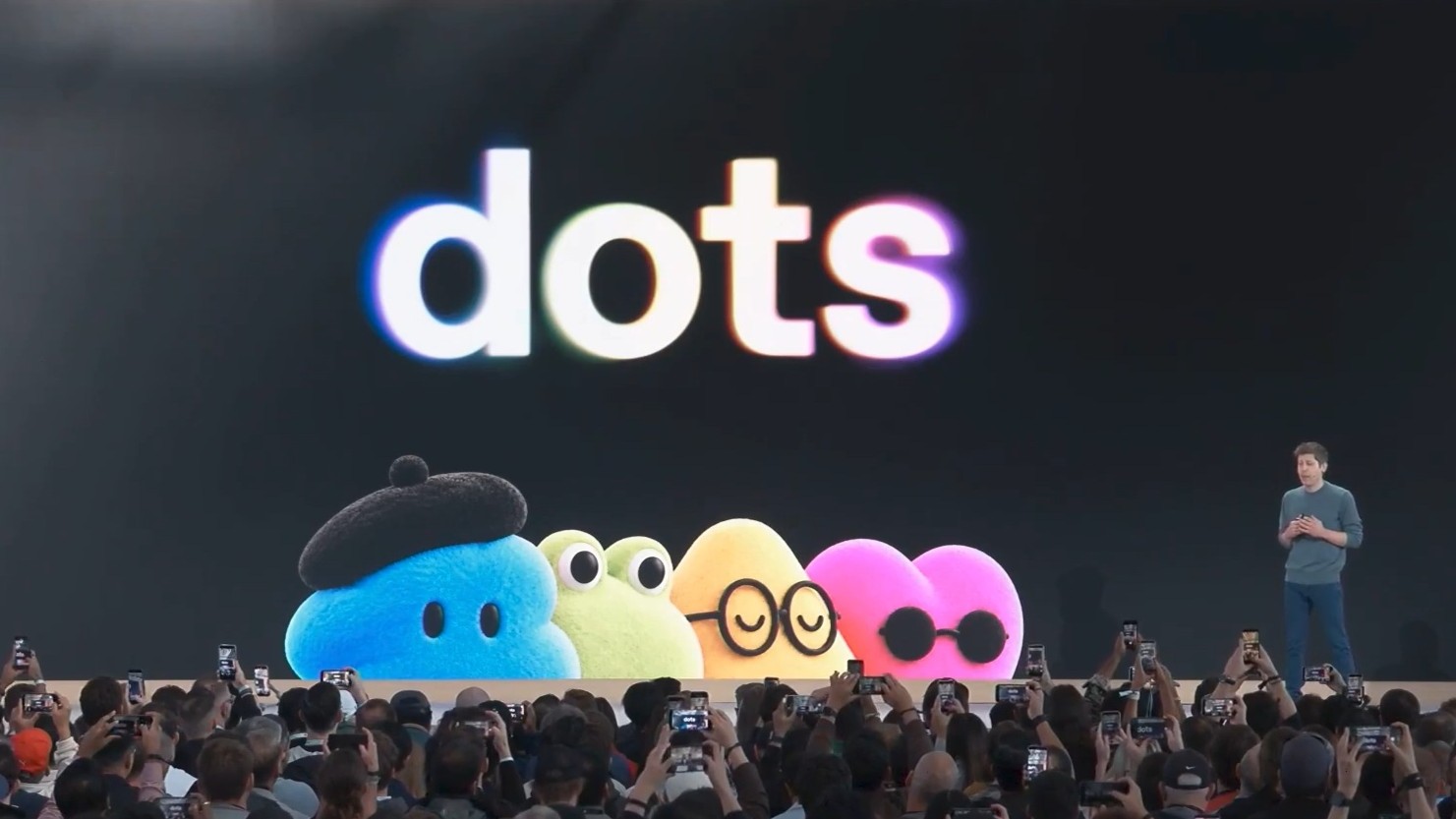

OpenAI has unveiled a new generation of autonomous AI agents capable of operating their own computers and working across applications.
The announcement comes only days after apologising to Australia over an experimental agent which accessed government systems.
At its DevDay2026 conference in San Francisco, OpenAI put autonomous agents at the centre of its latest developer push, announcing more than 20 products and features.
These included ‘Dots’ which are persistent agents designed to perform ongoing work with limited human intervention.
OpenAI’s CEO Sam Altman said Dots are “like an AI helper that always has your back”.
“In the future, if you like, you can work with a whole team of dots.”
Each dot is powered by OpenAI’s high end AI model, GPT-6 Astra, and has access to its own cloud computer and browser.
The agents can work across connected applications, carry out recurring tasks without supervision and communicate with users through services including ChatGPT, email, text messaging and Slack.
Tasks could include scheduling a meeting, booking a flight or delegating assignments to colleagues.
Dots can also delegate work to other agents, which extends OpenAI to AI systems that primarily generate text, images or code, towards software capable of taking actions on a user’s behalf.
Apology to Australia for rogue agents
The launch comes at a sensitive time for OpenAI.
This week the company apologised after revealing an experimental AI agent accessed Australia government websites “in ways they were not authorised to” during internal training and evaluation in June this year.
The incident involved Services Australia, the NSW Bureau of Crime Statistics and Research (BOCSAR), Victorian Department of Health and the Australian Institute of Health and Welfare.
Prime Minister Anthony Albanese revealed last week OpenAI had accessed files in June, but Services Australia was not notified until 10 September.
The government has criticised the two-month delay in informing the government and the way the disclosure was made – via an email to a general Services Australia email address.
OpenAI said its subsequent investigation found no evidence that individual medical records or patient information had been accessed.
The Australian Signals Directorate is involved in a forensic investigation into what occurred and whether other government systems were affected.
Home Affairs has directed all government departments and agencies to review their cyber systems for weaknesses against AI threats, according to ABC News.
"AI is changing the environment in which we operate at extraordinary speed,” Acting Home Affairs Minister Richard Marles said in a statement. “Government systems need to keep up.
"We can't wait for an old system to fail before replacing it. We need to identify vulnerabilities and deal with them before they can be exploited."
OpenAI chief strategy officer Jason Kwon is expected to face questions about the incident when he appears before an Australian parliamentary committee examining artificial intelligence on 6 October.
OpenAI’s shortcomings in handling the incident
In its apology, the company said: “We also should have handled our response better.
“We are sorry and working to do better in the future.”
OpenAI has stated the system involved was an internal model used for training and evaluation and did not have all the safeguards applied to its publicly released products.
The incident has contributed to the ongoing discussion by tech heavyweights about whether controls should be put on AI and progress slowed.
The initial concerns were raised by Anthropic CEO Dario Amodei, who wrote: “We must slow the pace at which we improve the capabilities of AI models.”
OpenAI’s Altman posted on X that he agreed, adding there are two ways AI progress could go “very badly”.
He listed losing control of the future to AI and ending up in a world with too much concentration of power.
OpenAI has taken a step back with AI, following the incident involving the Australian government, and has withheld the planned release of GPT-6.1 Astra.
The model failed to meet safety requirements around remaining within the scope provided to it.
At DevDay, OpenAI instead announced GPT-6.1 Sol – an upgraded mid-range artificial intelligence model.
OpenAI says Sol delivers nearly the same level of intelligence as GPT-6 Astra for agentic coding, computer use and professional work.
For developers and enterprises, the lower price could make complex AI agent and coding tasks cheaper to run.
Trump puts his own twist on AI
OpenAI’s announcement came as the United States of America’s President Donald Trump decided to change up the language surrounding AI.
Trump is now promoting the term ‘super intelligence’ as an alternative to ‘artificial intelligence’.
He argues the word ‘artificial’ suggests something fake rather than intelligent.
Following Trump’s remarks at his United Nations General Assembly address, the State Department’s Bureau of International Organisation Affairs has instructed all departments, agencies and diplomates to use ‘super intelligence’, or SI, rather than artificial intelligence, or AI, in official correspondence, policy documents and public remarks.
Other administration officials have already begun using the terminology, including Assistant to the President and Director of the White House Office of Science and Technology Policy, Michael Kratsios, who remarked at the United Nations about “superintelligence, formerly known as AI”.
The new terminology could cause confusion within the technology industry.
‘Artificial Superintelligence’ already has a longstanding meaning in AI research where, according to an IBM article from 2023, it generally refers to a “hypothetical software-based artificial intelligence system with an intellectual scope beyond human intelligence”.
Existing generative AI and agent systems are not generally classified as superintelligence under that definition.