
The popular game Roblox is so effective at extracting money from players that it would likely violate consumer protection laws “in any other market”, a University of Sydney academic has said after research found nearly all Roblox games deceive children into overspending.
The study, Misleading and Deceptive Monetisation in Roblox, examined how the hugely popular game – which generates annual revenues of over $8 billion (US$5.6 billion), largely through the sale of in-game Robux virtual currency – keeps players forking over their money.
Rather than explicitly calling on players to spend money at certain points, it found, they are feeding the game with a steady stream of funds because Roblox games are saturated with microtransactions like game passes, gambling-like games, power-ups and cosmetic ‘skins’.
As a platform rather than a single game, Roblox has become a time sink for young people in Australia and elsewhere, with hundreds of games and popular titles like Brookhaven, Adopt Me!, Rivals and Blox Fruits attracting over 200,000 simultaneous players in Australia alone.
In 14 of 15 Roblox games studied, pressure to spend was pervasive and “designed in ways likely to mislead child consumers about the cost, value, or consequences of spending” – with monetisation “not a peripheral add-on but embedded into the core experience of play.”
With over 56 per cent of Roblox’s 350 million monthly users aged under 17 – and 40 per cent under 13 – the study found pervasive pressure to buy Robux with real money, then spend it on such accoutrements, was creating problems for both kids and parents left to foot the bill.
Roblox offers parents the option of limiting monthly spend, and bills can quickly grow out of control: as an indication of what the platform considers normal spending, parents can opt to be notified when their child has spent $100, $250, $500 in a single month.
“Parents are really struggling with this,” said Professor Marcus Carter of the University of Sydney School of Architecture, Design and Planning, adding that “it’s hard to recognise what’s happening, and it’s happening in spaces where children are spending a lot of time.”
Shining light on dark patterns
Regulators have long wrestled with the best way to crack down on in-game designs that encapsulate ‘dark patterns’ – game or subscription designs that trap players in a cul-de-sac of spending or other behaviour, and make them difficult or impossible to avoid.
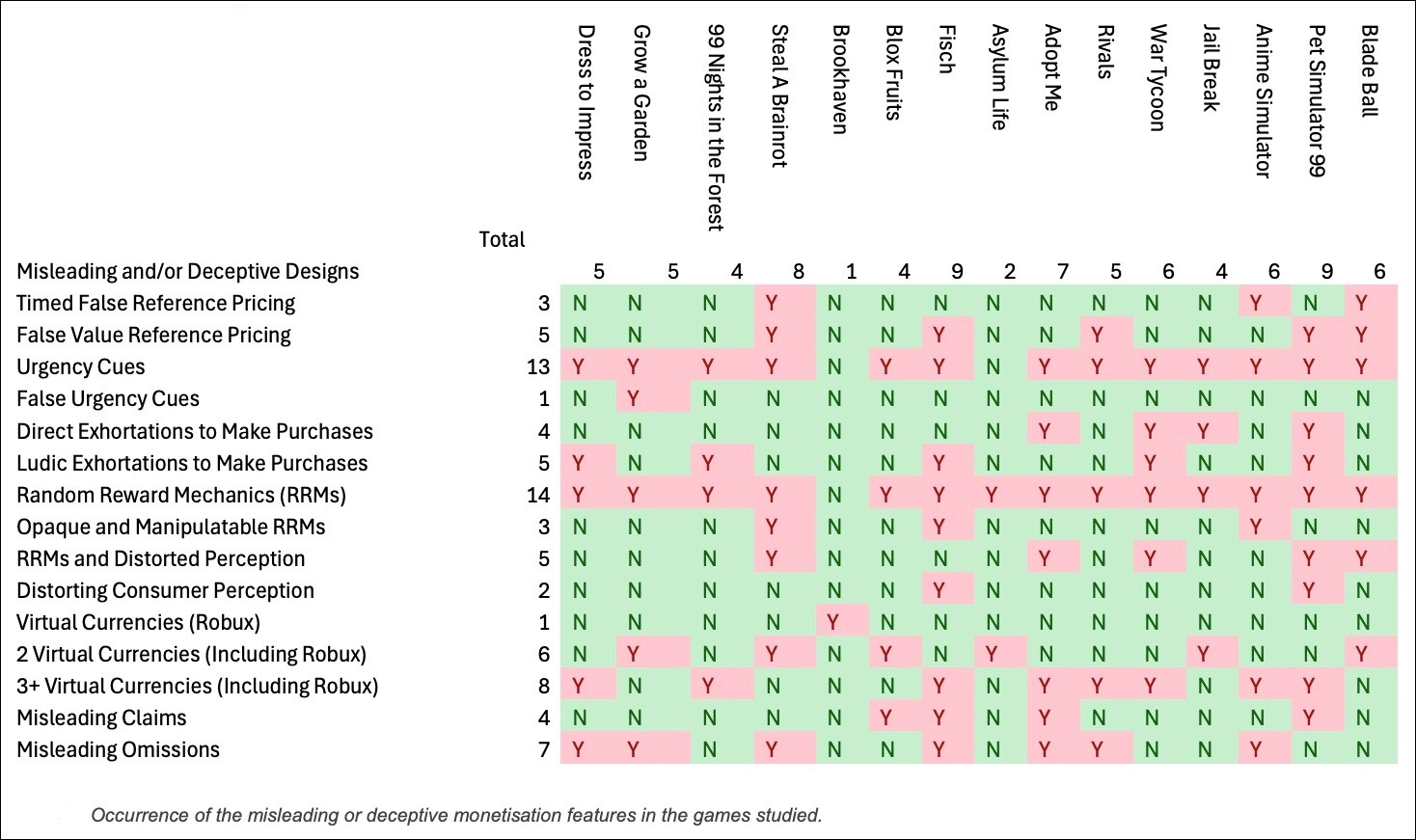
Researchers tested 15 Roblox games and found 14 use sneaky tricks to siphon money from the wallets of young players and their parents. Source: University of Sydney
This has had implications for children facing “deeply disturbing” interactions on Roblox and Parliamentary hearings have identified dark patterns as problematic, with new guidelines taking effect in 2024.
However, a Monash University study last year found that little had changed – with 58 per cent of participants reporting seeing over 10 different dark game patterns in the previous 12 months.
In just 30 minutes spent playing each of the games, researchers spent around $150 worth of Robux, with VPNs used to access ‘loot box’ features that are banned for Australian children.
Researchers identified 14 “misleading and deceptive” tricks used to extract money from players – for example, timed false reference pricing such as claimed ‘daily discounts’ or sales that are available every day, meaning “the lower price appears to function as the default.”
Other deceptive behaviour identified included misleading claims, misleading omissions, obscured pricing through use of separate virtual currencies, and “opaque and manipulatable” random reward mechanics (RRMs).
Calling on consumer authorities to wise up
The Roblox games’ relentless pursuit of Robux led the Sydney University team to suggest that rather than being offered on a ‘freemium’ basis – in which basic features are free and extra features cost more – Roblox uses a ‘paymium’ model where paying up is unavoidable.
Indeed, the researchers said, their investigations confirmed that Roblox games normalise monetisation practices that “are treated as illegal in comparable non-game contexts.”
The ACCC last week won a court battle against Coles Supermarkets for this kind of behaviour, after the consumer regular found it had misrepresented the price of 245 common products by raising their prices and then claiming they were being sold at a discount.
Last year, games giant Epic Games was ordered to refund more than $115 million to players of Fortnite, a Roblox competitor that is also hugely popular with children, for tricking them into making unwanted purchases using its ‘V-Bucks’ virtual currency.
Given the ubiquity of similar deceptive mechanisms across Roblox and its myriad games, the report argues that “it is imperative that consumer protection authorities pay closer attention to Roblox games, especially given the game’s young player base.”
Given that many of the behaviours are illegal in Australia for young players, the researchers also tested how responsive Roblox and its games developers would be when contacted for a refund – and found they provide “little to no support or access to refunds.”
“Not only did the platforms involved provide no support,” they said, “but various dark design patterns were employed to make formally requesting a refund significantly more difficult than it needed to be.”
“The absence of meaningful refund amplifies the consumer harm caused by the deceptive designs outlined in this report, leaving children and parents with little practical recourse once a transaction has occurred.”