



The AI boom is showing up everywhere* – at home, at work and in the media.
Even Australia’s economic statistics are distorted by the sums involved in AI at the moment. Like a snake swallowing an egg – you can vividly see the lump moving along.
The latest official economic release to end up lopsided thanks to the AI boom is our balance of payments. Australia ran a trade deficit in March, the first one in nine years.
It is quite rare for a country that exports as much iron ore as we do to find our trade balance in the red.
And when I saw the numbers – we suddenly slipped to a trade deficit of nearly $2 billion – I initially expected fuel to be the culprit.
It was not.
Instead, what happened is that in March, a truly astonishing amount of silicon-based equipment came to our country.
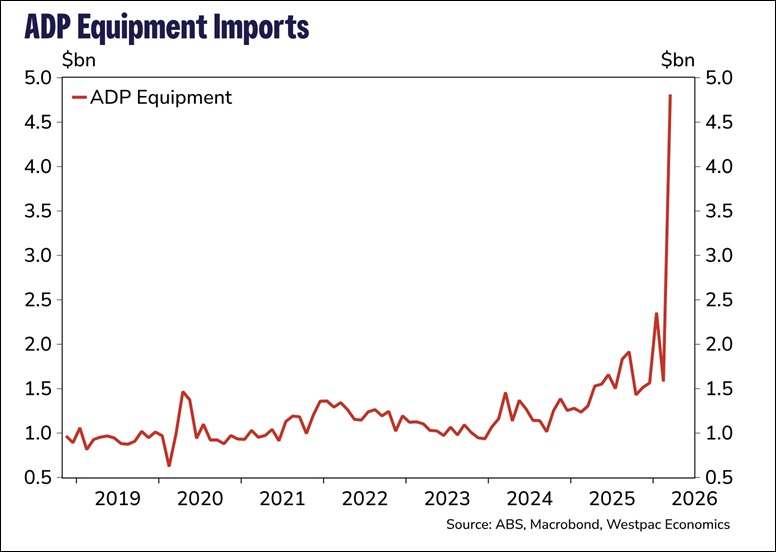
The following chart shows the value of automatic data processing equipment imported.
It leapt in the month of March, suggesting cargo-planes full of semiconductors arrived, all in a rush.
A chart of our imports from Taiwan shows a similar uptick, hinting most of the imports in question come from the fabled semiconductor foundries (they don’t say factories) around Taiwan.
A ship full of chips would be a delightful target for pirates – not since the Spanish galleons coming back from the new world has so much value been shipped with such little volume. So, data processing equipment goes by plane.
There are three mysteries in the AI imports.
Mystery one is who is behind the recent great lump in imports.
It is mostly likely to be one of the global AI names – Microsoft or Amazon. Both are pressing ahead hard on Australian data centre capacity.
But a regional player like Airtrunk or NextDC is also a possibility as the customer.
The timing of imports is proprietary information these companies aren’t releasing, however, so we can’t be sure it isn’t yet another party, for example the Australian government.
The second mystery: why Australia?
AI is expensive in terms of compute but not in terms of data transfer.
Why not put the data centres somewhere cheap?
In low-skill industries, avoiding high-wage, high land-price countries like Australia is the best way to lower the cost of doing business.
By contrast, in other parts of the high-tech sector, locating in the US is the best way to access a talent pool.
AI is evidently different.
What Australia offers is probably mostly stability – of governments, society, tax regimes.
Of electricity and water supply.
And not least of geology - the San Andreas fault means you probably shouldn’t put all your data centres in the Bay Area.
Mystery three is what we get from them.
A factory that employs Australians obviously spreads wealth throughout the community.
But a data centre that leases a building land and pays some electricity bills, while sending revenue back to its US parent… how much benefit is derived from that?
Time will tell.
(*almost everywhere. AI was not used in the writing or conceptualisation of this story.)