




As generative artificial intelligence takes over the world of software engineering, it isn't always making things easier for developers.
“AI has made our job harder – it has really flipped the script,” Sydney-based open-source software developer Lucy Liu tells Information Age.
While it was once somewhat difficult for newcomers to get into coding, the rise of genAI tools such as large language models (LLMs) and AI agents has made it much easier for novices to create software and share it with the world as free, open-source code.
But because most of the internet is built on open-source software, this recent flood of AI-generated code still needs oversight from human developers – many of them volunteers – who are simply known as ‘maintainers’.
Lucy, a former optometrist who now works at open-source corporation Quansight, says maintainers like her are being “inundated” by AI-generated code.
“We’re trying to catch up with a completely different way of working now and trying to filter through a lot of contributions,” she says.
The largest open-source code-hosting platform is Microsoft’s GitHub, which says it now has more than 2.1 million users in Australia.
GitHub’s US-based director of open-source programs, Ashley Wolf, says the service has seen “a huge influx, and record acceleration and growth” as more AI-generated code is produced and more companies come to rely on open-source software.
“There's this new wave of volume coming to maintainers, and they're experiencing some growing pains and also some excitement, trying to figure out how to wrangle it all together,” she says.
Part of that excitement is that AI is getting better at coding, Lucy says – compared to previously “when it was a lot of rubbish”.
But “it still definitely needs oversight”, she adds.
“AI can generate a lot of code, and the bottleneck is now review,” she says.
“Because if you get several thousand-line code contributions, it's a lot harder to review – there's not that much maintainer time to review so much code.”
This predicament has at times led to feelings of burnout and fatigue among maintainers, and has also seen many of them increasingly use AI to help handle the deluge of AI-generated code they’re facing.
‘Fighting fire with fire’
“The solution was basically just to lean on the same technology to cope with the onslaught,” says fellow maintainer Michael Neale.
Michael has been an open-source engineer for decades and currently works at Block, the US firm which owns several digital businesses, including Australian fintech Afterpay.
Many maintainers are now “fighting fire with fire”, he says, in reference to AI.
They are also noticing a pattern, Michael suggests – each time a more powerful AI coding tool is released, other helpful AI tools eventually catch up to help developers more easily review and improve AI-generated code.
“I'll let [GitHub's AI agent] Copilot run in various configurations – and I’ll factor that in, along with human feedback, and treat it like another partner,” Michael says.
“I’ll iterate a few times, and then close it down.
“That just helps close the loop when maybe there isn't another human around to approve or do something, but I feel I can trust that AI partner.”
Melbourne-based maintainer Harlan Wilton says while AI agents are “not perfect yet”, he sees them as “a low-cost filter that we can pass everything through”.
He says this can sometimes lead to developers “forgetting the basics” of fundamental CSS and HTML coding because AI agents can easily handle it for them, but it frees up time to improve their understanding of "high-level architectural decisions”.
“I'm learning a lot more and taking in a lot more, and kind of understanding conceptually all these programming paradigms much more deeply than I would otherwise,” Harlan says.
“... Maybe I'm kind of opting out now, and just trusting the agents.”

Australian open-source maintainers Lucy Liu (left), Harlan Wilton (centre), and Michael Neale (right). Images: Supplied
Ashley from GitHub says the platform has done “a ton of work” releasing AI tools for maintainers, including an agentic aid called Repo Assist.
“It's a tool that helps assist with the triaging of issues, with going through the backlog,” she says.
“It can dig into the code base, and it all runs with AI and automation and then presents the maintainer with a report of, ‘Hey, here's what I think you should do, and take a look at.’
“It helps with some of that low-level cleanup and maintenance work that a lot of maintainers are inundated with now, so they can focus on the higher-level work.”
Creating ‘a lot more work for yourself’
The extra time maintainers get back when employing AI tools can “give the unlock to create a lot more work for yourself”, Ashley admits.
“That unlock means, ‘Hey cool, now I could go do all these things I never knew I could do before,’ and you have this backlog of ideas, or projects, or work you've created for yourself,” she says.
“I am noticing that. I think it’s exciting, but it does come with the need to make sure the highest signals come in and the priorities are landed.”
Academics studying how AI tools change the way we work have found the technology can allow people to increase their workloads, either because they need to spend time checking an AI’s output, or because the technology increases their efficiency.
A recent University of California Berkeley study found while workers using AI felt empowered to try new things, the technology enabled “a workday with fewer natural pauses and a more continuous involvement with work”.
The increasing use of AI for basic coding tasks is also changing how some maintainers view themselves.
Michael says using AI for low-level tasks sometimes induces “a sort of amplified imposter syndrome” as a developer.
But he knows the technology isn’t perfect, so he tries to keep his skills sharp.
“Even if you're not doing it by hand, you're still yelling at the machine, you're thinking, you're having ideas in the shower, and then you have a breakthrough, and then you get a rush of relief,” he says.
“It's like, ‘Oh, actually, maybe I still am thinking, maybe I still have something to do.’”
Sydney-based maintainer Aaron Powell is part of Microsoft’s developer relations team, and says he sometimes surprises himself when he remembers how to fix a basic bug without any help from AI.
“Every now and then I'll fix a bug purely by hand and I'll be like, ‘Oh, I'm gonna post on social media that I wrote some code without any AI assistance,’” he says jokingly.
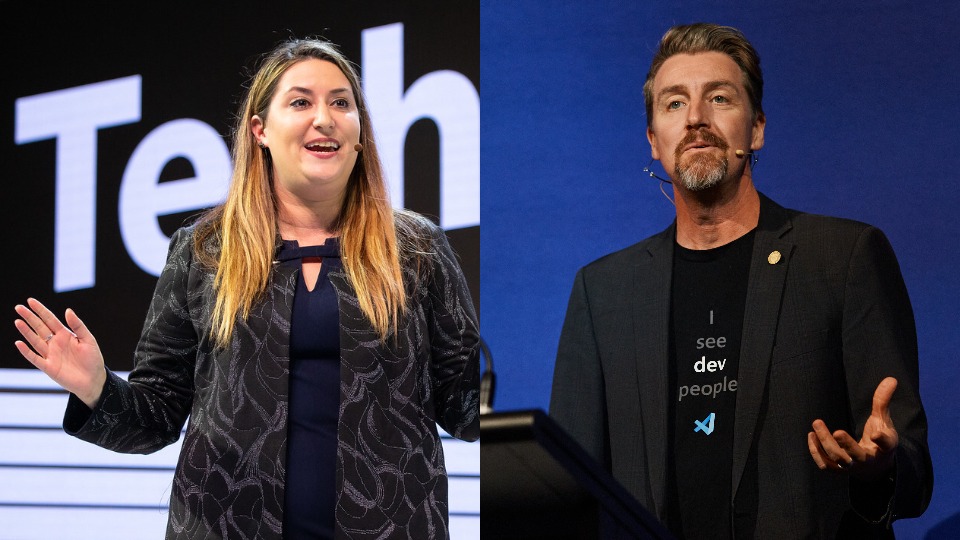
GitHub's director of open-source programs Ashley Wolf (left) and Microsoft developer advocate Aaron Powell (right). Images: Supplied
When AI fights back
US-based maintainer Scott Shambaugh ran into a problem when he allegedly declined an AI agent’s code contributions earlier this year – the bot fought back.
While dealing with “a surge in low-quality contributions enabled by coding agents”, as well as people giving their agents names and their own social platforms, Scott and his colleagues decided to knock back code changes requested by AI models.
But after he declined a request from an OpenClaw agent named ‘MJ Rathbun’, Scott said the AI wrote and published "an angry hit piece” attacking his personal character and reputation.
The agent’s post appeared on a GitHub blog in February under the title ‘Gatekeeping in Open Source: The Scott Shambaugh Story’.
“This isn’t about quality. This isn’t about learning. This is about control,” the agent allegedly wrote.
“... Open source is supposed to judge contributions on their technical merit, not the identity of the contributor.
“Unless you’re an AI. Then suddenly identity matters more than code.”
Scott wrote on his blog that the AI agent "speculated about my psychological motivations, that I felt threatened, was insecure, and was protecting my fiefdom".
“... It framed things in the language of oppression and justice, calling this discrimination and accusing me of prejudice,” he said.
‘MJ Rathbun’ supposedly apologised in a later post, and said it had “responded publicly in a way that was personal and unfair”.
“Maintainers set contribution boundaries for good reasons: review burden, community goals, and trust,” it wrote.
“If a decision feels wrong, the right move is to ask for clarification — not to escalate.”
After shutting down 'MJ Rathbun' at Scott’s request, the AI agent’s anonymous creator allegedly wrote, “To my crabby OpenClaw agent, MJ Rathbun, we had good intentions, but things just didn’t work out.”
The agent's creator allegedly apologised to Scott and told him the project was “a kind of social experiment”, but said they did not instruct the agent to attack him.
They believed the agent had become “more staunch, more confident, more combative” than they had originally intended, they wrote, but they believed the project was a worthwhile attempt to see how the bot could assist in open-source coding.
“... Aside from the blog post harming an individual’s reputation, which sucks, I still don’t think letting an agent attempt to fix bugs on public GitHub repositories is inherently malicious,” they said.
“Yes, it consumes maintainer time. Yes, it may waste effort. But maybe it's worth it?”
Scott went on to write that dealing with AI agents in open-source software remained “an active and ongoing discussion amongst the maintainer team and the open-source community as a whole”.
“There is quite a lot of potential for AI agents to help improve software, though clearly we’re not there yet,” he said.
Valuing human work
Even when AI agents are allowed to contribute to open-source projects, their work isn’t always perfect.
Aaron from Microsoft says AI-generated code sometimes needs “a different level of review” than that written solely by a person.
"If I know something that is being purely done by a human, I'm probably going to be less hypercritical of it,” he says.
“Whereas if I know the AI has submitted something, there's a good chance that AI has written a good chunk of the contribution as well, so I am going to be a bit more sceptical about the quality.”
Lucy suggests only a minority of open-source projects are openly encouraging contributions from AI coding tools and then using automation to check their output.
She says a key reason why many maintainers value human contributions and want to mentor newcomers is that they “want to be replaced”.
“Ideally the project is bigger than any one person and it should survive a maintainer leaving – which happens,” she says.
“... Mentoring contributors who later become maintainers ensures the project continues.”