
Nine Australian universities rank amongst the top 100 in the world overall, according to new standings that also saw 37 per cent of subjects at Australian and New Zealand institutions improve their positions – but revealed systemic shortcomings in research and teaching.
The Universities of Melbourne and New South Wales ranked 19 and 20 respectively, in this year’s QS Top Universities list, with the University of Sydney (25), ANU (32), Monash (36), Queensland (42), UWA (77), Adelaide (82), and UTS (96) also among the Australian institutions in the global top 100.
RMIT, Macquarie, Curtin, Wollongong, Deakin, QUT, Newcastle, and La Trobe universities also ranked in the global top 250 – putting 17 Australian institutions, or nearly half of Australia’s universities, among the best 250 in the world.
Government education advocate Study Australia was quick to crow about what it called “outstanding” results, noting that Australia’s overall average score in the QS rankings was 49.8 – “placing it well ahead of other major study destinations” including the US, UK, and Canada.
Course content is improving
QS also ranked the strength of universities’ individual study areas, examining over 21,000 academic programs in 55 disciplines at 1,900 ranked universities – and found Australian institutions were getting better in computer science and related subjects.
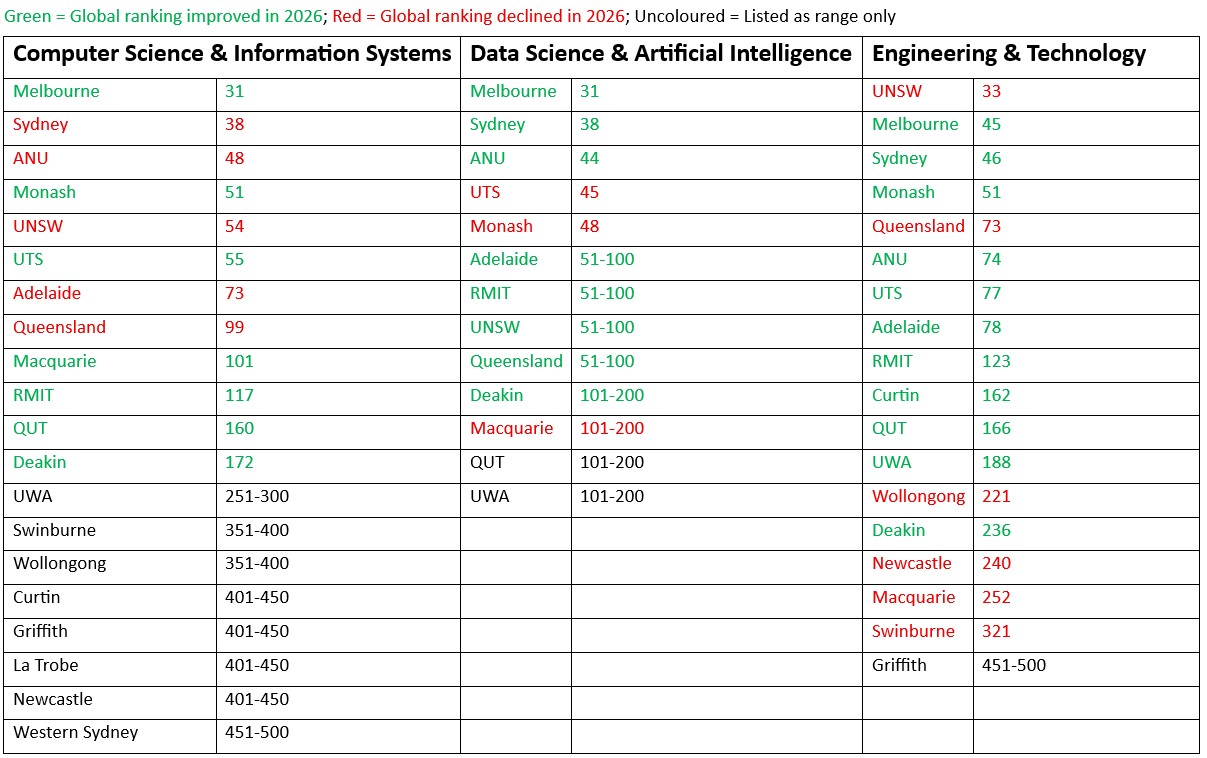
Computer science courses at Melbourne (ranked 31), Sydney (38), ANU (48), Monash (51), UNSW (54), UTS (55), Adelaide (73), and Queensland (99) were all among the world’s top 100, with Macquarie (101), RMIT (117), QUT (160), and Deakin (172) also in the top 250.
Significantly, seven universities’ computer science rankings increased substantially compared with last year – with Macquarie jumping 55 places, RMIT 50, Melbourne 15, Monash 11, and UTS seven places.
Some 164 ANZ region engineering and technology courses ranked overall, with 37 per cent of courses at local institutions improving their QS rankings over last year – the third highest out of 14 regions studied – even as 24 per cent slid in the rankings.
Despite concerns about middling performance on a recent AI skills benchmark, data science and AI teaching is also improving – with Melbourne, Sydney, and ANU surging as Adelaide, RMIT, and Queensland debuted in the top 100 – and Deakin, QUT, and UWA in the top 200.
UTS and Monash slid but retained their top-50 positions – contributing to what Monash called “strong performance across emerging and high-impact fields… reflecting Monash’s growing influence in disciplines shaping the future global economy and society.”
Australia’s best university technology courses, according to QS World University Rankings 2026
But universities have their challenges
Despite Australia’s solid showing overall, the QS rankings also reflected ongoing challenges within the university sector – with six of the top nine institutions sliding down the leaderboard since last year and eight others in the top 250 doing the same.
Melbourne, for one, dropped six spots while UNSW (1), Sydney (7), ANU (2), Queensland (2), UTS (8), RMIT (2), Macquarie (5), Curtin (9), Wollongong (17), Deakin (10), QUT (13), and La Trobe (16) also turned in lower numbers – while Newcastle dropped 48 places in a year.
Australian unis turned in dismal scores in categories such as faculty to student ratios – so low that despite their overall high standing, Melbourne, Sydney, Monash, UWA, UTS, RMIT, Curtin, Wollongong, Deakin, QUT, La Trobe, and others all ranked below 800 in the world.
Those figures suggest a relatively small number of lecturers are fighting to maintain standards despite growing student bodies – with 11 institutions outranking 95 per cent of all unis in terms of international student enrolments, and six ranked in the global top 50.
The vulnerabilities of Australian research institutions were also obvious, with measures such as the strength of international research networks and citations per faculty member far below the universities’ overall rankings.
Research standing is a point of pride, with Sydney Uni deputy vice-chancellor of research Professor Mike Ryan “congratulat[ing] our research community on these impressive results underpinned by our strong research networks, reputation and record of citations.”
Australian unis also fared poorly in another key metric: despite their high overall positions, only five institutions ranked in the global top 100 in terms of their reputation with employers – and just three were in the top 100 in terms of employment outcomes.
The results are further evidence that Australia’s universities are proving increasingly effective at teaching students skills that employers don’t want.
“Academic reputation and employer reputation metrics are central to the QS World University Rankings and pivotal in subject rankings,” Monash noted, urging alumni to share their experiences to bolster its performance in future QS World rankings.