

New legislation proposed in Victoria could see social media users de-anonymised in a bid to crack down on online vilification.
The proposed changes would see the Victorian Civil and Administrative Tribunal (VCAT) gain new powers to make ‘demasking orders’.
Announced by Victorian Premier Jacinta Allan on Sunday, the demasking orders would force social media companies to reveal the identity of anonymous users accused of online ‘vilification’.
“Hiding behind an anonymous account online should never mean you can vilify someone and get away with it,” said Allan.
The laws, which are being drafted at the time of writing, would build upon Victoria’s existing anti-vilification protections.
According to the Victorian government’s website, vilification includes a range of behaviour that “encourages hatred against you or is hateful of you because of who you are”.
This can include hate speech, but is generally distinct from discrimination, sexual harassment, and defamation.
Allan did not respond prior to publication when asked what identity information social media companies may be compelled to disclose under the proposed changes.
Introduction of country’s “toughest” workplace surveillance laws
Following its de-anonymisation announcement, Allan declared an additional suite of protective measures designed to stop tech giants and employers from “spying on workers at work”.
“Right now, workers can be watched, tracked and assessed by technology – often without ever being told,” the government announced.
“Labor will protect the rights of workers from inappropriate and unfair uses of AI in the workplace, including intrusive workplace surveillance.”
Among the proposed laws would be requirements that biometric data is only collected when there’s no “less intrusive” option available.
Using such biometrics to read staff emotions would also be prohibited unless there’s a “legitimate reason” to do so, such as monitoring fatigue among truck drivers.
The new laws would also forbid AI from being used to track bathroom breaks and certain physical conditions, such as pregnancy or having a limp.
These prohibitions can be overturned if an employer has a “specific, legitimate purpose”, while protections to prevent the use of workplace surveillance and AI for discriminative purposes would be unconditional.
Employers will need to tell workers if they’re being monitored, and human review will be mandatory for any “significant” automated decisions made using “surveillance data that affects a worker’s rights”.
According to Allan, the new laws would mark the “toughest workplace surveillance protection laws in the country”.
“I am sickened by the idea that a pregnant woman’s bathroom breaks or emotions could be tracked, logged, and used against her or her colleagues in a salary decision,” said Allan.
“We cannot allow discrimination to sneak back into the workplace via AI.”
Suing big tech will be made easier
The Labor government will also lower the barrier for lawsuits against social media and AI platforms whose negligence causes psychiatric harm to children.
“Social media and AI companies design their platforms to be addictive, and our kids are paying the price,” said Allan.
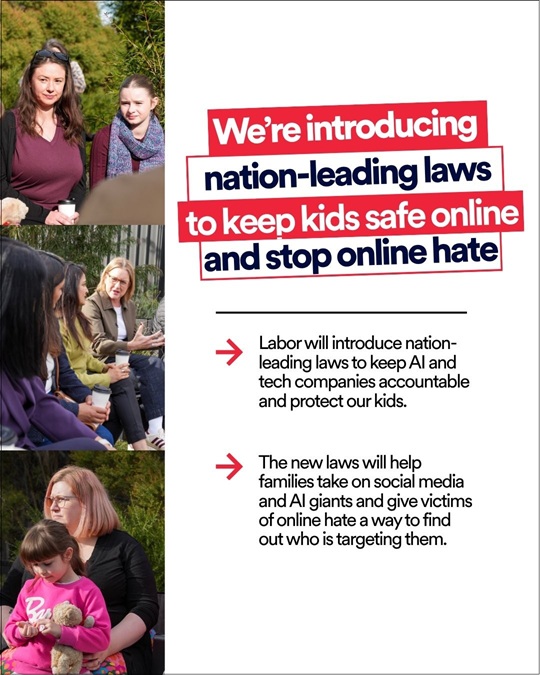
The Victorian government’s reforms are packaged as an online youth safety initiative. Source: Jacinta Allan, X.
Families seeking such lawsuits currently need to prove their child has suffered a permanent impairment of 10 per cent or more.
This threshold, which requires a medical assessment of injury, would be entirely scrapped for claims brought on behalf of minors against social media and AI providers.
“Whether the reform should extend beyond children to adults will be considered as the law is drafted,” read the Premier’s release.
State election looms as Labor prioritises reforms
Allan said the government would “use every single day available” to bring the laws to parliament.
Shadow Attorney General James Newbury, however, has reportedly deemed it unlikely the reforms will pass before November’s state election.
"They won't guarantee the laws will either be introduced or certainly passed, in the last four sitting weeks," said Newbury.
Though the Coalition and Victorian Greens have supported the sentiment of Labor’s reforms, neither party has committed to backing the changes prior to seeing a draft legislation.
Victorian Greens leader Ellen Sandell has meanwhile suggested the reforms don’t go far enough.
“It’s not enough to just react after harm is done,” Sandell told Information Age.
“We need strong, proactive interventions to stop these platforms using addictive algorithms, harvesting children’s data and amplifying harmful content in the first place.”
What are the risks?
Dana McKay, associate dean of Interaction, Technology and Information at RMIT's School of Computing Technologies, said she supported the demasking reforms in principle.
“We know that online hate disproportionately affects minoritised groups such as migrants, women, the LGBTQIA+ community, and people with disabilities,” said McKay.
“This has long made public speech more accessible to those without any of these characteristics, which is not a level playing field.
“Being able to unmask and hold accountable those who spew online hate makes social media much more like the public square it claims to be.
“You can act hatefully, but everyone is going to know who you are.”
She warned, however, that there were three major risks to the legislation.
“The first of these is shifting definitions of what is hateful, especially if these definitions are politically motivated,” said McKay.
“The second is the use of DARVO, or ‘Deny, Attack, Reverse Victim and Offender’, tactics to potentially criminalise victims.
“For example: a young person is bullied extensively but doesn't report it because they don't trust authorities.
“They finally snap, say something hateful, and end up in court as a result.”
“The third risk is the long and potentially costly court battle that will almost certainly ensue with social media companies under this legislation.”
Information Age approached X and Meta for comment on the reforms but did not receive a response prior to publication.