
Women hold just 15 per cent of the high-level roles at artificial intelligence companies in Australia, with new research revealing a stark gender gap in the tech industry’s fastest-growing and highest-paid jobs in tech.
New research by LinkedIn examining women’s representation in AI jobs globally found a significant gender gap across he industry, which widens as employees move into more senior positions.
The findings come as demand for AI skills continues to surge in Australia, with AI companies and executives increasingly making decisions that will shape the future of the technology.
‘Underrepresented at every stage’
The LinkedIn research examined the proportion of women in C-suite positions at AI and non-AI companies, as well as women’s representation in AI and non-AI roles.
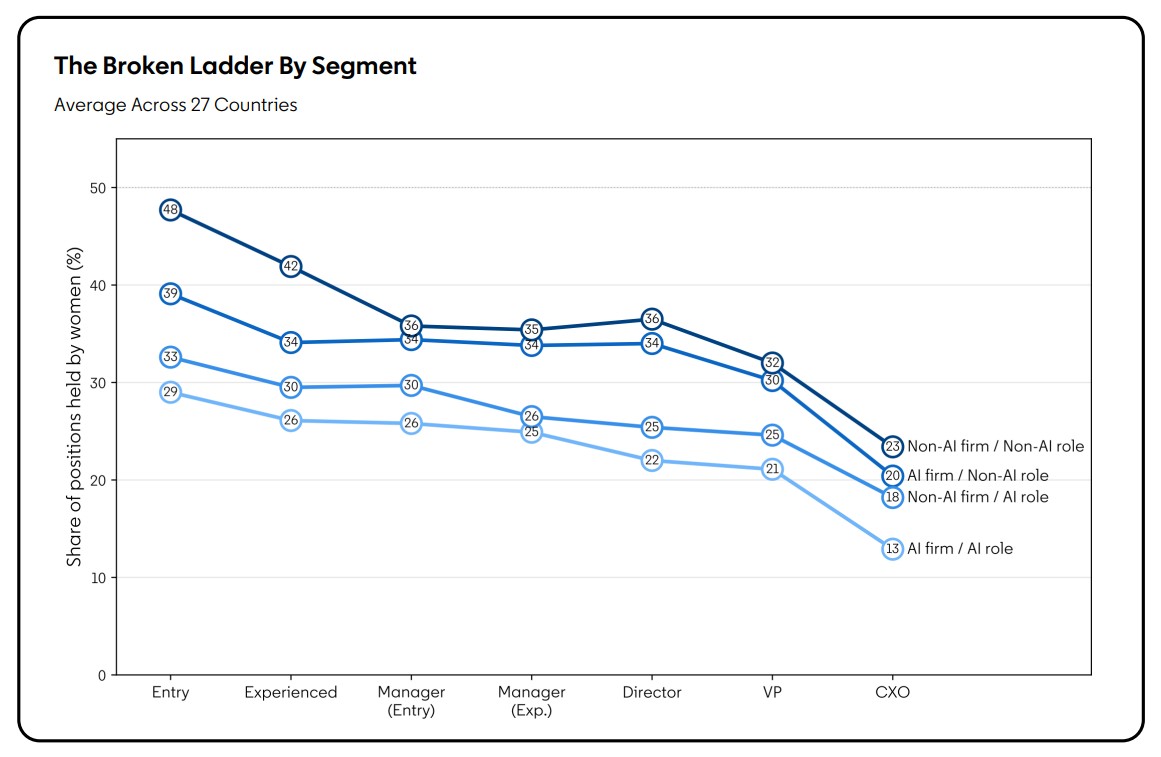
It found that just women occupy just 15 per cent of C-suite AI roles at AI companies in Australia, slightly above the global average of 13 per cent.
Women are underrepresented across Australia’s AI workforce, LinkedIn head of Public Policy and Economic Graph Australia and New Zealand, Audrey Lobo-Pulo, said.
“AI is creating some of the fastest-growing and highest-value opportunities in the labour market, but women remain underrepresented at every stage: getting hired into AI, reaching its highest-value roles, and leading the companies shaping its future,” Lobo-Pulo said.
“If women are underrepresented in the roles shaping AI, companies and countries are leaving talent, perspective and growth potential on the table.
“We need to ask what employers, institutions and workforce systems need to do differently so more people can enter and lead in the AI economy.”
At lower levels of seniority within AI companies, women account for about one-third of AI workers.
Women occupy just over one in five C-suite roles focused on non-AI functions within AI companies, while they hold just under a quarter of AI executive roles at non-AI businesses.
Huge growth
The LinkedIn research also found the number of AI job postings on the platform have roughly doubled in the last three years, reflecting growing demand for AI skills and expertise.
AI roles are also significantly better paid than non-AI jobs, with AI workers earning an average of $177,000 a year compared with $80,000 for non-AI roles.
The ACS’s Australia’s Digital Pulse 2026 report revealed women remain underrepresented across Australia’s broader tech workforce, accounting for less than one-third of tech roles.
It found that while this is a 4 per cent increase from a decade ago, this progress is uneven across career stages.
Women tech workers with 10 to 19 years’ experience have seen the least improvement, with no meaningful increase in their representation over that period.
The LinkedIn research found that the AI occupations with the highest salaries also have the lowest proportion of female new hires.
These roles include head of AI, applied AI, machine learning engineer and AI engineer.
In contrast, the role with the best gender balance, data annotator, is also the AI job with the lowest pay.
“The gender divide in AI isn’t just about who gets into AI,” the report said.
“It’s who gets access to the highest paying opportunities once they’re there.”
Previous LinkedIn research published earlier this year revealed AI jobs are among the fastest growing in the country, and are in high demand across the economy.
According to the report, AI engineer is now the fast-growing role. This job involves designing and building systems that use AI to perform tasks.
Director of AI placed at number four. The role involves overseeing the development and implementation of AI strategies within an organisation.