
A group of mostly billionaires has collectively secured the title of Time Magazine’s Person of the Year for 2025, with the publication’s latest annual list honouring ‘The Architects of AI’ as generative AI (genAI) giants shed any pretence of risk aversion and put pedal to metal.
Tech titans like Nvidia CEO Jensen Huang, Meta CEO Mark Zuckerberg, X and xAI CEO Elon Musk, OpenAI CEO Sam Altman, and ‘godmother of AI’ professor Fei-Fei Li, Time’s writers observed, have been honoured because they “grabbed the wheel of history.”
“This year, the debate about how to wield AI responsibly gave way to a sprint to deploy it as fast as possible,” they said, and “placed multibillion-dollar bets on one of the biggest physical infrastructure projects of all time.”
During 2025 AI “wrote millions of lines of code, aided lab scientists, generated viral songs, and spurred companies to re-examine their strategies or risk obsolescence – but researchers have [also] found that AIs can scheme, deceive, or blackmail,” they wrote.
These threats have been a constant counterpoint to the widely touted productivity benefits of AI, particularly as initially mooted ethical and operational shackles have been cast aside in the name of growth – and that, Time has noted, is both good and bad.
“This was the year when AI’s full potential roared into view, and when it became clear that there will be no turning back or opting out,” it said, noting that “whatever the question was, AI was the answer…. We saw it seem to make the impossible possible.”
A controversial choice, but not for the first Time
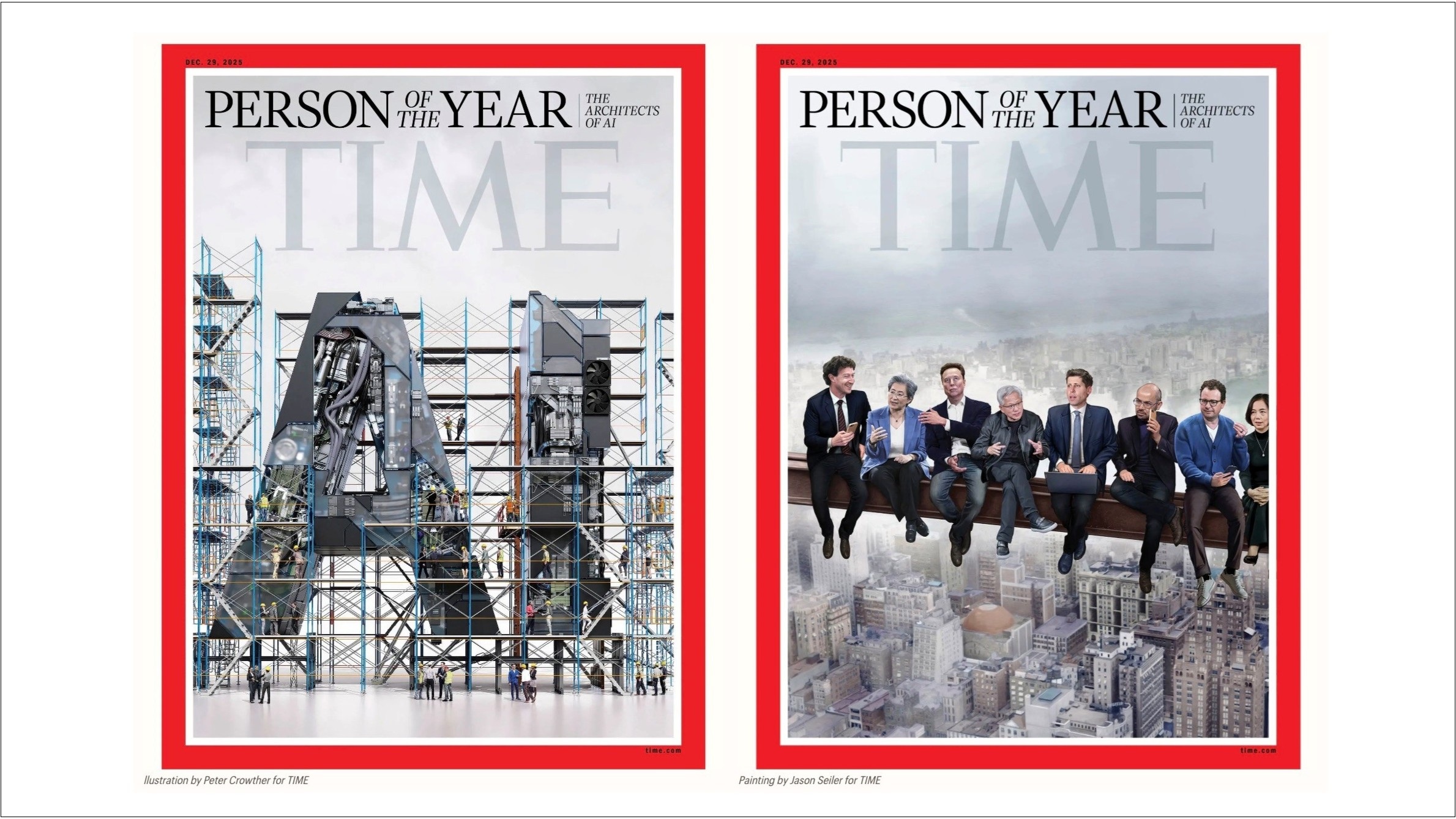
Time’s view of AI’s impact is clear in the design of its two covers – one a stylised ‘AI’ and the other a tribute to the classic 1932 photo Lunch Atop a Skyscraper, whose subjects evoke the industrial might that made the US a world economic leader.
The leaders honoured by this year’s award are driving an equally significant revolution, Time notes, with hundreds of billions invested already and McKinsey expecting $7.8 trillion ($US5.2 trillion) to be invested by 2030.
Those investments are reshaping economic markets and global infrastructure, with data centres turbo-charging construction markets and tech giants scrambling to find enough power to run facilities that are expanding to become the size of cities.

Also pictured in Time's illustration are AMD's Lisa Su (second from left), Google's Demis Hassabis (third from right), and Anthropic's Dario Amodei (second from right). Image: Jason Seiler / Time
Indeed, Goldman Sachs has predicted data centres will use 8 per cent of US power by 2030 – twice their share in 2023 – and AI capital investments have kept the US economy out of recession, although some fear the risks of “circular financing” that’s paying for it.
Yet AI’s ever-expanding bubble of investment and hype could go very wrong with drastic consequences, warn critics who have labelled Time’s choice a snub of murdered firebrand Charlie Kirk, and a bow to AI masters set to obsolete millions of jobs.
Celebrating the lack of regulation
The Time award is often controversial, but the choice to award the title to AI visionaries this year was driven by the technology’s rapid escalation, as putative controls on AI’s functioning and moral ground give way to unfettered populist investment.
Walking this line has been a focus for governments in Australia – where the recently launched National AI Plan opted to ignore expert advice for restraint and instead let AI companies set the pace – and elsewhere, with the EU’s AI Act forcing AI transparency.
This battle is also playing out in the US, where 38 states have passed their own legislation to apply standards relevant for their diverse populations.
The risk of creating a conflicting patchwork of AI regulations recently drove US President Donald Trump to sign an executive order banning “onerous” US state laws that, he warned, threatened the country’s ability to dominate the AI race against China and others.
“We remain in the earliest days of this technological revolution and are in a race with adversaries for supremacy within it,” the order says, adding that “to win, US AI companies must be free to innovate without cumbersome regulation.”
“Excessive State regulation thwarts this imperative.”
This ideological change was perhaps best exemplified by Altman, who had long claimed he was proud that ChatGPT had not joined the trend of sexy-talking AI companions – then announced a feature allowing it to engage in “erotica”.
This gloves-off approach to AI is what makes it so significant in 2025, wrote Time, noting that “the risk-averse are no longer in the driver’s seat.”
“Thanks to Huang, Son, Altman, and other AI titans, humanity is now flying down the highway, all gas, no brakes, toward a highly automated and highly uncertain future.”