
Nearly a third of workers at Australian software company WiseTech Global and hundreds at the Commonwealth Bank are facing potential redundancy, the companies announced this week amid escalating adoption of artificial intelligence within both firms.
WiseTech, which produces logistics software, will axe around 2,000 jobs during a two-year restructure focused on using generative AI to increase efficiency in software engineering and support, the company announced on Wednesday.
A “deep AI transformation” across WiseTech would lead to a “leaner, more efficient AI-led organisation supporting a structurally lower cost base and improved scalability”, the company said in an earnings presentation.
Teams in product and development, as well as customer service, would see their headcounts reduced by “up to 50 per cent”, WiseTech confirmed.
CEO Zubin Appoo said AI was “unlocking levels of efficiency gains across WiseTech that were previously out of reach”.
“Software development has experienced its most significant shift in decades,” he said.
“I am prepared to say this clearly: the era of manually writing code as the core act of engineering is over.”
WiseTech said its “deeply experienced” staff had already focused on “coordinating across a swarm of AI agents to deliver value”.
The company, which was co-founded by scandal-hit billionaire Richard White, also told shareholders it would “continue to monitor future benefits of AI to capitalised [sic] development and headcount”.
Investors appeared pleased with WiseTech, as its share price closed up 11 per cent on Wednesday and rose a further 5 per cent at the start of trading on Thursday.
Technology workers cut at Commonwealth Bank
The Commonwealth Bank of Australia (CBA) also confirmed on Wednesday it had cut some roles in its technology team, but suggested it was not a direct result of the company’s increasing use of generative AI tools.
The Finance Sector Union (FSU) said the bank had decided to cut approximately 300 jobs – the majority of which were in technology, but also in retail, business, institutional banking, and human resources.
The bank had “reduced some standalone support and coordination roles”, a spokesperson told Information Age, “by embedding the capability” directly into its software delivery teams.
“AI is changing how some tasks are performed but it is not the driver of these role changes,” they said.
“We do expect that over time technology, including AI, will continue to reshape how work is done across CBA and the broader economy.”
CBA on Tuesday announced a $90 million ‘Future Workforce Program’ it said was designed to “help employees build skills” as part of an “AI-ready workforce”.
CEO Matt Comyn said Australia had to “get really good at adopting this technology and whatever follows it”.
“Our priority is to transition people into higher-impact roles which require greater expertise, judgement, critical thinking, and empathy,” he said.
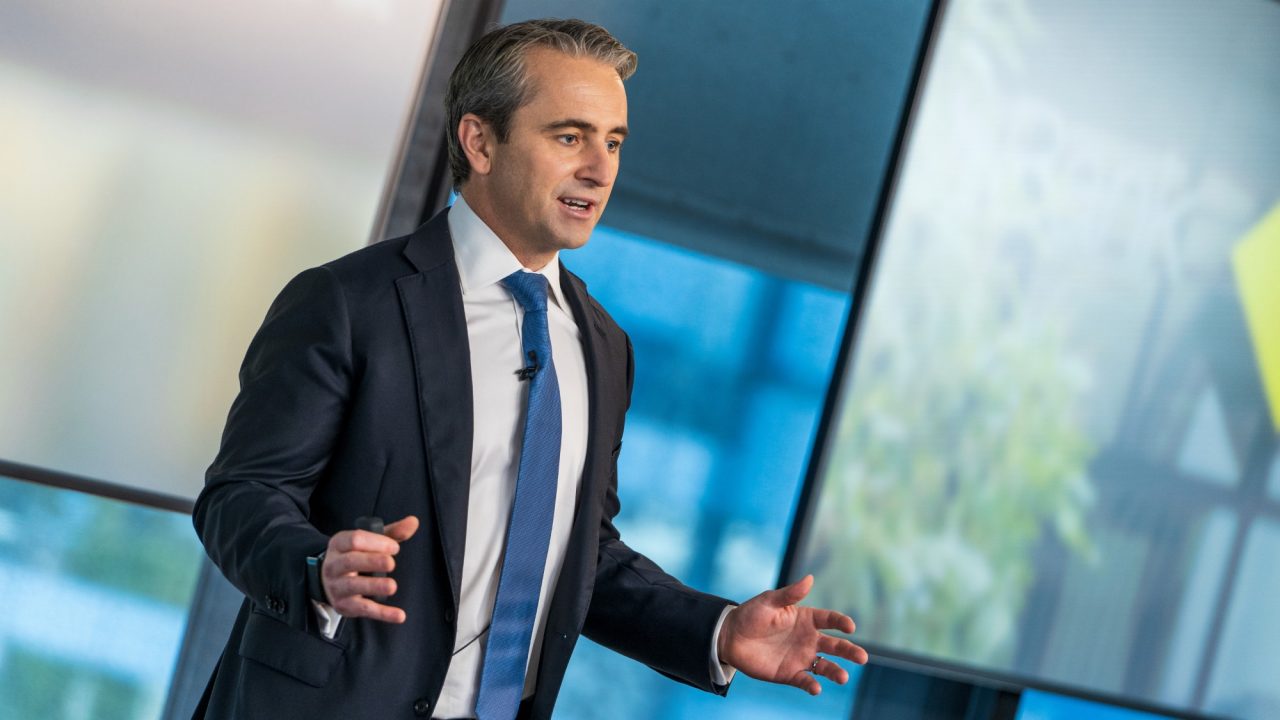
CBA CEO Matt Comyn says the bank is increasing its use of genAI technologies, while training staff in how to use it. Image: Commonwealth Bank
The comments suggested CBA’s entry-level roles may be more affected by the adoption of AI – a phenomenon already seen in other Australian businesses.
The FSU said it urged CBA to use its new program to support workers displaced by the latest job cuts, and to help upskill staff.
FSU national secretary Julia Angrisano said it was “totally unacceptable” for CBA to cut 300 jobs after posting a $5.4 billion half-yearly profit earlier this month.
“For years we have seen CBA continue to axe hundreds upon hundreds of jobs while raking in billions in profits – we've heard countless stories of CBA workers being tossed onto the redundancy pile and having to fend for themselves at the whim of the bank,” she said.
“Which is why our union has fought hard for improved support for workers – stronger protections when AI or new technology is introduced in the workplace and genuine support for workers to retrain and redeploy into other areas of CBA.”
CBA last year reversed a decision to cut 45 customer service roles which it originally planned to replace with an AI chatbot, after also offshoring some technology roles.
Optus cutting up to 300 jobs in 'organisation-wide transformation’
Telecommunications giant Optus this week proposed changes which could see up to 300 jobs cut.
Optus CEO Stephen Rue told a Senate committee on Thursday he expected the job cuts to affect “between 200 and 300” employees.
While Optus would not confirm which roles were in scope for consultation, it confirmed it was undertaking an “organisation-wide transformation” which would include “new appointments, leadership changes, and some role adjustments”.
“We are bringing in new expertise where needed, supporting transitions, and simplifying areas of the business to drive faster, more effective decision making,” a spokesperson said.
“We recognise some of the changes will have a significant impact on some of our people and we are committed to approaching this decision with empathy and respect.”
Optus’s restructuring comes as the telco attempts to rebuild trust with customers and the wider public following an outage which impacted Triple Zero calls, a proposed $100 million fine for “unconscionable” sales practices, a one-day network outage in 2023, and a significant data breach in 2022.
James Perkins, national assistant secretary of the Communication Workers Union (CWU), said it was “an absolute disgrace” that Optus was cutting jobs when it “should be rebuilding trust and investing in Australian jobs”.
"You don’t fix systemic failures by reducing the people responsible for keeping the network safe and reliable,” he said on Wednesday.
“Cost-cutting like this does not make the network more robust or secure.”
Optus, which currently has around 6,800 staff, is preparing to “significantly increase its workforce in the next 12 months”, including by bolstering its network team, bringing some network and call centre jobs back to Australia from India, and retaking control of retail stores, Rue told the Senate committee on Thursday.
Much like its competitors, Optus has also begun using genAI technologies both for internal work and on customer-facing platforms.