

The Australian government’s workforce is facing “a potential digital talent shortfall of more than 8,000 people in the next five years”, according to a report released on Thursday by the commonwealth’s Digital Transformation Agency (DTA).
The agency’s 2025 APS Digital Workforce Insights Report found the Australian Public Service (APS) “must double its digital workforce by 2030” as use of new technologies increases and around 20 per cent of tech workers retire in the coming years.
Australia’s public service currently employs around 8,000 ICT and digital employees, with a median age group of between 40 and 44, according to DTA.
Adopting generative artificial intelligence tools has become a key goal of the federal government’s work to increase national productivity, with the APS announcing on Wednesday that chief AI officers will be appointed to every federal agency in 2026.
“A continuing digital transformation agenda and the evolution of emerging technology is placing even greater demand for digital roles than previously seen,” DTA’s report found.
It suggested that even if continued annual workforce growth of seven per cent continued, APS would still have “some work to do in attracting, building and developing the workforce required in the future”.
“The APS won’t be able to rely on the market to secure its digital workforce requirements for the digital future,” DTA said.
It suggested APS may need to redistribute its workforce, “particularly as emerging technology changes the nature of work”.
Minister for the Public Service, Katy Gallagher, told Information Age, “The DTA’s report reinforces what we already know — digital capability is critical to the APS delivering for Australians, and we’re acting to address it."
The minister added the government was "investing in skills, modernising recruitment, and building the workforce we need to harness technology safely and responsibly".
Josh Griggs, CEO of the Australian Computer Society (ACS) — the publisher of Information Age — said the shortfall projected by the DTA was “a clear warning for the public sector”.
“Australia is already facing widespread digital skills shortages, and the public service won’t be immune,” he said.
“… If we fail to act, Australia risks falling further behind global competitors in digital capability.
“But with the right investment now, this challenge can become an opportunity to build a future-ready, digitally skilled public workforce.”
How could APS bolster its tech workforce?
Improving APS’s digital workforce would require government agencies to reconsider who they hired and how they did it, according to DTA.
The agency suggested APS could diversify its education and entry pathways to rely less on university programs and graduates, and instead increase partnerships with vocational and micro-credential providers.
It also suggested addressing digital skill shortages, which were reported by more than 70 per cent of APS agencies.
“Addressing these gaps will require a coordinated, whole-of-service approach to reskilling and upskilling,” DTA said.
“Building capability at scale will allow the APS to reduce reliance on contractors and ensure inhouse expertise evolves alongside technology.”
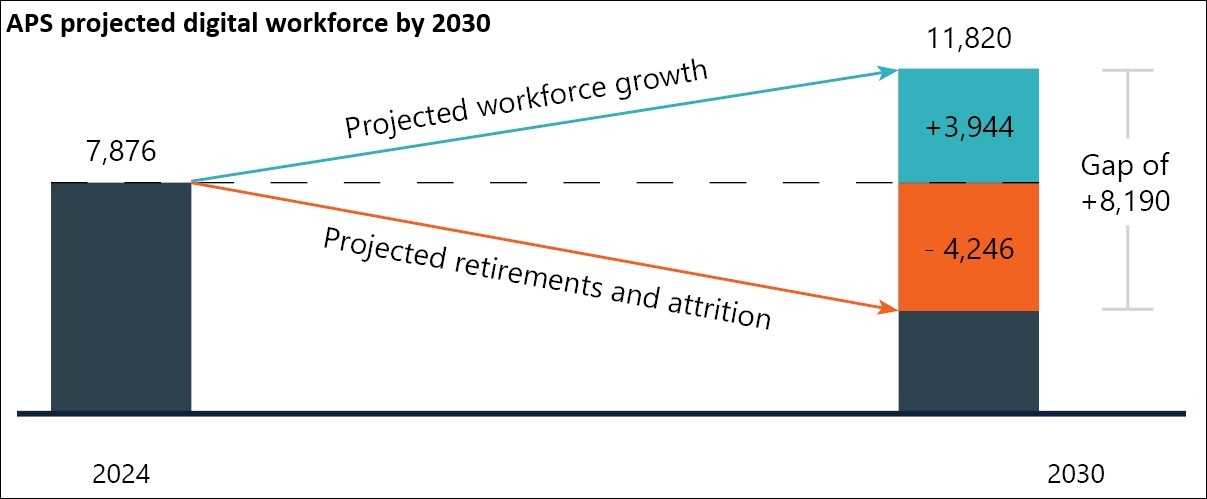
DTA says the public service must add one new digital worker for each one currently employed. Image: DTA / Supplied
The agency also suggested APS become more flexible in its hiring by “breaking the Canberra bottleneck” and employing more workers who live outside of the nation’s capital.
Around 60 per cent of public service ICT and digital workers currently resided in the ACT, DTA found — but this meant talent was drawn from only 4.6 per cent of the national ICT workforce.
“At the current pace, it will take 132 years to balance the APS workforce between the ACT and the rest of Australia,” DTA suggested.
The agency also recommended APS improve career development for more junior workers and clarify which digital skills it needed most.
Chris Fechner, CEO of DTA and head of the APS digital profession, said APS would “build the skills and talent needed to deliver digital services that meet the needs of all Australians”.
“By investing in skills, partnerships and career development, we can build a confident, capable and connected APS workforce ready to meet the opportunities of a rapidly changing digital landscape,” he said.
Griggs from ACS added, “To deliver on its digital transformation goals, government must invest as much in people as in technology, through stronger pathways into tech roles, targeted upskilling, and better workforce planning.”
Australia ‘not on track’ to meet tech job goal
DTA’s findings come after new data showed the broader Australian economy was “not on track” to meet the federal government’s goal of 1.2 million technology‑related jobs by 2030, according to the Department of Industry, Science and Resources (DISR).
The Future Skills Organisation has also predicted there will be a shortfall of more than 61,000 digital jobs across Australia by 2030.
Shadow minister for industry and innovation, Alex Hawke, last week accused the government of breaking promises by failing to reach its tech jobs target, which it adopted from industry lobby group Tech Council of Australia.
“Tech jobs underpin everything from AI to AUKUS; they’re not a ‘nice to have’, they’re a national imperative,” Hawke told Smart Company.
“We need more tech jobs to power the next wave of cutting-edge opportunities, but this data confirms Labor is taking us in the wrong direction.”
Tech Council of Australia said last week that it was “closely analysing” the latest data on the nation’s technology jobs.