

Australia is “not on track” to meet the federal government’s goal of 1.2 million technology‑related jobs by 2030, according to new economic data from its Department of Industry, Science and Resources (DISR).
The target, which was set by industry lobby group Tech Council of Australia and adopted by the federal government in 2022, would no longer be met in time based on updated jobs figures publicly reported in DISR’s latest annual report on Tuesday.
Growing the number of tech-related jobs in Australia is one of the department’s key performance measures, and one it admitted it had not met.
“The measure was not met as the trajectory is not on track to reach the target by 2030,” DISR said.
“… A decline in [three] successive quarters throughout the year indicates a potential ongoing trend.”
While DISR had met its goal of maintaining a trajectory towards 1.2 million tech jobs between 2022 and 2024, it said numbers were no longer on track following a drop of around 31,000 tech jobs in the year to May 2025.
This was a 3.7 per cent decline since the same time in 2024, while Australia’s broader labour market grew by 2 per cent in that period, DISR said.
Australia had around 950,000 tech workers as of May 2025, found the department, which suggested the figure could continue to hover below 1 million based on an average of the eight most recent quarters.
The largest contributor to the decline in technology jobs in the past year was a 3.9 per cent drop in such roles in non‑technology industries, according to DISR.
“There was also a 3.6 per cent reduction in technology jobs in technology industries, which was consistent with global trends, and a 3.2 per cent reduction in non‑technology jobs in technology industries over the same period,” the department said.
Industries such as energy, healthcare, and education had seen increases in the past eight quarters, but DISR found the drop in technology jobs “aligned more closely with declines in some traditional industries”.
These included information, media, and telecommunications (down 6.9 per cent), manufacturing (down 2.3 per cent), and administrative services (down 2 per cent).
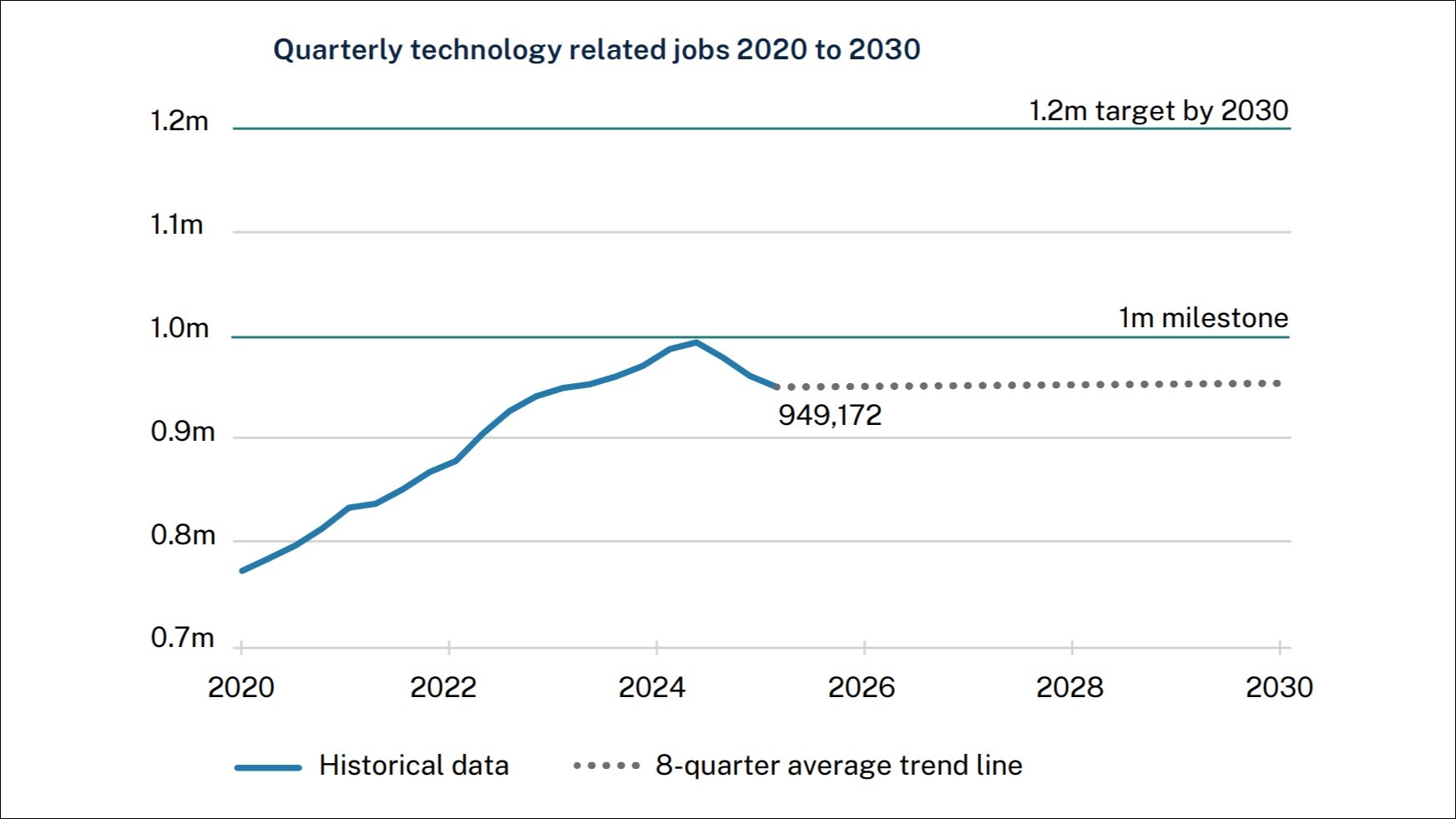
The Department of Industry, Science and Resources says tech jobs have dropped in the last three quarters. Image: DISR / Supplied
Australia 'must invest in people'
While various organisations have defined and measured Australia’s technology sector in different ways, the Australian Computer Society (ACS) — the publisher of Information Age — had forecast that the nation would reach 1.2 million tech workers by 2030.
The society’s latest Australia’s Digital Pulse report, produced annually by Deloitte Access Economics, suggested Australia would have almost 1.48 million tech workers by 2035.
ACS CEO Josh Griggs said DISR’s latest numbers showed Australia “must invest in people as much as in technology”.
"Developing Australia’s technology talent pipeline requires a coordinated, long-term approach,” said Griggs, who added ACS hoped to inspire students to pursue technology careers.
“We also support tech-adjacent workers transitioning into digital roles and help existing professionals continually upskill as technologies evolve as every business is a tech business,” he said.
Tech Council of Australia said it was “closely analysing” the latest tech job figures.
“While there has been some fluctuation, the tech sector continues to be one of the fastest growing sectors in Australia and we remain optimistic that the 1.2 million jobs goal by 2030 is achievable,” a spokesperson told Information Age.
“Achieving this goal will take continued collaboration between government and industry and that means improving pathways to tech careers, building digital skills across the economy and making sure businesses can access the talent they need.”
A spokesperson for the Minister for Industry, Innovation, and Science, Tim Ayres, said the federal government was “committed to giving Australians the skills they want, for the jobs we need – especially in tech-related roles”.
“Since the Albanese Government’s Free TAFE program started in January 2023, there have been more than 65,000 enrolments in technology and digital sector courses,” they said.
“In addition, our Building Women’s Careers program has funded several partnerships aimed at growing the tech workforce.”
ACS’s latest Australia’s Digital Pulse report found realising a potential $25 billion economic boost over the next decade partly required addressing digital skills gaps and upskilling non-tech workers.
“A range of initiatives” were in place to give Australian workers the skills to take on technology-related jobs, DISR said.
These included diversity in STEM initiatives and programs focused on AI, quantum, and emerging technology graduates.
Job cuts hitting tech workers
Technology workers have recently faced job cuts at large corporations such as Amazon, Intel, Microsoft, and Telstra, while several major Australian banks have faced criticism for redundancies which have included tech-related roles.
Australia’s national science agency CSIRO is also expected to lose hundreds of staff this year.
Some employers have also reported hiring fewer entry-level workers amid the rise of more capable generative AI technologies.
Federal agency Jobs and Skills Australia has suggested such technologies have “a greater capacity to augment work than automate work”.
It found roles in data entry, record-keeping, accounting, and communications were among the most vulnerable to potential automation.
Australia’s overall unemployment rate has risen since mid-2022, and reached 4.5 per cent in September — the highest seasonally adjusted unemployment rate recorded since November 2021.
The nation’s service industries — those not directly related to producing physical goods — have driven almost 90 per cent of employment growth over the past decade, according to Jobs and Skills Australia.