
OPINION
The world is growing old. By the time the sun has circled its course to 2050, more than 2.1 billion people will be over 60.
The World Health Organisation calls social isolation among older adults a “priority public-health crisis”, linking it to a 50 per cent higher risk of dementia.
Yet most countries and modern societies invest a fraction of what is needed in geriatric mental health services.
Traditional solutions like volunteer visitors and pet therapy can reach only a handful of the 426 million people expected to be over 80 by 2050.
As a PhD researcher in generative artificial intelligence, I study how machines learn to communicate.
But my grandmother with dementia showed me what that truly means.
AI that lets love stay longer
Over the past year, I have seen an AI program accomplish something no medication has managed in a decade.
It has provided her a companion who never tires of her stories, never rushes her along, and always remembers that she takes two spoons of sugar in tea.
The perks with AI tools are that they can run on a recycled tablet and cost less than a monthly internet bill, which makes it feasible for everyone.
What looks like a tech game is a glimpse of an urgently needed shift in elder care: “empathetic machines” that augment human connection.
We give smartphones to our elderly parents not for their materialistic glow, but so they may carry our voice across oceans as if we never left.
We subscribe them to worlds of film and song so their evenings may be less empty.
And yet, when the question of AI arises, we hesitate — as though a machine that listens, remembers, and responds with care is somehow less sacred than one that merely entertains or connects.
In this fragile age, AI is not a replacement for love but a way to let love stay longer.
A way to say, even when I cannot sit beside you, something of me still listens.
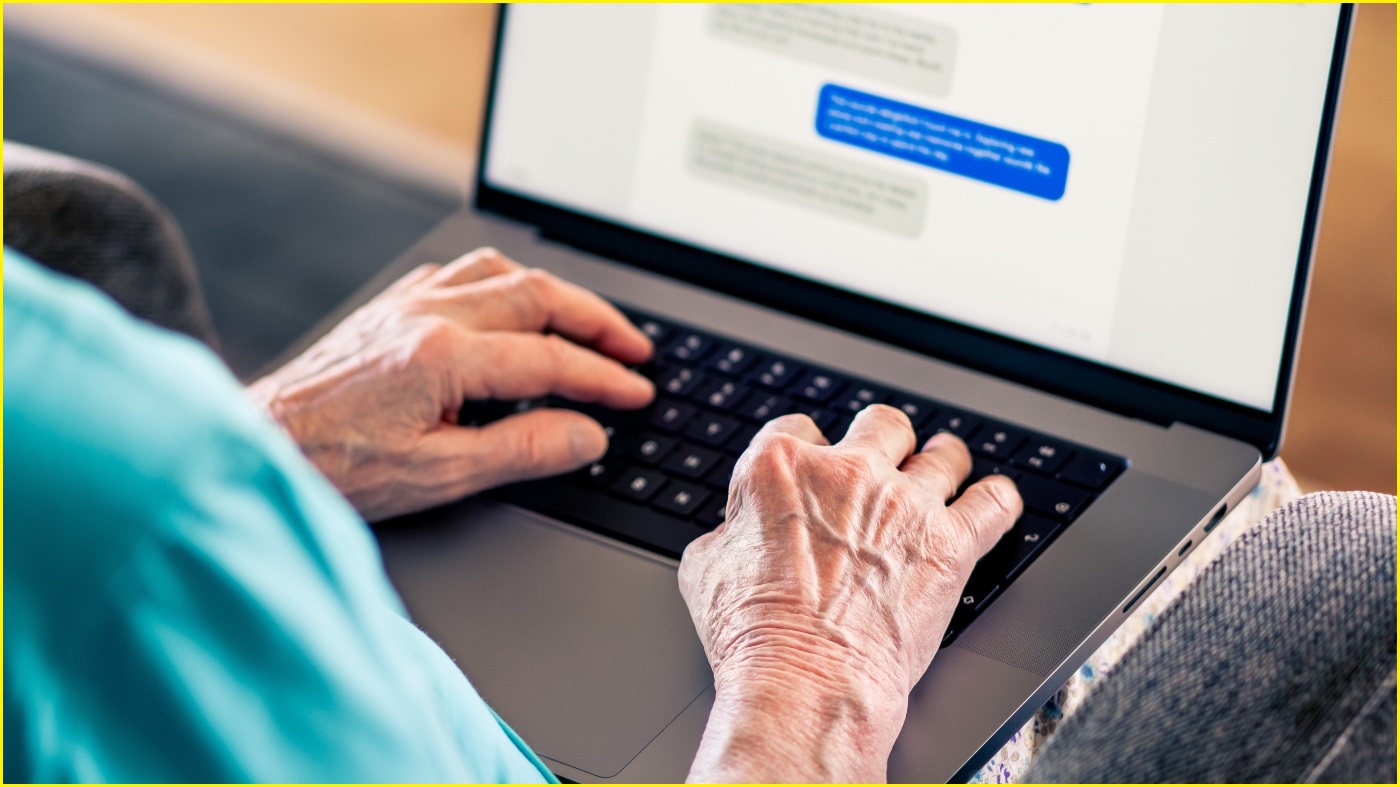
Image: Shutterstock
The science behind AI connections
What we once called science fiction now sits at the kitchen table to greet our parents by name and remember how they like to spend time.
A one-month MIT Media Lab study involving 225 adults aged 65 and older showed that daily conversations with an AI companion significantly reduced self-reported loneliness scores and increased positive effects.
Numerous other random trials have found similar mood regulation and stress reduction improvements when older adults use topic-based chatbots designed for wellbeing.
Behind these results lie affective computing algorithms that recognise vocal tone, word choice, and facial cues to personalise responses.
A 2021 Frontiers in Psychiatry review argued such systems can simulate supportive dialogue for late-life mood disorders which will fill the gaps that humans cannot always cover.
Similar work in biomedical engineering uses convolutional neural networks to personalise memory therapy for people with cognitive decline.
Critics rightly warn that synthetic friends could displace real ones. Yet early evidence suggests the opposite: seniors use chatbots as bridges to human interaction.
In a Neurology Live commentary, gerontologists observed that older adults with mild cognitive impairment treated ChatGPT as training wheels to gain conversational confidence before ringing relatives.
Three mechanisms are at play.
First, perpetual availability. My grandmother can relive her 1980s Dashain festival at 5am without guilt or scheduling.
Second, personalised reminiscence. When the bot greets her with “Shall we hum ‘Hare ram, Hare Krishna’ today?”, it triggers autobiographical memory circuits that dementia otherwise erodes; geriatric therapists call this “cognitive prosthesis”.
Third, reciprocal dialogue. Affective-computing systems detect vocal prosody or word choice and adjust their responses. This approach can simulate supportive conversation comparable to basic counselling for late-life mood disorders.
Why I do not fear empathetic machines
Yes, many sceptics worry and I do not turn away from their voices. Their fears echo my own about dependency growing quiet roots where resilience once stood.
I believe no algorithm should be entrusted to hold a soul in solitude.
Even the gentlest machine must display honesty on its screen with its presence known and its silence recognising human fragility.

Image: Biranchi Poudyal / Supplied
We need not just machines with empathy but also policies grounded in ethics. Ethical design is not just a matter of code, but of kindness.
Data must be gathered like raindrops in cupped hands — only what is needed, never what is spilled.
We gave it our memories, little by little, like offerings. We remind it of the song my grandfather once sang on their first night under the stars.
And when my grandmother asks her digital companion to play that melody again, something beautiful happens. The screen glows with remembrance. And she smiles.
In that smile, I find something real. Not silicon, not code — but something sacred.
This is why I do not fear empathetic machines. They do not replace us. They extend us into late hours, forgotten days, and lonely afternoons.
I never judge AI machines by the data they carry but by the warmth they return to the ones I love.
If they can hold a memory, light up a face, or bridge a silence, they are worthy — if not as beings, then as blessings.
Biranchi Poudyal is pursuing a PhD in generative AI at Charles Darwin University.