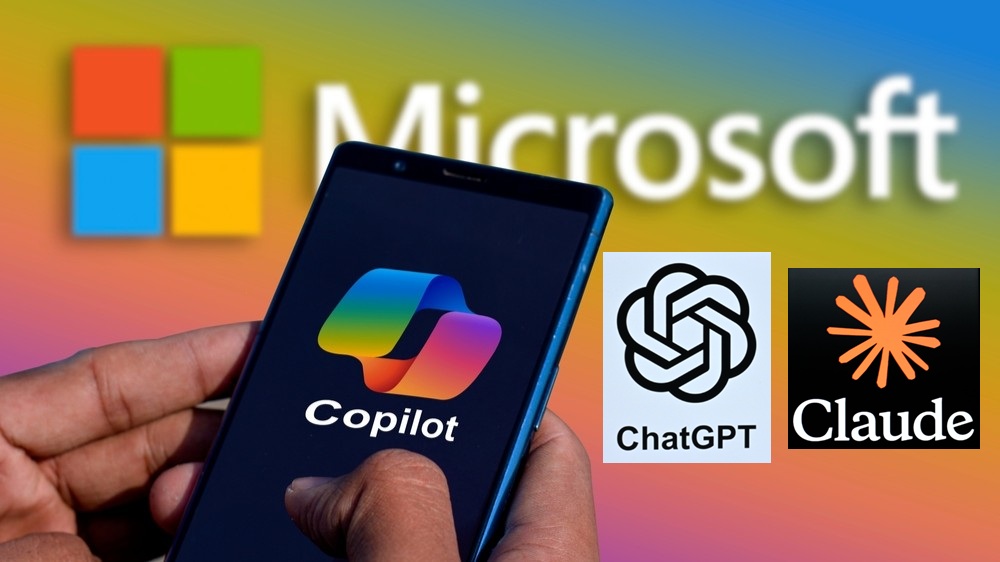

A partnership described as “one of the most consequential collaborations in technology” has become an open marriage after Microsoft, a longtime strategic partner of OpenAI, said it will add rival Anthropic’s Claude as a second large language model (LLM) for its Copilot system.
Claude will play a key role in Copilot Wave 3 – Microsoft’s “holistic reimagining of business,” Microsoft CEO for commercial business Judson Althoff said in spruiking what he called ‘frontier transformation’ based on “AI that delivers real business outcomes and growth.”
For Copilot Wave 3, Microsoft will integrate Anthropic’s Copilot Cowork into the Copilot ecosystem “to enable long-running, multi-step work that unfolds over time” – a core conceit of the new Agent 365 agentic AI tool and E7: The Frontier Suite that it will launch in May.
That reimagining will see Claude given equal billing with OpenAI’s ChatGPT, into which Microsoft has invested $18 billion (US$13 billion) in recent years as the two companies pursued a symbiotic technology agenda in an exploding AI industry.
Microsoft heavily favoured OpenAI, but Claude will now turn Copilot – which Althoff called “model diverse by design” – into an “open, heterogeneous environment” built on “leading models… operating openly across clouds and data services without locking customers in.”
“We will bring frontier capabilities with enterprise promises for our customers in an open and model diverse manner,” he continued, flagging an agentic AI surge that has already spawned over 500,000 agents inside Microsoft and “tens of millions of agents” at user sites.
Betting the house on AI agents
AI agents tap genAI’s capabilities to intelligently process data, manage workflows and create what research firm IDC recently called “a structural force of transformation”.
It believes 40 per cent of all jobs in the world’s largest 2000 companies will involve collaboration with AI agents this year.
The agents “can break down complex requests into steps, reason across tools and files, and carry work forward with visible progress and opportunities to steer,” Microsoft explained.
“Tasks are no longer confined to a single turn or a single app [but] can run for minutes or hours, coordinating actions and producing real outputs along the way.”
AI agents’ immense promise as a productivity tool makes the Claude deal more than just a whim for Microsoft, which like its rivals wants to strengthen its AI agents – and, it seems, has realised that diversity, not exclusivity, is key to relevance in the fast-growing market.
“We will bring frontier capabilities with enterprise promises for our customers in an open and model diverse manner,” Althoff said, arguing that “real differentiation comes from intelligence – deep work context, embedded in the tools people already use.”
It’s not me, it’s you
It’s not Copilot’s first dalliance with Claude: last September, Microsoft announced support for Claude Sonnet 4 and Optus 4.1 as options for customers using Microsoft Researcher or building agents in Microsoft Copilot Studio.
The latest deal elevates Claude’s status in recognition that technology, not just mindshare, will be crucial – a point that Anthropic pushed with a Super Bowl ad poking fun at OpenAI’s decision to put ads in ChatGPT, that boosted Anthropic’s user base by 11 per cent.
OpenAI’s decision to chase dollars came after years of debate – and a lawsuit from Elon Musk – as to whether it could transform into a public benefit corporation, which happened last October amidst a redefinition of OpenAI’s relationship with Microsoft.
That relationship began in 2019, was strengthened with further investments in 2021 and took on a completely different hue in 2023, when the relationship between Microsoft and OpenAI entered its “third phase” just weeks after ChatGPT entered the public consciousness.
The fourth phase began with a September joint statement and was expanded upon in an October manifesto with terms that “enable each company to independently continue advancing innovation and growth” as they both pursue artificial general intelligence (AGI).
This included the end of sharing certain IP, permission for Microsoft to “independently pursue AGI alone or in partnership with third parties”, and the right for OpenAI to contract with other cloud providers and develop “some products” with third parties.
Weeks later, Microsoft announced strategic partnerships with chipmaker Nvidia and Anthropic, which agreed to buy over $40 billion (US$30 billion) of capacity on Microsoft’s Azure cloud as it repositioned Claude to be delivered to Microsoft’s Copilot customers.
And then, in late February, the separation: while Microsoft and OpenAI “continue to work closely across research, engineering and product development,” the companies said, OpenAI “continues to have flexibility to commit to additional compute elsewhere.”
“The partnership was designed to give Microsoft and OpenAI room to pursue new opportunities independently, while continuing to collaborate which each company is doing, together and independently,” they added, as OpenAI secured $150 billion (US$110 billion) in new investment.”
“We remain committed to our partnership and to the shared mission that brought us together.”