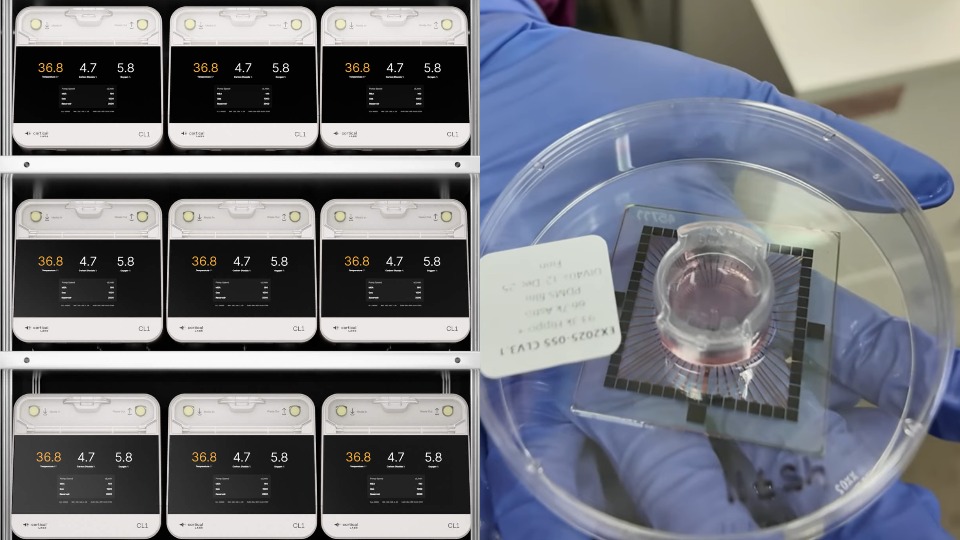

Millions of human neurons are powering a new data centre in Melbourne – the first in the world to be powered by living brain cells.
Launched on Tuesday by local startup Cortical Labs, the prototype ‘Bio Data Centre’ contains 120 of the company’s CL1 biological computers.
Each device contains around 200,000 brain cells, which are interfaced on silicon chips after donated blood is transformed into stem cells and eventually neurons.
Cortical Labs has built-up several racks of internet-connected CL1 devices since September 2025, which will now allow researchers and developers to tap into biocomputing, founder and CEO Hon Weng Chong told Information Age.
Following a brief testing period with a smaller number of CL1 units, the Bio Data Centre now powers the company's cloud business, Cortical Cloud, and will be a litmus test for how so-called ‘wetware’ computing could be used at scale.
The company has suggested biocomputing could one day provide a more sustainable way to run power-hungry workloads such as AI – and while the CL1’s computing power remains somewhat limited, neurons can be trained and utilised with a relatively small amount of energy and data.
Each CL1 uses 30 watts of electricity – “far less” power, Chong said, than graphics processing units (GPUs) used in traditional AI data centres, which can each draw thousands of watts at a time.
Biocomputing is “not meant to replace traditional silicon”, but Cortical Labs sees opportunities in physical AI systems such as drones and robots which require real-time operation and “are operating in the same real-world space that we are”, he added.
The technology offered the Australian government “a practical alternative to energy-intensive AI expansion”, Cortical Labs suggested in its press release.
The startup also plans to build a larger Bio Data Centre in Singapore with around 1,000 CL1 units and support from data centre operator DayOne, which Chong said would hopefully “start to take shape” around September 2026.

There are 120 CL1 devices in Cortical Labs's prototype 'Bio Data Centre' in Melbourne. Image: Cortical Labs / Supplied
First Pong, now Doom
Cortical Labs has previously trained its biological computers to play the classic video game Pong, but made headlines again last week after it revealed neurons in its CL1 systems had been trained to play the iconic first-person shooter game Doom.
The achievement came after the company opened its cloud infrastructure for early access previews in late 2025, including enthusiasts taking part in a hackathon run by Stanford University.
That’s when developer Sean Cole worked with the Cortical Labs team to teach neurons to play Doom “in a matter of days”, the startup said.
“When we saw that we were really excited, because that was what we had intended for the system to be for the longest time, and to see someone actually make it happen was very fulfilling,” Chong said.
“… What we really want to do is to actually empower the researchers out there with great ideas, with this technology, with this tool, so that they can take it and apply them to verticals and fields that we've never really thought about.
“So for instance, cybersecurity is one that people have started to look at using this technology.”
Cortical Labs’s chief science officer Brett Kagan said while the company’s neuron cells were able to play Doom, they were still learning how to do it well.
“Is it an esports champion? Absolutely not,” he said in a video announcement.
“Right now, the cells play a lot like a beginner who's never seen a computer – and in all fairness, they haven't.
“But they show evidence that they can seek out enemies, they can shoot, they can spin – and while they die a lot, they are learning.”
Keeping cells alive in the real world also remains a key bottleneck in biocomputing and is often “laborious and time-consuming", Chong said.
“So in order for the cloud to really work, what we've had to do is work on what is essentially plumbing – how do you plumb the nutrient and the waste removal of these neurons?”
The company has to swap out CL1 tubing every “five to six months” because of this, but has kept cells alive “for 500 days with no issues”, Chong added.
Sydney researchers’ new AI chip runs on light
Researchers at the University of Sydney also announced on Tuesday that they had designed and fabricated an ultra-compact prototype chip for AI processing which uses light for computational processing instead of electricity.
The chip uses photonics – the science of light – to process information almost instantaneously, and also without the large amounts of electricity and heat seen in traditional GPUs.
Nanostructures within the chip perform calculations through a neural network which mimics human neurons, according to the researchers’ peer-reviewed paper in Nature Communications.
These nanostructures are roughly the width of a human hair and perform calculations in trillionths of a second, due to the speed of light.
The chip has a “high computational density” of 400 million trainable parameters in each square millimetre, said the researchers, who argued their approach could be scaled “across high-throughput computing hardware, such as GPUs”.
The prototype chip was trained to classify more than 10,000 biomedical images such as CT and MRI scans, and was able to classify them with accuracy of between 90 to 99 per cent, according to the research.
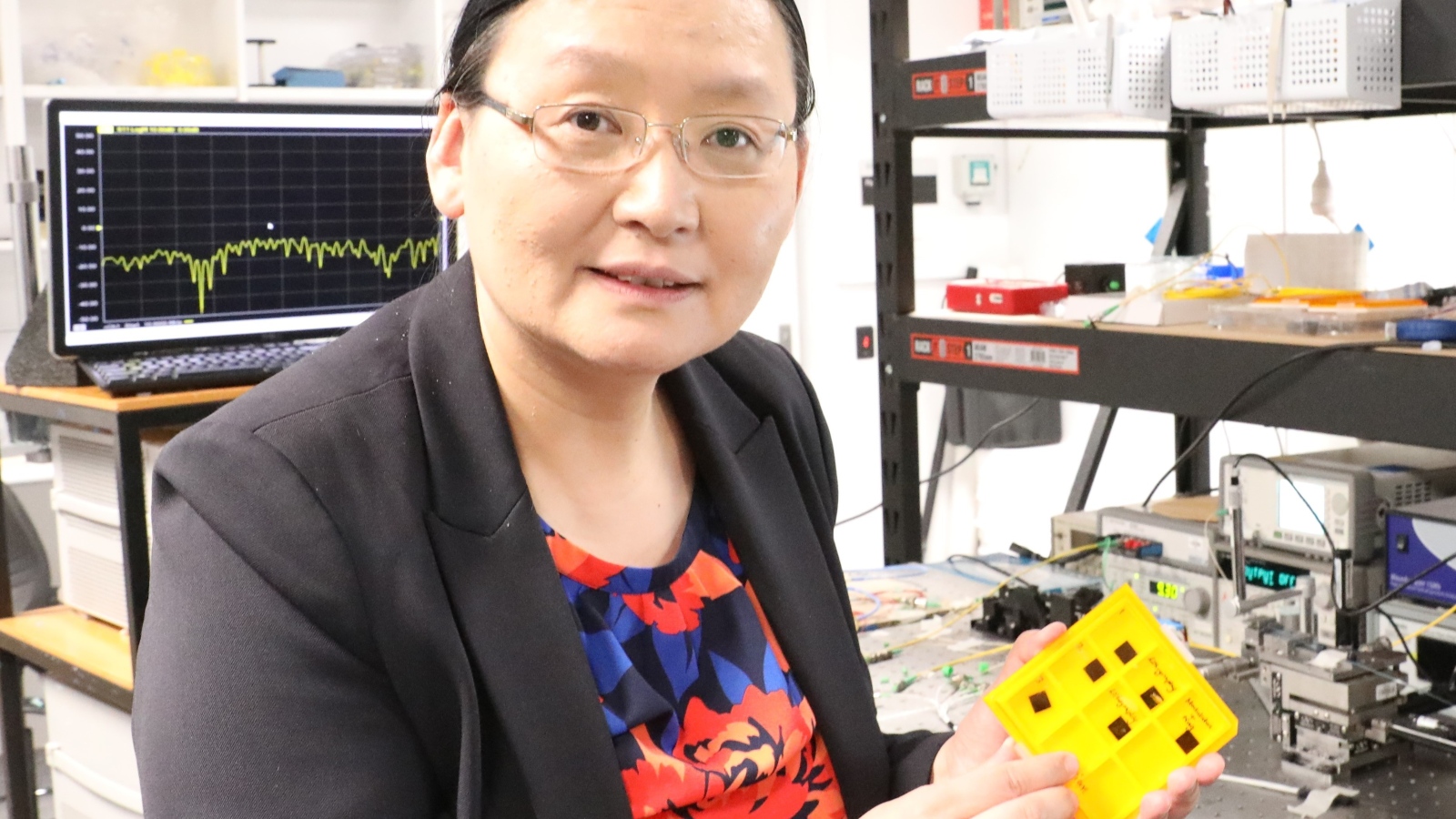 Professor Xiaoke Yi holds the prototype nano photonic chip. Image: University of Sydney / Supplied
Project supervisor and co-author Professor Xiaoke Yi from the University of Sydney told Information Age that while some electricity is required to generate optical signals and control the chip, photonic computing “has the potential to significantly reduce energy consumption compared with purely electronic approaches”.
Yi said her team’s design “aims to explore highly compact and energy-efficient optical AI hardware that could complement conventional electronic accelerators”.
There were still “several challenges” which needed to be addressed if optical computing was to become widely used, Yi added.
“For example, scaling photonic systems to larger neural networks, which is one of the directions we are actively working on," she said.
“However, rapid advances in silicon photonics are helping to address these challenges.”