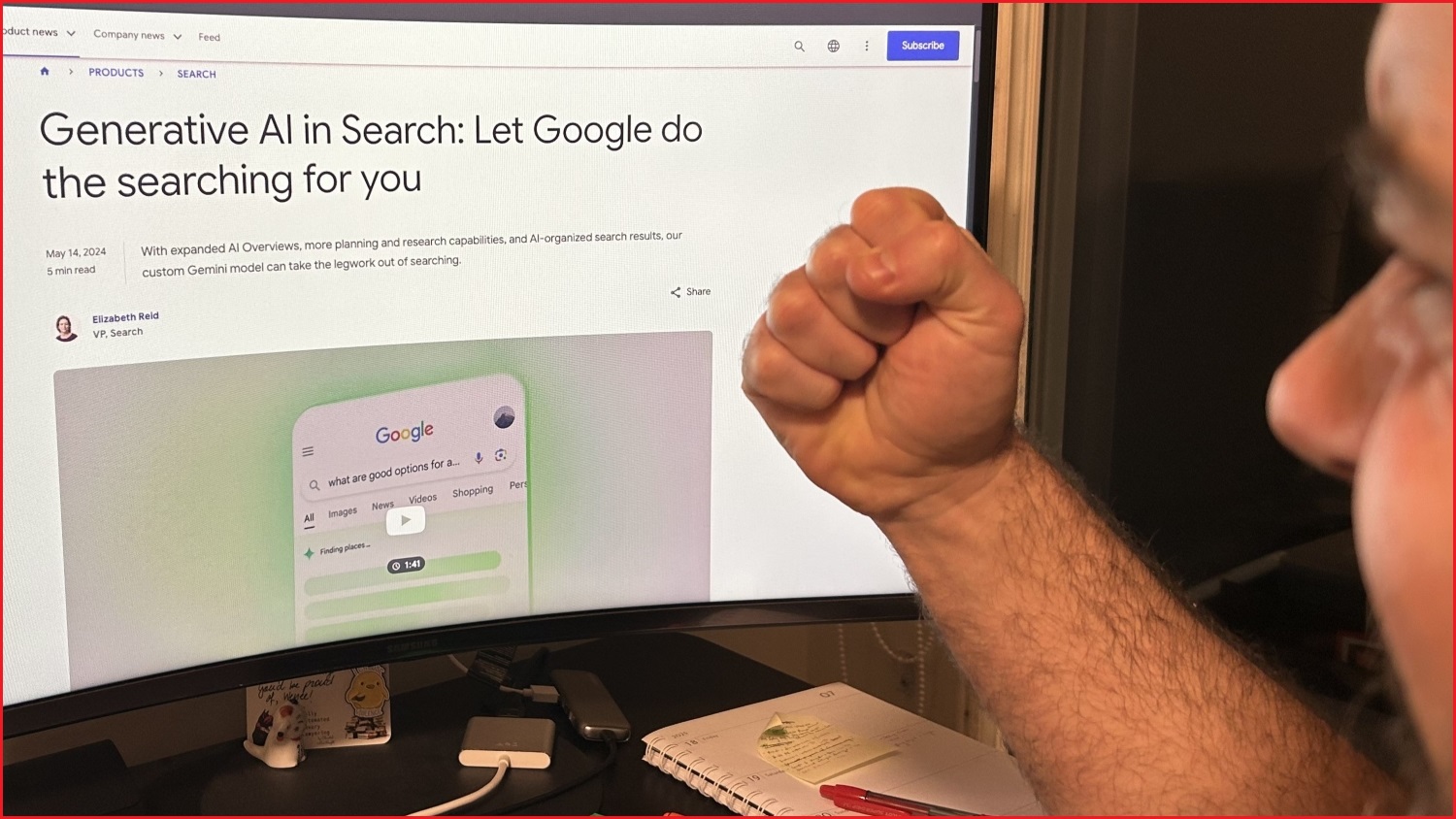

When 37–year-old Sydneysider Thomas was told his job at a finance technology startup was being made redundant, the reason was far from a typical one — it was because of Google.
More specifically, it was the technology giant's increasing use of generative artificial intelligence (genAI) within the world’s most popular search engine.
Google Search's new AI Overviews feature, which launched in Australia in October 2024, uses genAI to summarise web pages and provide AI-generated answers to some user queries.
What began as an experiment is now appearing on many Google searches, reducing the usual flows of internet traffic to some websites in the process.
“What was explained to me was that in the advent of Google’s AI Overviews feature, our SEO traffic had plummeted,” Thomas tells Information Age.
SEO, or Search Engine Optimisation, is a set of techniques websites have used for decades to gain prominence on search engines; being among the top results on Google can do wonders for website traffic.
Thomas says his team “attempted to make several pivots” when they noticed the number of people visiting their website was falling.
“But the bottom line was that users no longer had a reason to click on a website”, he says.
“That obviously led to a decline in website traffic, which led to a decline in revenue.”
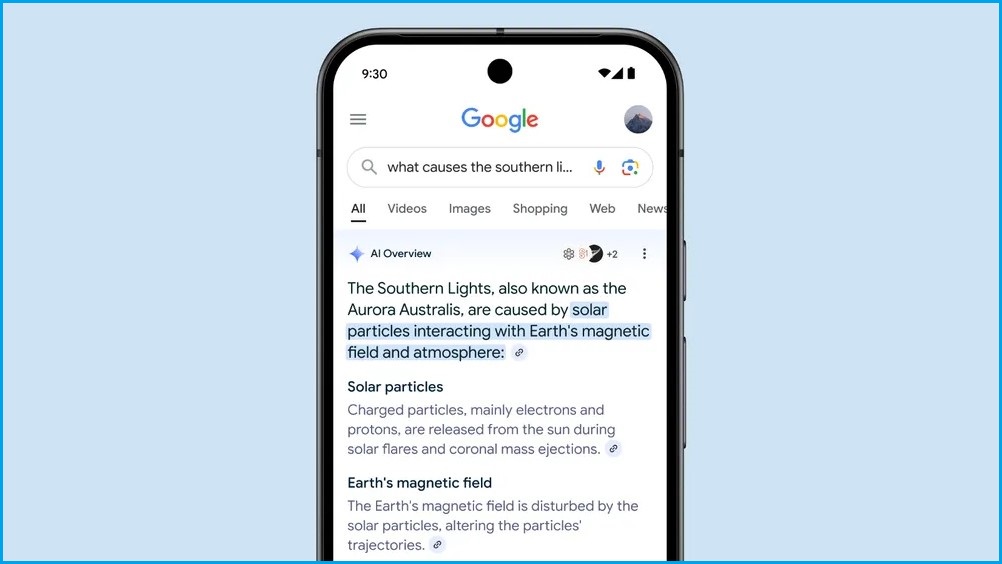
Google says over two billion people use AI Overviews each month, across more than 200 countries. Image: Google / Supplied
Thomas once led a team of three freelance writers creating articles and blog content for his employer's website, using SEO techniques to help reach new potential customers through search engines.
The company reduced the team to two freelancers following the meteoric rise of OpenAI’s ChatGPT in late 2022, Thomas says, with the two remaining writers asked to use the popular large language model (LLM) to augment their writing work.
The company later decided to stop employing the writers altogether, and told Thomas in July that he was being made redundant too.
Despite the redundancy, Thomas says he was not entirely surprised by his bosses’ decision to cut his role, and he has “no ill will” towards them.
“They just mentioned the AI landscape was changing faster than anyone could really account for at the moment,” he says.
More than two billion people now use AI Overviews each month across more than 200 countries, according to Google.
As its use grows, its impact on some websites’ traffic is becoming increasingly clear.
“It sort of feels like somebody's written a novel and thanked us in the acknowledgements — which is very flattering— but we also don't receive any commission from the sale of that book,” says Thomas.
AI Overviews hurt traffic, study finds
Figures published in May by American thinktank the Pew Research Center found Google Search users were less likely to click on links when they were presented with an AI Overview, according to data from 900 adults in the United States.
While 15 per cent of users clicked a link from Google's usual search results when they were not given an AI summary, only eight per cent clicked them when presented with an AI Overview, researchers found.
“Google users who encountered an AI summary also rarely clicked on a link in the summary itself,” they added.
“This occurred in just one per cent of all visits to pages with such a summary.”
What’s more, users who saw AI Overviews were found to be more likely to end their entire browsing session after receiving the summary, compared to those who did not.
Experts have also raised concerns about using genAI to summarise search results, given the technology can struggle to identify correct information and sometimes make things up in a phenomenon known as ‘hallucination’ — like when AI Overviews told users to eat rocks and put glue on pizza.
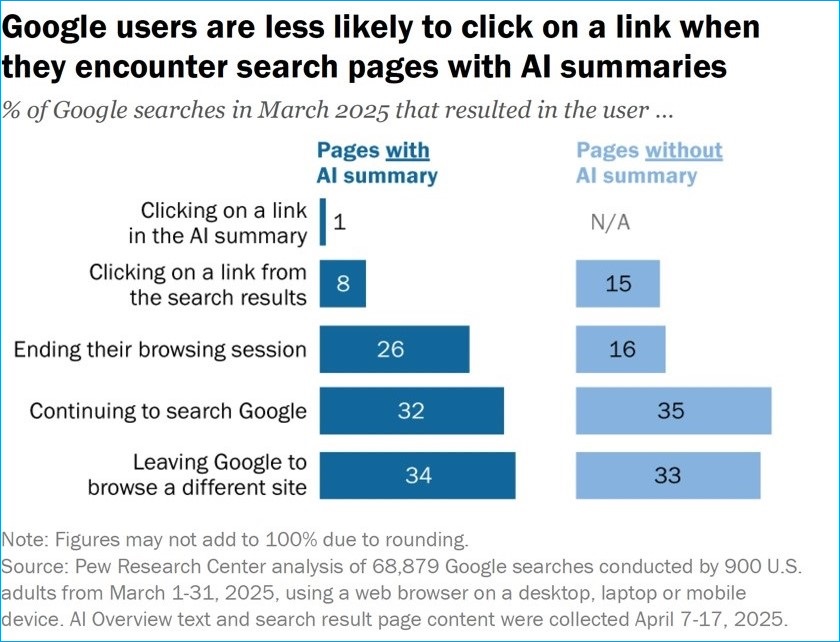
Image: Pew Research Center / Supplied
A Google spokesperson said the company had not seen “significant” drops in traffic to websites listed in Google Search since the introduction of AI Overviews, and argued the Pew study used “a flawed methodology and skewed queryset that is not representative of Search traffic”.
“We consistently direct billions of clicks to websites daily and have not observed significant drops in aggregate web traffic as is being suggested,” Google said in a statement to Information Age, adding that "people are gravitating to AI-powered experiences, and AI features in Search enable people to ask even more questions, creating new opportunities for people to connect with websites".
Thomas says the Pew Research Center findings that genAI can hurt traffic mirror what his counterparts at other companies say they are experiencing, but he admits there is “some truth to Google’s claims about an improved user experience”.
“It's a daunting shift, but the reality is that users want to find quality search results as effortlessly as possible,” he says.
“AI Overviews seems to be serving that purpose, which means it falls to us to find new growth channels.
“After all, 30 years ago SEO didn't even exist in a mainstream format.
“Can you guess how I confirmed that date? That's right — AI Overviews.”
The head of Google Search, Elizabeth Reid, wrote in May that people who used AI Overviews were “happier with their results” and searched more often.
“In our biggest markets like the US and India, AI Overviews is driving over 10 per cent increase in usage of Google for the types of queries that show AI Overviews,” she said at the time.
Google Search and its related products saw a 12 per cent increase in revenue in the second quarter of 2025 compared to the same quarter the previous year, according to filings from Google’s parent company Alphabet.
Locally, the Australian Competition and Consumer Commission (ACCC) has found Google receives around 90 per cent of internet searches in Australia, despite the company claiming it does not dominate the local search market.
How do we ‘define ourselves’ in an AI world?
Thomas says he experienced “somewhat of an existential crisis” in the weeks before his redundancy, as he pondered what the rise of genAI might mean for the future of work.
“I had already started to question my role as a professional, but then also, I suppose my role as a human,” he says.
“If AI evolves to a point where it can perform better than humanity at any task — and humanity has historically derived meaning from creating value in some way, shape, or form — then how do we define ourselves?
“We have the relationships that we form, we have the people we love and nurture, but creating value is a core part of our identity.”
Thomas says the introduction of Google's AI Overviews meant users often 'no longer had a reason to click on a website'. Photo: Supplied
Thomas says he has seen various technologies, forms of media, and distribution channels — including the marketing world’s focus on SEO — “rise and fall a few times” throughout his career, with each change bringing unique challenges and opportunities.
“I feel like my profession, specifically, was quite susceptible to AI disruption,” he says.
“Other professions, to my understanding, won't be for the immediate future.
“But this could also create opportunities — just in the same way that search disrupted print media but created opportunities for print professionals, right?”
Jobs in communications are among the occupations with the highest exposure to potential AI automation, according to a study released in August by government agency Jobs and Skills Australia.
The week following the report's release, Minister for Industry, Innovation, and Science, Tim Ayres, told the 2025 TechLeaders summit that generative AI may lead to “some displacement in the labour market”, much like previous waves of technological change.
“But it’s also true that there’s no going backwards, and that going backwards itself leads to disinvestment and poorer outcomes in terms of good quality jobs,” Ayres said.
Thomas says it is clear genAI is "a new, easily accessible tool that from an employer's perspective can't be ignored".
“I do think that probably will lead to shrinking workforces with the passage of time, and I think it could well have an impact on entry-level roles — and it could well bolster the productivity of mid-level and senior employees," he says.
Google receives more than 90 per cent of internet search queries in Australia, according to the ACCC. Image: Shutterstock
Can you teach an old dog new AI tricks?
The internet’s decades-long focus on SEO has already begun to shift to techniques dubbed AEO (Answer Engine Optimisation) and GEO (Generative Engine Optimisation).
Instead of websites tailoring themselves to please the needs of traditional search engines, they are increasingly trying to get noticed by — and linked within — genAI search engines and chatbots.
For Thomas, his experience has left him weighing up which skills will be in demand in an increasingly AI-centric world.
“I oscillate between spending my time trying to upskill in AI and become an AI savvy professional, and wondering if maybe I should re-qualify as a park ranger or a sheep shearer,” he says, half-jokingly.
“I suppose it’s part of my own soul-searching journey at the moment, which is questioning what makes the most sense for me.
“But I am also aware that information is more accessible than it's ever been, and for a committed individual I think it is easier than ever to learn new digital skill sets.
“I suppose I'm trying to get back in the saddle, convince myself that you can teach an old dog new tricks, and just ensure that my mind remains receptive to the possibilities posed by AI.”