

Australian tech firms have laid off 4,450 workers so far this year, with every cut attributed to AI, according to a new analysis.
The findings reinforce concerns that the technology is eliminating jobs, though some argue AI is also creating new roles at an even faster rate.
In the first quarter of this year, 43 tech firms laid off 45,363 workers, according to a new analysis by RationalFX data analyst Alan Cohen.
Globally, Amazon alone cut 16,000 jobs, with “entire departments” either restructured or eliminated in favour of leaner, AI-assisted workflows, he said.
About 9,238 layoffs “have been linked directly to AI adoption, automation, or organisational restructuring tied to these technologies,” Cohen said, pointing to a shift towards “AI-assisted operations, where fewer employees are needed to manage increasingly automated workflows.”
The Australian layoffs – which include 2,000 job cuts at WiseTech, 650 at Telstra and 1,600 recently announced by Atlassian – highlight a “significant regional impact” due to “the concentration of cuts within a small number of major firms”, he noted.
“Tech layoffs in Australia are accelerating rapidly after a relatively quiet 2025,” Cohen added, noting the country now ranks second globally for tech job losses, with AI “cited as the primary driver behind all of these layoffs.”
Sydney ranked third globally – behind San Francisco and Seattle – in terms of the absolute number of jobs cut, and this is expected to grow throughout a year.
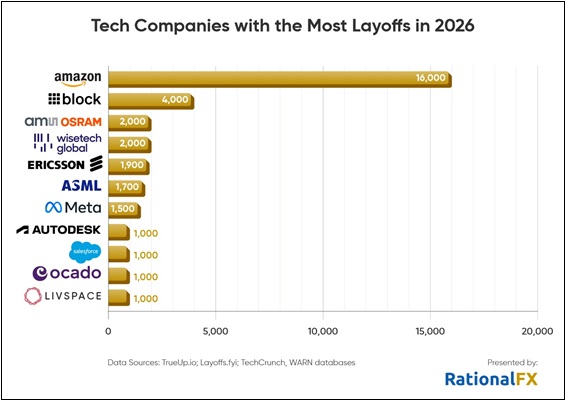
Cohen predicts the tech industry could lay off 264,730 people globally by year’s end – well up from 245,000 last year.
“Australian firms such as WiseTech and Atlassian are now part of this broader reshaping of the industry,” he said, “driven by economic pressures and strategic pivots toward new technologies, particularly AI and AI-driven automation.”
“What we’re seeing is not simply a cyclical slowdown, but a sector in transition, where firms are reorganising teams and resources in response to rapidly changing market and technology landscapes.”
AI is replacing the need for humans… or is it?
Analysts are closely watching how AI is reshaping the workforce.
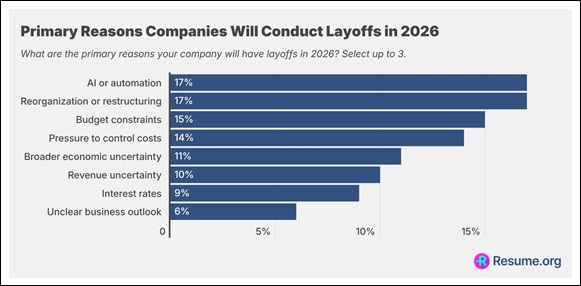
A recent Resume.org survey of 1,000 hiring managers found that 92 per cent of companies plan to hire this year, but 55 per cent also expect layoffs — with 44 per cent citing AI as the main driver.
“What we are seeing is workforce rebalancing,” said Resume.org head of career advising Kara Dennison. Companies are “laying off in areas that no longer align with near-term priorities while hiring aggressively in functions tied to revenue, transformation, and efficiency,” she said.
This kind of large-scale reorganisation has been signalled for years by tech leaders such as Amazon CEO Andy Jassy, who said last year the company’s workforce would shrink as greater use of AI and AI agents “should change the way our work is done.”
However, Amazon is also encountering challenges with AI-generated code. Shravan Tickoo, founder of Rethink Systems, said that after two major rounds of layoffs – totalling 30,000 roles – the company was forced to “deep dive” into changes driven by AI-assisted development.
According to Tickoo, Amazon experienced four critical “Sev-1” outages in a single week.
One incident led to a 13-hour AWS outage after an AI system deleted a live application environment due to having production-level permissions.
Another outage caused Amazon’s retail systems to crash for six hours.
“The biggest risk in AI is not bad code,” Tickoo said, but “leaders becoming arrogant enough to think experience is optional.”
“Amazon is now discovering what those AI optimism stats look like at the scale of a US$500 billion revenue company, with 30,000 fewer people left to catch the mistakes.”
Walking back AI-driven layoffs
Research firm Gartner has monitored AI’s jobs impact, with one survey of over 700 CIOs finding that by 2030, 75 per cent of IT work will be done by humans augmented with AI – and 25 per cent of all IT work will be done by AI without any involvement from humans.
This change will be particularly pronounced in entry-level jobs, where tech leaders have already seen AI reduce the need for junior workers – threatening traditional skills pipelines and diluting graduate employment opportunities.
A recent Snowflake study of 2,050 business and technology leaders in 10 countries corroborates Gartner’s optimism, finding that while half of ANZ organisations had cut jobs due to AI, 74 per cent said its introduction had actually created new jobs as roles and goals morphed.