

The first of seven portable, shipping container-sized AI data centres landed on Australian soil this month, as local startup WinDC prepares to place them at renewable energy hubs around the country.
The company, founded in 2019 by ASE Tech CEO Andrew Sjoquist, will deploy 11 megawatts of processing power across renewable energy sites such as wind and solar farms, including initial locations in New South Wales and Western Australia, it announced on Monday.
While that amount of power is much lower than seven traditional data centres could accomodate, bringing AI data processing closer to where renewable electricity is generated will help prevent energy from being lost in transmission lines or curtailed due to oversupply in the wider network, WinDC suggested.
"The localised consumption of electricity, as opposed to transmitting it long distances to metropolitan city-based data centres, reduces the demand and therefore investment required in electricity transmission networks – the grid,” the company said.
“Australia has the wind, the sun, and the land to be a genuine force in global AI infrastructure,” Sjoquist added in a statement.
“What has been holding us back is the grid.
“We identified that problem 10 years ago working alongside renewable energy providers on the east coast, and this is the solution we built."
Not completely ‘Made in Australia’ just yet
WinDC’s data centres are built in the United States and Europe by American computing company Armada, but both firms said they planned to shift production to Australia “once WinDC reaches a defined number of units in-country".
WinDC would not confirm exactly how many units it would require before bringing its data centre production to Australia, but confirmed to Information Age it was “in the dozens”.
The firm said it also hoped to attract global technology companies to carry out more of their AI computation in Australia, rather than in the US or Europe.
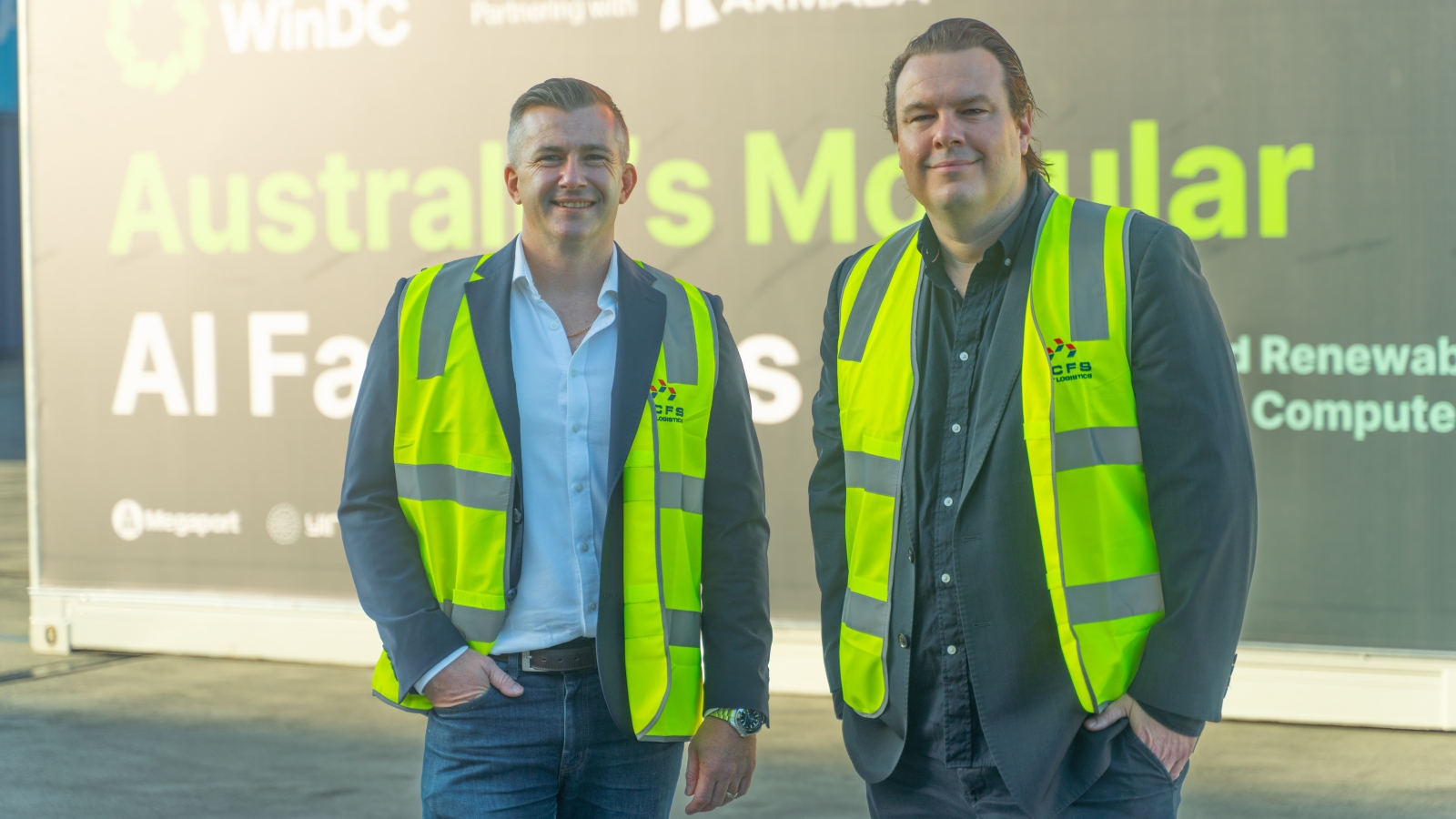
WinDC executive director Jonathan Staff (left) with founder and CEO Andrew Sjoquist (right). Image: WinDC / Supplied
Sjoquist suggested WinDC’s partnership with Armada aligned with the Australian government’s push "to ensure that the next generation of AI-ready infrastructure is not only deployed here, but increasingly built, integrated, and scaled from Australia itself”.
The deployment and operation of WinDC’s portable data centres will be managed by Armada, but will integrate WinDC’s software platform which “prioritises and manages the efficient use of renewable energy during operations”, the company said.
The data centres have a closed loop cooling system; can host a combination of graphics processing units (GPUs) and central processing units (CPUs); and can be deployed in around 90 days with internet connectivity from 5G, SpaceX’s Starlink, or fibre, WinDC added.
Armada co-founder and CEO Dan Wright argued centralised AI infrastructure such as data centres in major cities could not keep up with escalating computing demand.
“This partnership with WinDC enables sovereign AI factories to be built where energy is produced, delivering resilient, scalable compute without waiting on grid expansion in Australia,” he said.
The push for more efficient AI
Other Australian companies and researchers have also been developing ways to more efficiently power AI-based computing, as carbon emissions from domestic data centres continue to rise.
Local AI neocloud infrastructure company Firmus has pledged to pursue “transformative reductions in energy and water use” as it builds its down data centres around Australia with tens of thousands of NVIDIA GPUs.
The company has said it will have “facilities sited where renewable capacity already exists, reducing grid strain and transmission loss”.
This approach is similar to WinDC’s, but both companies are still at the relatively early stages of their infrastructure buildouts.
Meanwhile, researchers at the University of Sydney are designing more efficient AI chips which use light for processing instead of electricity, and a new data centre in Melbourne is being powered by millions of human brain cells which require much less energy than traditional computer chips.