





One in five Australian borrowers have used artificial intelligence to create or alter documents for a home loan application, including payslips and bank statements, new research has found.
According to a new report from research platform OurTop10, 18 per cent of surveyed Australians said they had used AI to either alter existing documents or create new ones for a mortgage application.
The research, based on an online survey of 1,018 Australian borrowers conducted through PureProfile, found that bank statements were the documents most commonly generated or modified using AI.
Employment documents were created or altered using AI in nine per cent of cases, while six per cent of respondents said they had used the technology to generate payslips or other proof of income.
In a small number of cases, Australians also used AI to produce documents showing competing lenders' interest rate offers.
The findings did not distinguish between borrowers using AI to prepare truthful documents and those deliberately falsifying information.
However, OurTop10 head of research Mansour Soltani warned that AI tools were “evolving faster than many lenders’ ability to detect false documents”.
“Some are still relying on legacy verification systems that weren’t built for this,” said Soltani.
“As AI improves, fabricated paperwork could become harder to spot, even for trained staff and automated checks.”
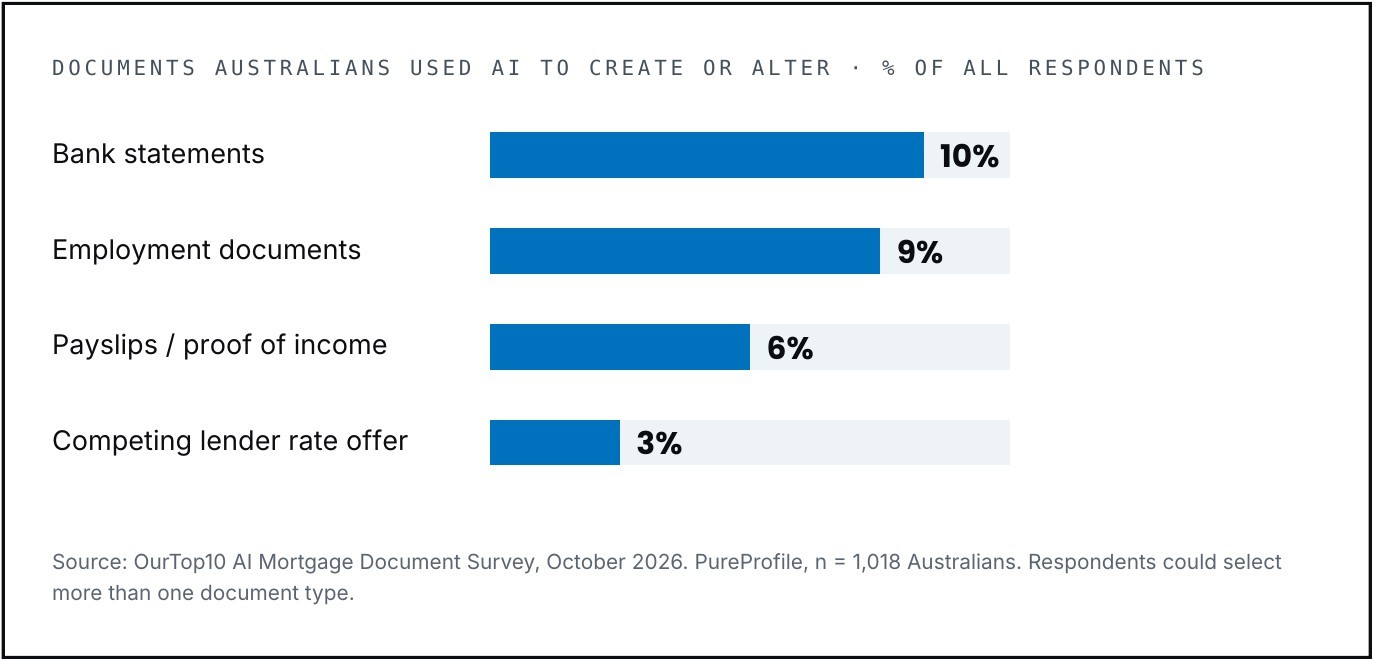
Research found bank statements and employment documents were most frequently crafted with AI. Source: OurTop10
OurTop10 also warned borrowers that altering documents such as payslips and bank statements amounts to fraud.
“If they’re caught, their application can be declined, their loan called in, or they could face criminal charges,” OurTop10 warned.
“And if it slips through, they may end up with a loan they can’t afford to repay.”
AI more prevalent among younger borrowers
Younger Australians were “far more likely” than older generations to report using AI to create or alter documents for a home loan application or negotiation.
According to the research, 56 per cent of Gen Z respondents (aged 14 to 29 years old) and 36 per cent of Millennials (30 to 45 years old) said they had used AI for this purpose, compared with 18 per cent of borrowers overall.
Bank statements and other financial records were the most commonly cited documents among younger respondents.
Karin Verspoor, dean of the School of Computing Technologies at RMIT University, told Information Age that AI tools had made manipulating digital documents easier than ever.
“Even though it has been possible for a long time to edit PDFs and even longer to manually produce realistic fraudulent documentation, in the past it has required specialist software or graphic design skills,” said Verspoor.
“People who might have contemplated it previously likely didn’t have the technical resources to make it happen.
“That has changed.”
RMIT professor of finance Angel Zhong said younger Australians' greater familiarity with generative AI did not necessarily explain why they were using it to manipulate mortgage documents.
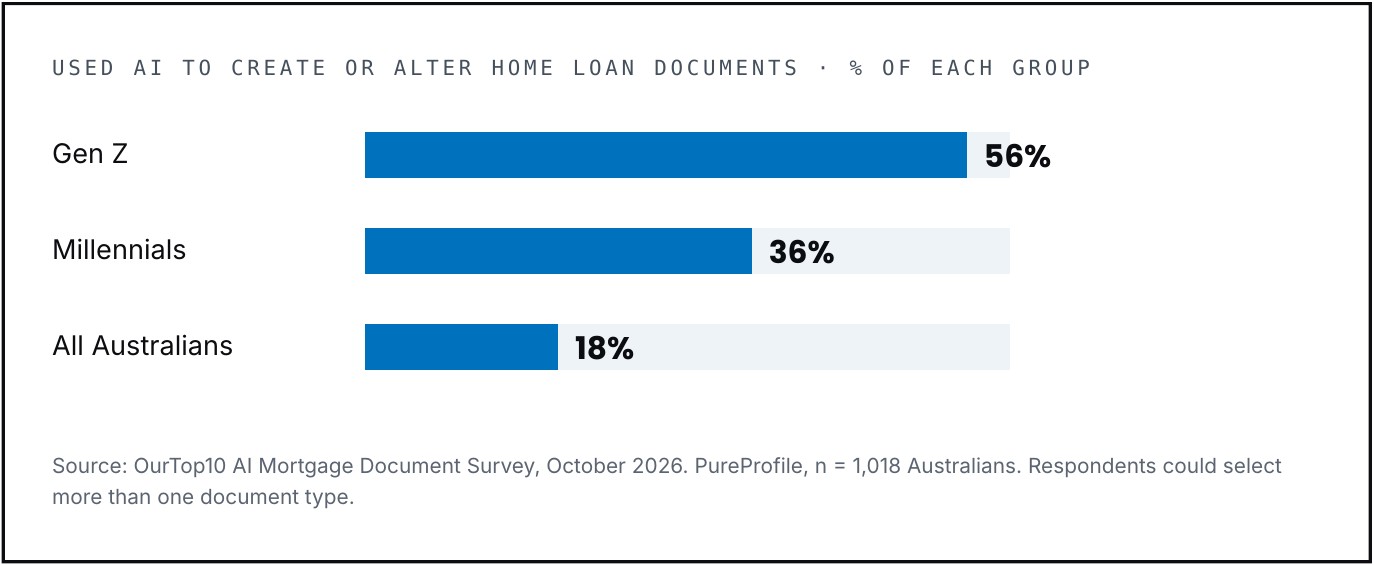
Younger borrowers were more likely to have used AI to manipulate documents. Source: OurTop10
“Gen Z and Millennials are trying to enter a market where prices have run far ahead of incomes, and higher interest rates have reduced how much they can borrow,” Zhong told Information Age.
“When the gap between what you earn and what you need to borrow feels impossible, some people will start to see an altered payslip as a shortcut rather than as fraud.”
Should the ATO share more data?
Soltani said the findings strengthened the case for secure data sharing between the Australian Taxation Office (ATO) and banks, provided borrowers gave their consent.
“That would let lenders verify declared income against an independent government source, rather than relying on a PDF that can be altered in seconds with AI,” said Soltani.
Zhong cautioned, however, that making access to tax information a condition of obtaining a mortgage would undermine the idea that data sharing was voluntary.
She also raised concerns about how the information might be used beyond income verification.
“The second [question] is scope creep: data collected to verify income shouldn’t be used for marketing, pricing or other purposes,” Zhong.
“The third is security, because any new pipeline for sensitive government data becomes a target.”
Zhong said a better approach would be a 'verify, don't share' model, in which lenders could confirm whether a borrower's declared income broadly matched ATO records without receiving their full tax information.
Banks uncover major mortgage fraud
The findings come amid growing concerns about mortgage fraud in Australia and the role AI is playing in making it easier to falsify financial documents.
In February, the Commonwealth Bank of Australia alerted authorities to a possible fraud racket that obtained approximately $1 billion in illegitimate home loans, including through the use of AI.
In August, Australia’s financial crimes watchdog AUSTRAC revealed that an analysis of data from 10 major Australian banks identified potentially hundreds of millions of dollars in suspected fraudulent loans, mostly linked to properties in Sydney.
AUSTRAC said the suspected mortgage fraud involved inflated incomes, misrepresented employment, and fabricated or unverifiable business activity used to support loan applications.
AUSTRAC chief executive Brendan Thomas said generative AI was now “widely used” to create or alter fraudulent documents, making them easier and potentially more convincing to produce.
“The banks see fraud regularly — the risk is not new, but advances in AI technology are making it easier to commit fraud at scale,” Thomas told Information Age.
“While AI may make it easier to generate false or misleading documentation, our focus remains on behaviours, risk indicators and vulnerabilities rather than the specific tools used to facilitate them.
“People applying for home loans must provide accurate and truthful information, whether they use AI or not.”