
Deceased actor Val Kilmer will be ‘starring’ in an upcoming feature film thanks to the use of generative AI.
Kilmer, known for his performances in The Doors, Batman Forever, and the Top Gun franchise, passed away last year after a long period of health problems.
Some ten months after his death, director Coerte Voorhees confirmed the late actor’s likeness will be reproduced for a role in the upcoming feature film As Deep as the Grave.
Five years prior to his passing, Kilmer was cast as Father Fintan – a role that would reportedly draw on his Native American heritage and ties to the US Southwest.
According to Variety, however, Kilmer’s battles with throat cancer left the star too ill to make it to set.
“He was the actor I wanted to play this role,” Voorhees told Variety.
“It was very much designed around him.
“He was just going through a really, really tough time medically, and he couldn’t do it.”
By using a purported state-of-the-art generative AI solution, Voorhees’ film will reportedly include a posthumous ‘performance’ with Kilmer’s physical likeness and a recreation of his voice.
Alongside Kilmer’s AI appearance, the film will feature Abigail Lawrie from Tin Star, Tom Felton from the Harry Potter franchise, Wes Studi from Avatar, and Abigail Breslin from Signs.
Family backs AI ‘performance’
As Deep as the Grave is based on a true story about Ann and Earl Morris, a pair of US archaeologists who traced the history of the Navajo people, including by investigating an 1805 massacre site.
Kilmer believed the film was an “important story that he wanted his name on”, according to Voorhees, while members of the actor’s family repeatedly told the director “how important they thought the movie was”.
“It was that support that gave me the confidence to say, okay let’s do this,” said Voorhees.
Kilmer’s likeness is expected to appear for a “significant part” of the film, though little has been made public on how involved the AI ‘performance’ will be.
The project will reportedly use Kilmer’s voice, family-supplied images of his younger self, and footage from his final years to portray his character at different ages.
“Despite the fact some people might call it controversial, this is what Val wanted,” the director said.
Can Kilmer consent?
Daniel Binns, senior lecturer in media at RMIT University, said Kilmer’s upcoming ‘performance’ raised some “genuinely complex” points surrounding consent.
He noted that after Kilmer’s voice was hampered by a tracheal procedure, the actor willingly adopted AI to digitally reconstruct his vocals for the 2022 film Top Gun: Maverick.
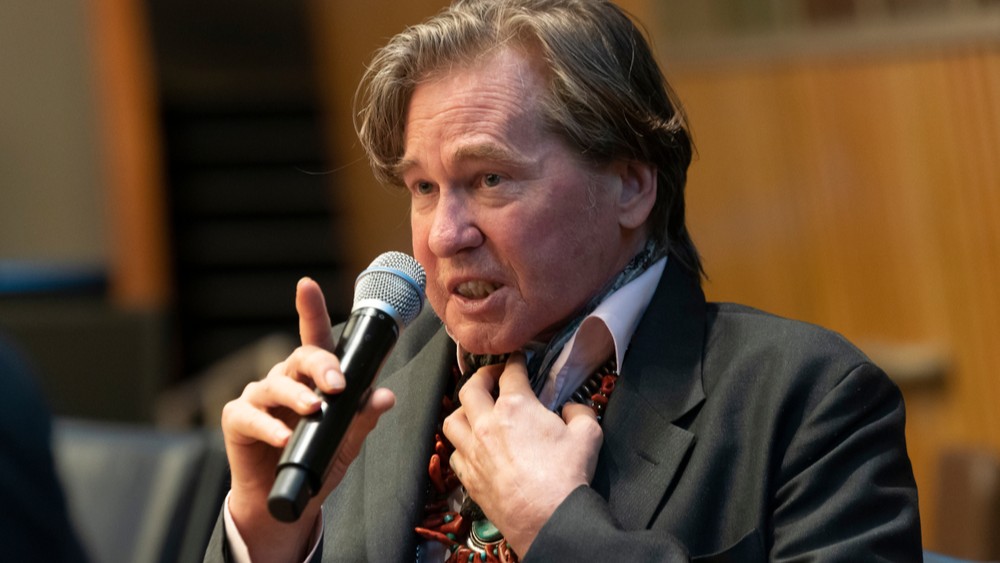
Val Kilmer relied on AI to digitally reconstruct his voice for Top Gun: Maverick after a tracheal procedure affected his vocals. Photo: Shutterstock
Given his family were also supportive of As Deep as the Grave, Binns said “this isn't a case of a likeness being exploited against a performer's known wishes”.
“But that's what makes this particular case ethically thorny,” he added.
“Family consent isn't the same as the performer's own consent, and it sets a precedent where the rights to someone's face, voice, and presence could be licensed – and exploited – indefinitely after death.”
Auditioning is hard, AI could make it harder
Nigerian-Australian actress Yinka Olorunnife said she was concerned the use of AI likenesses could impact job opportunities in the film industry.
“It is extremely competitive, and we already have issues with actors being exploited in other forms such as pay,” Olorunnife told Information Age.
“The use of AI likeness will only make things more difficult.”
Notably, Voorhees told Variety his team would normally “just recast an actor” but could not afford to “roll camera again”.
“We don’t have the budget,” he said. “We’re not a big studio film, so we had to think of innovative ways to do it.
“And we realised the technology is there for us.”
Olorunnife, best known for her role as the Weeper in the 2022 Hellraiser reboot, said the technology could also see production companies exploit actors by offering a “one-time lump sum to use their likeness in perpetuity”.
“At the most basic level, it means fewer work opportunities for already struggling actors and, at its worst, ongoing exploitation in regard to pay,” she said.
‘More like a portrait than a performance’
Melbourne-based film director and producer Justin Macawili said although AI has the potential to do “amazing things creatively”, he did not believe it could “replace humans”.
“A good performance is complex in its nuance and emotions,” said Macawili.
“It works in a lot of grey areas, which is something I think AI will never understand.
“If a director can’t bring a character into an actor and instead has to rely on celebrities that have passed to make money, I question their ability to direct.”
Binns said although the technology’s ability to reconstruct a person’s appearance and voice had “advanced enormously”, AI still had a critical shortcoming.
“What AI still can't generate is the thing that actually makes a performance work: the in-the-moment responsiveness to other actors, the accidents, the choices made under pressure on set.
“What you get with a fully AI-generated performance is essentially a very sophisticated composite of past Kilmer.
“This might be moving — might even be beautiful — but it's still a representation, more like a portrait than a performance.”
Voorhees and his brother John (the film’s producer) told Variety they hope the project will show how AI can be used ethically.
The brothers said the production relied on guidelines from the US actors' union SAG-AFTRA, and Kilmer’s estate had been compensated.
As Deep as the Grave is currently in post-production with no release date announced.