





OPINION
I recently joined a panel discussion with OpenAI on moving organisations from AI experimentation to measurable ROI.
One of the themes I spoke about was something I think we're at risk of overlooking in the rush to build AI capability:
AI doesn't make people smarter. It makes people more powerful.
The more organisations I work with, the more convinced I am that we're often getting the sequence wrong.
We start by teaching people AI: how to prompt, use the tools and automate tasks.
Those skills are useful, but AI isn't the underlying capability – it’s an amplifier of the capability that already exists.
Give a great salesperson, marketer, consultant or leader effective AI tools and the results can be extraordinary.
Give the same tools to someone who lacks the underlying capability and you may simply help them produce mediocre work faster.
So perhaps the question isn't just, "How AI-capable is our workforce?"
It's also: "How capable is our workforce before AI?"
AI is changing more than technical skills
The ACS Australia's Digital Pulse 2026 report, produced with Deloitte Access Economics, provides some interesting evidence for this.
Technology workers report that an average of 70 per cent of their work time is already affected by AI, compared with 45 per cent for professional workers and 37 per cent across the broader workforce.
But what I find more interesting is how work is changing.
More than half of surveyed workers said AI had significantly affected or transformed their data analysis and numeracy skills, creativity and innovation, and digital skills.
Almost half said the same of communication.
I think we've spent so much time talking about "AI skills" that we risk missing this broader capability challenge.
As AI becomes more powerful – judgement, critical thinking, communication and commercial capability don't become less important.
In many cases, they become more important.
AI capability isn't separate from human capability.
A strong business developer can use AI to research an account, identify opportunities, prepare for a meeting or pressure-test a pitch, but the technology doesn't give them the judgement to recognise the right opportunity or the relationship skills to pursue it.
The underlying professional capability still matters. AI simply gives them more leverage.
Access isn't capability either
While 84 per cent of Australian workers have used at least one AI tool, only 7 per cent demonstrate advanced AI literacy and more than half remain at beginner level.
Simply knowing that someone "uses AI" tells you very little about how capable they actually are.
Giving people access to ChatGPT or Copilot is not the same as developing their capability to use it well.
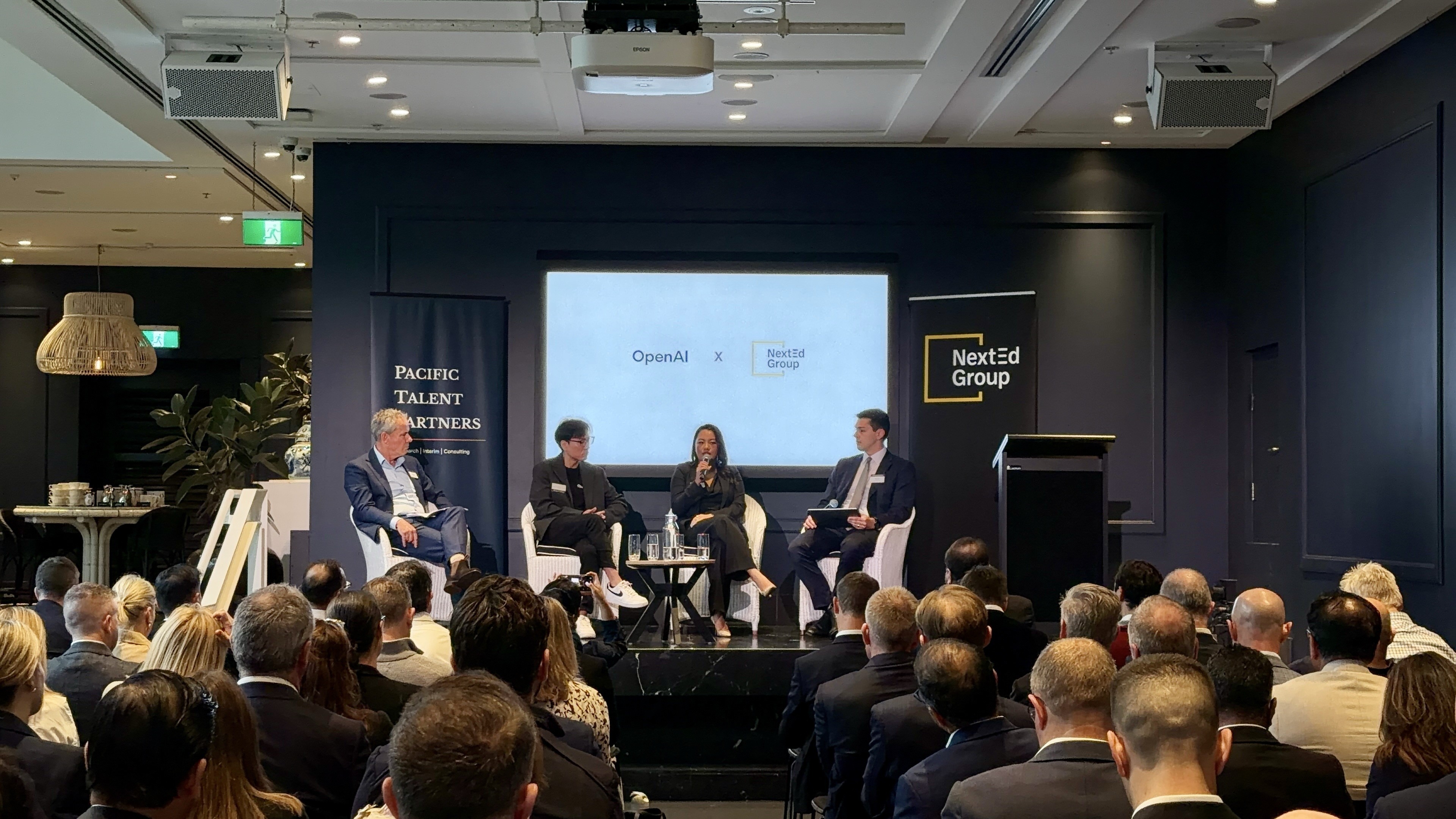
Lisa Qu spoke on a panel on moving organisations from AI experimentation to measurable ROI. Photo: Supplied
They need to know where AI adds value, how to assess its outputs, when human judgement should override it and how to use it responsibly.
That requires deliberate development.
Capability development doesn't happen by accident
Digital Pulse reports that two in five people who reskilled into a technology role did so within their existing organisation.
Universities and VET will remain critical, but when technology and jobs are changing continuously, more capability development inevitably needs to happen throughout people's careers and inside organisations.
That puts a greater responsibility on employers, and it doesn't necessarily mean sending everyone on more courses or Lunch and Learns.
Capability develops through learning, but also through practice, coaching, feedback, mentoring and opportunities to apply new skills in real work.
What matters is that it is intentional
Digital Pulse notes that 89 per cent of today's technology workers are employed in occupations that did not exist when ACS was founded in 1966.
I find that statistic reassuring – we’ve adapted to enormous technological change before.
The difference now is the speed of change.
At the OpenAI Executive Summit in Singapore in May, they shared that the time between major model releases has compressed from around 15 months to as little as six weeks.
We’re now facing what OpenAI describes as a capability overhang, where what AI is capable of is advancing far faster than our ability to use those capabilities.
We cannot assume people will simply keep pace with technology that is evolving this quickly.
We cannot assume they will become better critical thinkers because AI makes critical thinking more valuable or develop better judgement simply because they have access to more information.
And we cannot assume that putting increasingly powerful AI into everyone's hands will automatically make them better at their jobs.
Capability development doesn't happen by accident. The technology is accelerating. Human capability must be deliberately developed alongside it.
The organisations that create sustainable advantage from AI won't necessarily be those with the most tools or even the highest adoption.
I think they'll be the organisations that understand what makes their people great at what they do, deliberately develop those capabilities, and then give them AI to amplify them.
Because ultimately, AI doesn't create a capable workforce.
Capable people create value with AI.
Lisa Qu is a member of the ACS AI in Society Technical Committee.