
Authorities at Queensland’s City of Moreton Bay are eagerly awaiting the results of an upcoming trial of AI-powered traffic lights that they expect will dramatically cut red light wait times for motorists and better prioritise traffic for buses, cyclists and others.
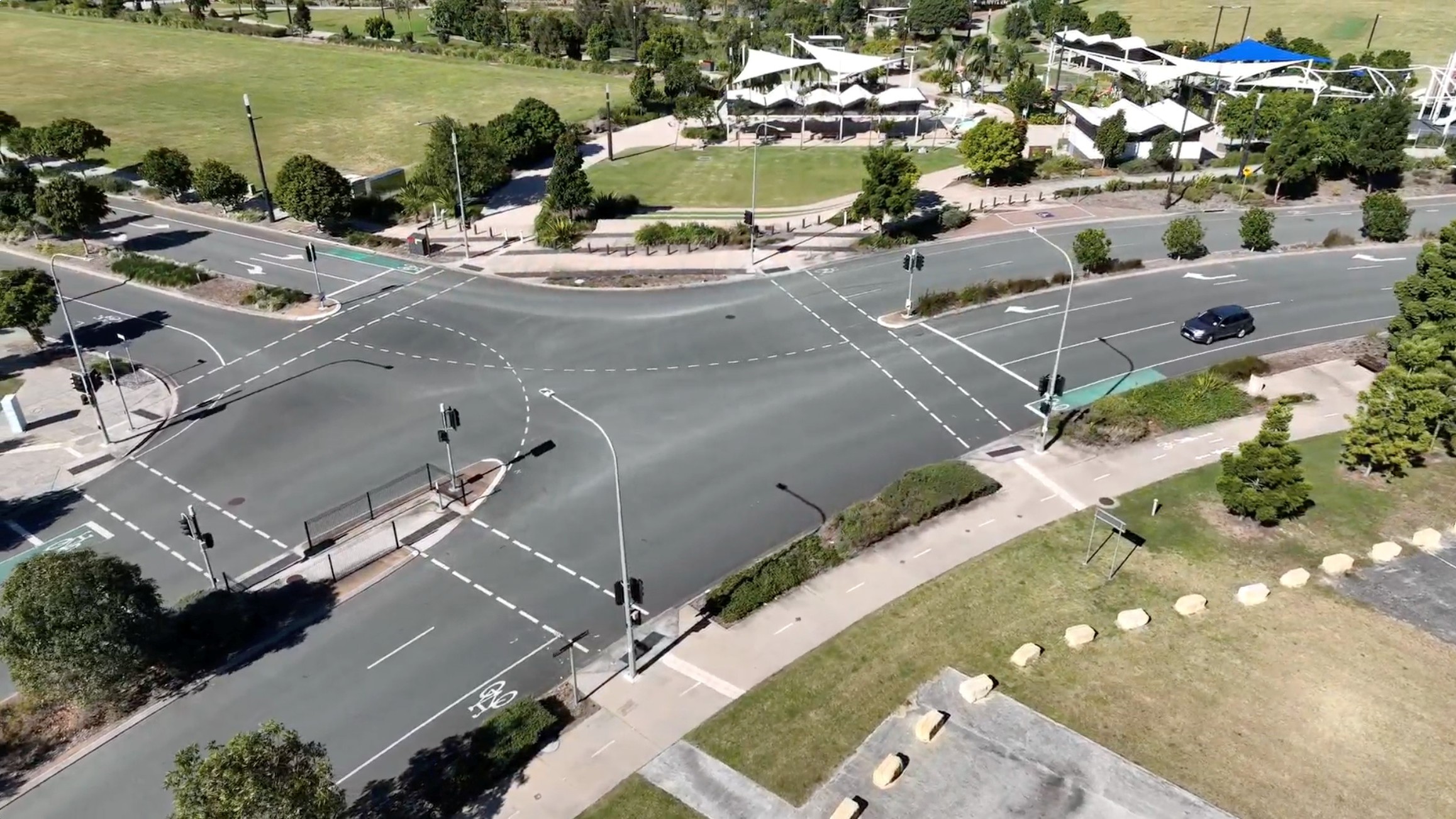
Set to be installed at the intersection of Moreton Parade and Paper Avenue – the access road to the carpark for the University of the Sunshine Coast’s Moreton Bay campus at Petrie – the new technology is set to go live later this year.
Whereas conventional traffic controllers work on time-based schedules and don’t account for changes in traffic volumes – a problem that can leave drivers queued at red lights while nobody crosses the other way – the AI lights take a different approach.
By using CCTV cameras and LiDAR sensors, the new Next Generation traffic signalling technology – which is being supplied by Swarco – involves the installation of CCTV video cameras and LiDAR sensors that map the intersection in 3D.
Purpose-built AI algorithms analyse real-time traffic flows, tweaking signal durations to reflect actual conditions in a move that the company says can reduce wait times by more than 10 per cent while reducing emissions and improving safety.
The Sunshine Coast trial is Australia’s first implementation of technology that has already been successfully installed in cities like Washington, D.C.; Helmond, The Netherlands; Tampere, Finland; Montevideo, Uruguay; and several cities in the UK.
The technology – which will reportedly cost around $170,000 to be installed at the trial site – “has the very real potential to improve the flow of traffic around our road network,” City of Moreton Bay mayor Peter Flannery said as the new trial was announced.
“There is the potential to substantially reduce the time motorists spend unnecessarily sitting at red lights, which is often constrained by legacy traffic control methods and can be extremely frustrating when there are no [crossing] cars in sight.”
Addressing a drag on productivity
The AI-based technology is a step change from current systems in which humans monitor traffic and adjust signal timing from central facilities like Queensland TMR’s Sunshine Coast Traffic Management Centre in Maroochydore.
Similar sites are running across Australia but struggle to limit congestion that, the Inrix Global Traffic Scorecard found, wastes 81 hours of the average Brisbane commuter’s year – with Melbourne (66 hours), Sydney (47), Adelaide (47), and Perth (43) little better.
Unsurprisingly, regional cities score better: Canberra drivers waste just 30 hours annually and those in Geelong (28), Wollongong (18), Townsville (16), Cairns (15) and Albury (8) all enjoy faster-flowing traffic despite big overall increases in recent years.
Yet the federal Bureau of Infrastructure and Transport Research Economics (BITRE) has estimated that the avoidable cost of traffic congestion in Australian cities will grow from $16.5 billion in fiscal 2015 to as much as $37.3 billion by 2030.
It’s a global problem: the US Urban Mobility Report put the annual cost of congestion at $1,480 per capita, although a recent Victoria Transport Policy Institute (VTPI) review found many studies overestimate the financial impact and revised the figure to $131.
“Traffic was previously modelled as a fluid that flows through a road system, but we now recognise that it often behaves like a gas that fills available space and can be condensed with suitable incentives,” VTPI found, noting congestion “tends to self limit”.
Yet congestion is a global problem, and its cost adds up quickly in busy economic regions: one recent analysis of traffic in Medellín, Colombia, for example, estimated the annual total economic cost of congestion at around $540 million (US$375.7 million).
Trial success will greenlight broader adoption
By basing traffic light adjustments on movement rather than fixed schedules, the new system enables regular timing changes through regular fluctuations such as morning and afternoon school drop-offs, the lunchtime rush, and seasonal surges.
Existing in-ground sensors installed across main roads will be complemented with analytical tools that can differentiate cars, trucks, pedestrians, and cyclists to provide a comprehensive analysis of actual road usage.
Assuming the initial trial proves successful, the City of Moreton Bay will expand it to a more complex intersection, with adoption likely to snowball across the country if observed waiting times, and overall congestion, are reduced as expected.
Use of AI will help “inform optimised traffic operations under a new traffic management approach,” Flannery said, “that means higher traffic flows of vehicles, including public transport, can be prioritised dynamically throughout the day.
“This presents the opportunity to reduce emissions as vehicles will idle less at traffic lights… and congestion can be better managed.”