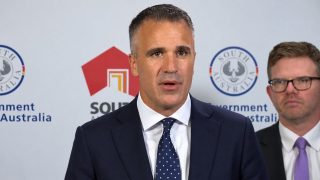

South Australia will establish a royal commission into artificial intelligence to address concerns about the technology's effects on society, Premier Peter Malinauskas announced on Monday.
The major inquiry – the first Australian royal commission into AI – will examine the technology's effect on work, the creative industries, education, public services, and more, with the goal of informing proactive government regulation, the Labor premier said.
South Australia, which spearheaded an under-16s social media ban before it became federal legislation, will also play "a leadership role" in AI, Malinauskas suggested.
Any implementation of new state-based AI regulations or policies would not be delayed until the royal commission reports its findings, which are due by 1 July 2027, he said.
The AI inquiry will not look at infrastructure such as data centres, but at how the technology is used in society – "which is far more consequential than where a data centre gets built", the premier said.
The royal commission's terms of reference will be confirmed in the next six weeks, he added, with the inquiry expected to begin on 1 October.
The state government plans to appoint three royal commissioners to lead the inquiry, which will likely cost South Australian taxpayers upwards of $3 million, Malinauskas said.
While the premier said it was "absolutely clear that the use of artificial intelligence is an exciting opportunity to advance the cause of humanity", he also described unchecked AI systems as "a material risk to the way our society operates, and a risk to the future of work if not thought through carefully".
South Australia's Liberal opposition leader Ashton Hurn questioned the need for a royal commission, and described it as "a $3 million headline on the taxpayer dime that risks duplicating work parliament has already done".
"A parliamentary committee examined these issues, made 15 recommendations and specifically called for South Australia to work with the Commonwealth on clear, consistent, and comprehensive national laws governing AI," he said.
"Before the [state] government spends another $3 million asking many of the same questions again, South Australians deserve an update on how many of those recommendations have actually been implemented."
Malinauskas said the cost of the royal commission would be "chicken feed in comparison to the cost to society if we don't think through the complex questions that are going to be asked of us with the deployment of this technology".
Premier discussed plans with tech giants – but not the PM
Malinauskas told a media conference that he discussed his plan for a royal commission with major technology companies during a recent trip to the United States, but did not tell Prime Minister Anthony Albanese about the plan ahead of its announcement.
The federal government has signalled it will monitor South Australia's royal commission, but has not suggested any plans for a national inquiry.
Albanese unveiled plans in July for dedicated federal AI legislation to be introduced in 2027, largely focused on data centres and copyright.
Malinauskas suggested South Australia's royal commission will make recommendations which could then be adopted by state or federal authorities.
The premier returned to Australia on Sunday after holding meetings in the US with companies including OpenAI, Anthropic, and Apple, as well as local government officials.
He said he wants every company he met with during the trip to participate in South Australia's royal commission.
During his US travel, Malinauskas signed a memorandum of understanding with OpenAI's cofounder and president, Greg Brockman, "to explore opportunities to develop AI skills, accelerate local research and innovation, attract global investment and spread the benefits of AI across South Australia".
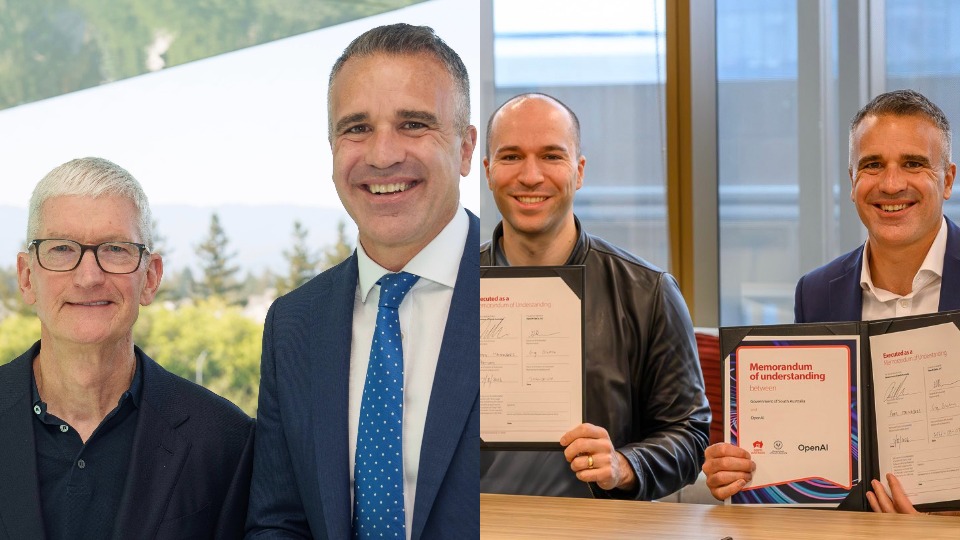
Peter Malinauskas with Apple CEO Tim Cook (left) and OpenAI president Greg Brockman (right). Images: Facebook / X
Malinauskas invokes AGI-speak
During his Monday press conference, Malinauskas appeared to allude to what is known as artificial general intelligence (AGI) – a still theoretical and somewhat disputed capability some tech companies are working towards, in which AI becomes equally or more intelligent than humans.
The South Australian premier argued humankind is now facing the unprecedented prospect of "a new form of intelligence that is able to match, and then soon exceed, the capabilities of human beings".
"Never before in human history have we contended with a world where there is something that we're working with that is smarter than us," he said.
"Now we have it, and its intelligence is only going to increase at warp speed over the course of the next two years alone – that will change everything."
Malinauskas admitted that given the speed of AI development, South Australia's royal commission "won't necessarily give all the specific policy prescriptions" for individual AI models.
But he suggested it could "put in place the architecture of creating a society where AI is working for us, rather than the other way around".
The premier said he personally "fiddled around with" both Anthropic's AI chatbot Claude and OpenAI's ChatGPT during his recent US trip.
"It's impossible not to be utterly impressed by its capability," he said.