





Australia's technology workforce has shrunk for the very first time, according to a new report released on Tuesday which calls for more workers to join the sector and for greater government investment in AI skills and training.
The number of people employed in technology in Australia dropped by 0.3 per cent in 2025 to around 967,000 workers, the twelfth annual Australia's Digital Pulse report found using data from the Australian Bureau of Statistics.
The report was commissioned by Australian Computer Society (ACS) – the publisher of Information Age – and prepared by consultancy firm Deloitte Access Economics.
Its analysis found the number of roles in ICT sales, ICT trades such as support technicians, and ICT administration and logistics support had declined since 2024, while positions in technical, professional, and management roles had grown.
The findings follow previous government research which found sales and administration jobs were among the most vulnerable to potential automation by generative AI models.
Deputy Prime Minister Richard Marles is scheduled to launch the latest Australia's Digital Pulse report in Canberra on Tuesday night.
He said in a pre-launch statement the report will help inform "the choices governments, industry, and educators must make now" to shape Australia's workforce for "the next wave of technological change".
“As AI continues to reshape the way Australians work, our task is not to fear that change, but to ensure people have the education, training, and recognised professional skills to succeed, while building sovereign capability in those critical technologies where Australia can make the greatest contribution, working alongside trusted international partners,” Marles said.
ACS CEO Dr Prins Ralston said technology alone won't deliver Australia's AI agenda.
"Every outcome depends on capable, trusted professionals."
"... In the age of AI, clarity about human capability is just as critical as standards and regulation.
"We must take action now to ensure technology professionals are equipped with the skills required to enter and support the workforce."
A 'fundamental shift in the talent pipeline'
The report recommends a national commitment to have 20 per cent of entry-level tech hires come from alternative pathways by 2030, supported by government-funded 'earn while you learn' and micro-credentialling programs.
Around 40 per cent of new technology workers entered the workforce through alternative pathways over the past five years, the report found.
This was through undertaking workplace training and upskilling (around 55,000 people), achieving industry credentials (around 44,000), or by self-directed learning with no formal training (around 34,000).
The recent increase marked "a fundamental shift in the talent pipeline" away from traditional pathways such as university education, Vocational Education and Training (VET), and migration, the review suggested.
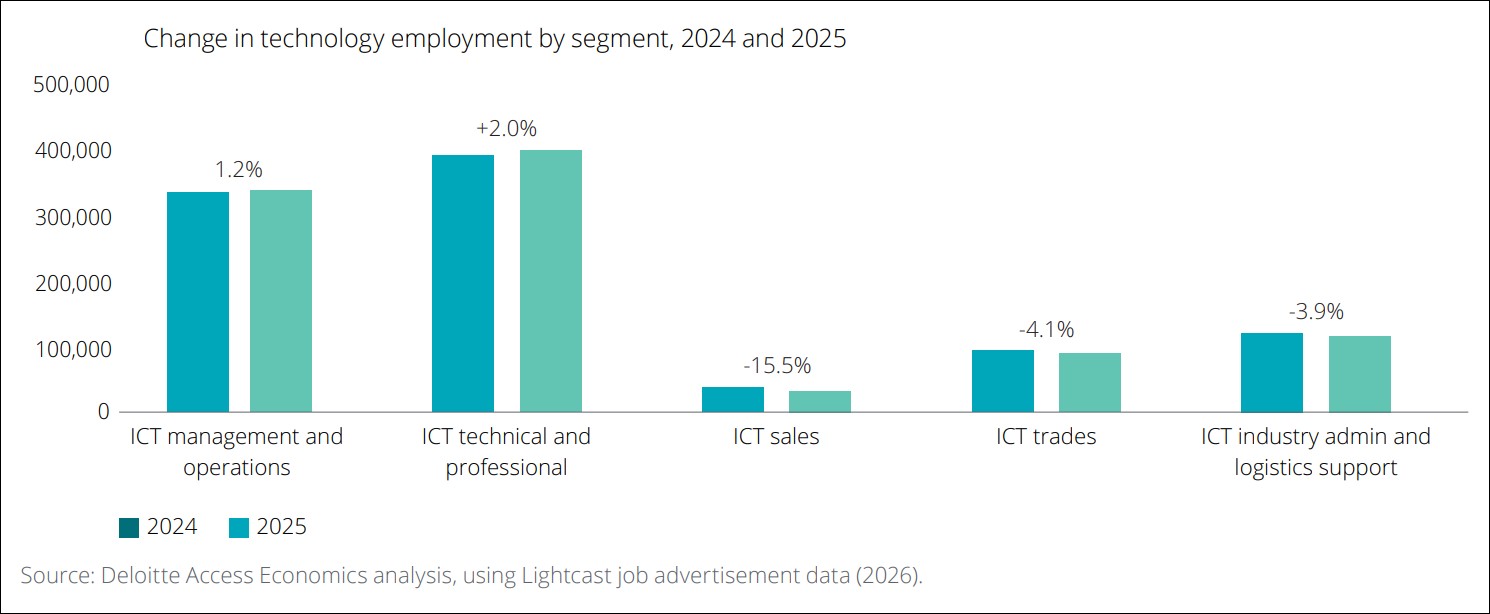
Image: Supplied
The report recommends improving Australia's tech workforce professionalisation by including skills frameworks such as Skills for the Information Age (SFIA) in recruitment and procurement criteria, both inside and outside of government.
ACS President Beau Tydd said entering the technology industry is "no longer defined by a single route".
"While alternative pathways broaden our talent pool, professionalisation provides the shared language and trusted credentials needed to ensure skills are recognised, portable, and built to high standards across the entire economy," he said.
Alternative pathways are generally more gender-diverse than traditional routes, and the report also called for improvements to the retention of women in tech through "more inclusive and flexible workplaces, better return-to-work pathways, and greater diversity in leadership".
Tech jobs drop despite industry's economic growth
The slight reduction in Australia's technology workforce comes as the sector sees growth in its economic activity and exports, according to the report.
It found the industry contributed $142 billion to the economy in the 2025 fiscal year – a 5 per cent increase on FY24 after accounting for inflation – and saw a 13 per cent jump in technology exports to $12 billion.
Digital skills in the broader Australian workforce were also estimated to have contributed $476 billion to the economy in 2025.
Despite these economic boosts, Australia will need an additional 259,000 technology workers over the next decade, the report suggests.
While the review said Australia's video game industry "presents an enticing entry option for younger Australians into tech careers", it also cited a drop in Year 12 technology subject participation, which fell to 28 per cent of students in 2024.
The report also suggests Australia would need an extra $13 billion per year in private AI investment to catch up to counties such as the United States, Israel, and Singapore, which have greater AI investments as a proportion of their GDP.
The federal government unveiled plans in July for dedicated AI legislation, and Prime Minister Anthony Albanese said the technology should be used to create jobs.
The announcement came after a first-of-its-kind government report found AI adoption had not caused widespread job losses in Australia, despite the technology being cited as a factor in recent layoffs at companies such as Telstra, Atlassian, WiseTech, and Afterpay.