

Wholly AI-generated music will be excluded from Australia’s official music charts under a new set of eligibility rules announced by the Australian Recording Industry Association (ARIA) on Wednesday.
ARIA – which runs Australia’s main single, album, and genre-based music charts – will enforce new rules on songs created with AI from Friday, 28 August.
In a post explaining its suite of updated rules, ARIA emphasised that recordings developed with generative AI can still be eligible for the charts if they meet two key criteria: the track has to be “substantially human made”, and it can’t raise any concerns surrounding “stream or chart manipulation”.
In a dedicated FAQ page, ARIA clarified that “substantially human made” is broadly defined as songs where “human creative input is the primary driver of the work”.
Tracks that fail to satisfy these conditions may be subject to removal, exclusion, or their chart position being adjusted.
ARIA will also have the option to revoke or request the return of physical awards, and to withdraw accreditations on tracks deemed ineligible.
“Australian artists are competing for attention in the most crowded market in history and a AI-generated recording taking a chart place matters to the people who create human artistry,” wrote ARIA.
“Recordings with no human performance behind them are generating streams on streaming services.
“ARIA is not interested in promoting or celebrating the success of AI-generated music that does not contain human artistry.”
Though ARIA’s new rules prioritise human-made content, the association emphasised that “nothing changes for an artist using AI as a tool”.
“What is out is a recording with no human performance at its centre,” ARIA explained.
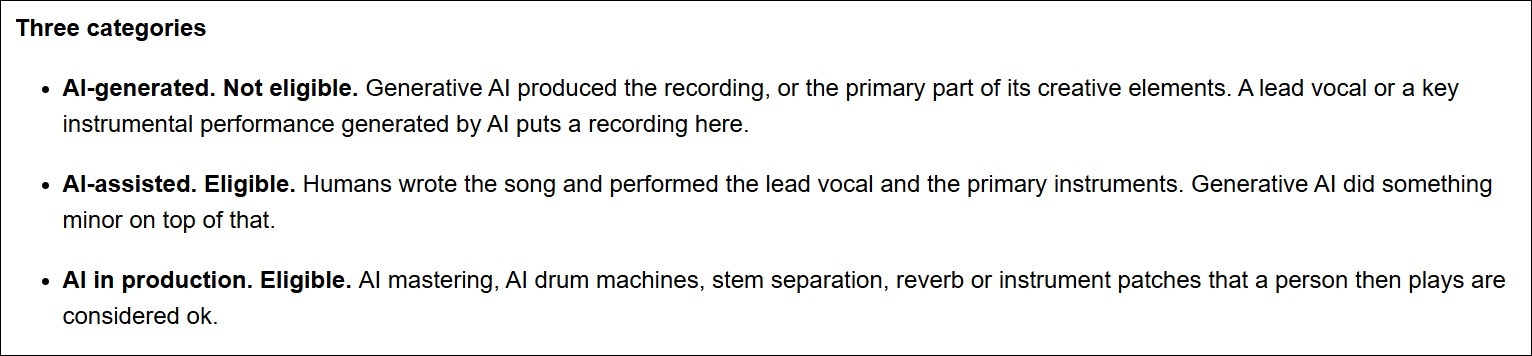
ARIA outlined three categories where AI usage will or won’t affect eligibility. Image: ARIA FAQ
Like a (AI-generated) version
The announcement came after Queensland man Josh Fawaz attracted widespread success with a substantially AI-generated cover of pop icon Madonna’s ‘Like a Prayer’.
After reaching fourth place on two separate ARIA charts in July, Fawaz confirmed he had used AI during production of the track, and updated a description on streaming platform Spotify to specify the vocals and drums were AI-generated.
Information Age understands the cover has outperformed songs from Madonna’s latest album Confessions II – including on the Top 20 Australian Dance Singles chart, where it ranked 14 spots ahead of a fresh Madonna and Kylie Minogue song for the week of 24 August.
ARIA chief executive Annabelle Herd said the association’s AI rule changes reflect an intent to “remain dynamic and promote the human nature of artistry in what is – to say the least – a rapidly developing space”.
“Artists already use AI tools in their work, the charts can and should evolve to keep room for that, but music generated wholesale by services built on artists’ recordings is a different matter,” said Herd.

ARIA chief executive Annabelle Herd says radio stations should follow similar rules on AI-generated music. Image: ARIA
How will this impact AI music?
Further to the new rules, Herd called on “all parties who have a role in deciding the music played and promoted to Australian audiences, particularly radio”, to implement similar changes across their own codes.
Catherine Strong, an RMIT University associate professor and sociologist specialising in popular music, pointed out that chart eligibility would not impact whether a recording can earn royalties.
“Herd called for radio to adopt similar policies restricting what can be played if AI is involved,” Strong told Information Age.
“If no change happens on that front, or in terms of other places music is played, the impact on what someone can earn from a song might be too small to provide a disincentive to producing them.
“The effectiveness of detection of AI will be another factor, given that the new system is based around self-reporting.
“The rapid evolution of AI means detection is always getting harder, and showing that a song has exceeded some threshold of AI input might be quite difficult.”
Listeners still value human music
The changes put ARIA’s charts in line with global principles recently announced by the International Federation of the Phonographic Industry (IFPI).
ARIA said it would also apply new definitions from an industry-backed labelling standard that distinguishes between “AI-generated” and “AI-assisted” songs.
Strong noted ARIA’s rules were also partly about the “unresolved question of how copyright will be determined for AI content”.
“Artists have not been compensated for the use of their work to train the AIs being used to produce music, and the discussion over how this might happen is ongoing,” she said.
“The perception that AI songs are essentially built on the theft of musicians’ work means there will be discomfort among consumers and in the industry if these songs are rewarded with recognition in the charts.”
Strong said even if proper compensation is achieved in the future, she suspects the “human element of songs and music” will continue to be important to listeners because of music’s role in connecting with one another.
“Whether this is redefined in some way to incorporate AI will be interesting to watch,” she said.