



Twelve scientists working in STEM teaching, physics, oncology, biopharmaceutical translation, First Peoples knowledge systems, and more have been recognised in this year’s Prime Minister’s Prizes for Science, showcasing science innovation amidst major hits to Australian science funding.
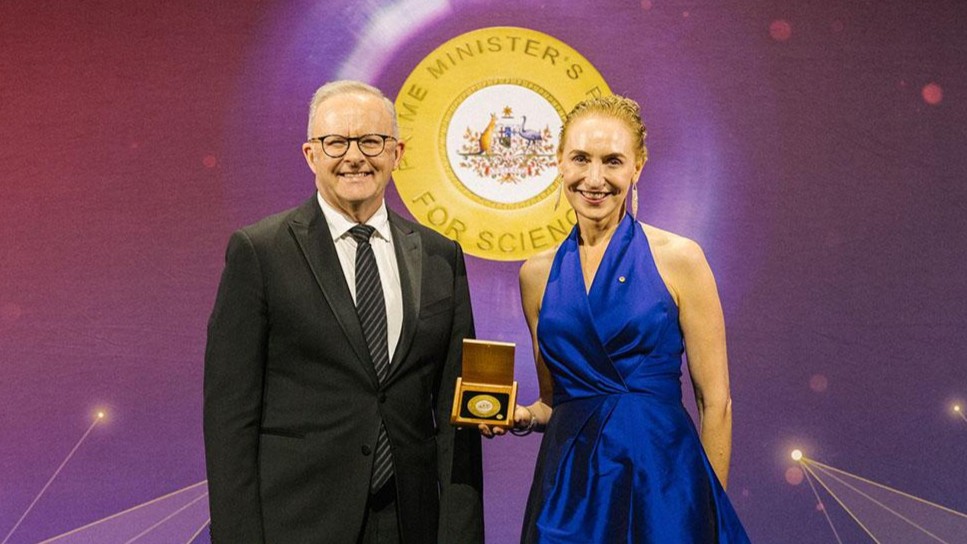
Sydney University Professor Georgina Long, who was named Australian of the Year in 2024 alongside late collaborator Professor Richard Scolyer, received the Prime Minister’s Prize for Science for her work in melanoma research and translation.
She shared the award with Adelaide University Professor Anthony Thomas, a subatomic theorist and mentor whose theoretical work in dark matter has led to internationally renowned astronomic research.
Also recognised were experts including:
- STEM educators including Dr Gabrielle Oslington – whose work at NSW’s Arden Anglican School uses novel approaches to teach inquisitiveness and scientific method to primary students – and secondary teacher Nicolette Wheaton, of Toowoomba’s The Glennie School.
- Professor Mark Smythe, a University of Queensland biopharmaceutical translation expert who has founded seven companies including NASDAQ-listed Protagonist – now valued at over $8.9 billion.
- Applied mathematician Professor Christopher Matthews, a UTS expert whose Goompi Model demonstrates how mathematical thinking is embedded in the Indigenous sense of country and place.
- UWA and Perth Children’s Hospital paediatric infectious diseases specialist Professor Asha Bowen, whose work with Aboriginal communities has halved the prevalence of childhood skin sores in communities across the Kimberley.
- Environmental science expert Associate Professor Fengwang Li, whose renewable electrochemistry research spawned a new acidic reactor system that converts industrial emissions into ethylene for use in clean manufacturing.
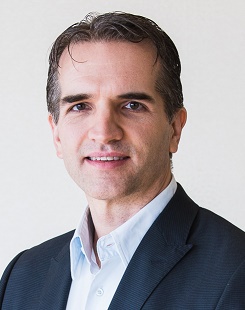
- RMIT University’s Dr Joseph J Richardson, whose nanotechnology research led to the creation and commercialisation of game-changing products including antimicrobial fabric sprays and biodegradable agricultural sprays that bind treatments to plant leaves.
“Science is central to the industries and technologies that will shape Australia’s future,” Minister for Industry and Innovation and Minister for Science Tim Ayres said in lauding the recipients’ work as demonstrations of “the extraordinary breadth and depth of Australian science.”
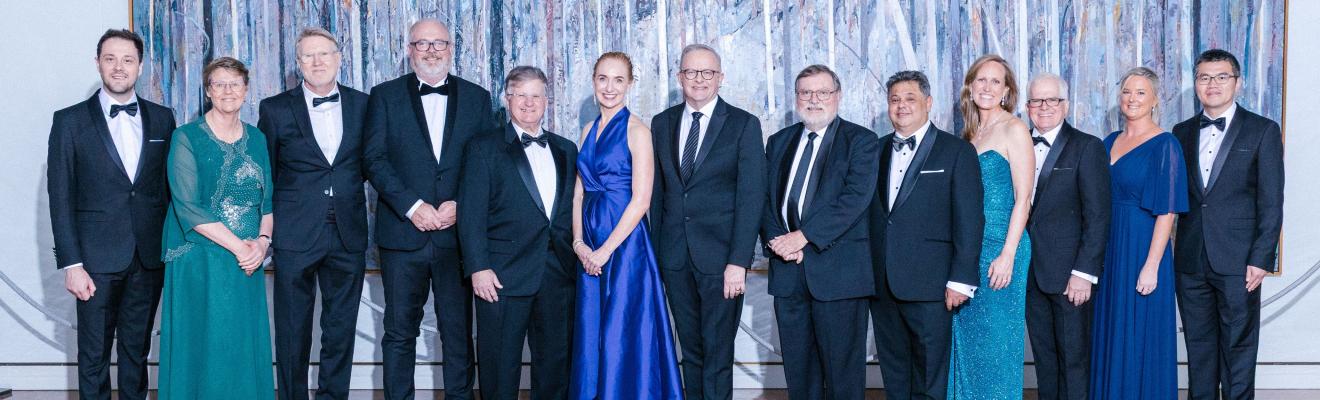
Left to right: Dr Joseph J Richardson, Dr Gabrielle Oslington, Simon Draper PSM (our Secretary), Senator the Hon Tim Ayres, Professor Anthony Thomas AC, Professor Georgina Long AO, Hon Anthony Albanese MP, Professor Tony Haymet PhD FTSE (Australia’s Chief Scientist), Professor Christopher Matthews, Professor Asha Bowen OAM, Professor Mark Smythe, Mrs Nicolette Wheaton, Associate Professor Fengwang Li. Photo: Supplied
“Most Australians don’t have the opportunity to visit places where this year’s recipience have spent their careers working towards important discoveries,” he said in his awards dinner speech, commending recipients’ tireless and often thankless work to develop game-changing innovations.
“That curiosity, testing ideas, learning from setbacks, and persevering when there’s failure or when answers don’t come easily – all in pursuit of a breakthrough that might be years or decades in the making… is what turns scientific endeavour into progress.”
Great minds are a terrible thing to waste
The public recognition of Australia’s scientific innovators comes amidst a backdrop of financial uncertainty in the scientific sector, with Prime Minister Anthony Albanese citing the importance of a “brighter, smarter Australia” even as CSIRO sheds staff and refocuses its operations.
Earlier this year, an inquiry into CSIRO blamed a “long-term, bipartisan failure” to properly fund the national scientific agency, which a year ago announced it would fire or retrench over 1,100 workers despite a $233 million cash injection by the government.
The long-established heads of CSIRO’s manufacturing research unit and digital research business Data61 departed on the same day last November, underscoring a crisis in Australia’s scientific community as the agency seeks to sharpen its investment in areas likely to generate better returns.
CSIRO’s shakeup is part of a broader languor that was called out earlier this year when an expert review noted Australia’s R&D investment continues to lag that of other countries, with flagging commercialisation and an undiversified economy ranked 105th globally in economic complexity.
That report called for “bold reform” to reverse the “siloed” R&D system behind the decades-long slide – a point that Ayres alluded at the awards, noting that “science strengthens our economy… informs our public policy, strengthens our democracy, and helps Australia become more resilient.”
New funding on the Horizon
Even as the CSIRO works to right itself, the government continues to fund local innovators it hopes can spawn significant businesses – simultaneously announcing $81 million in CRC-P funding for 30 industry-led scientific projects just weeks after allocating $12.3 million for quantum firms.
From 1 January, Australian innovators will also gain access to new funding and partnerships after the Commonwealth government this month formally signed the Horizon Europe Agreement, a treaty-level agreement that will open up access to Horizon Europe Pillar II funding.
Yet making the most of that funding also requires entrepreneurship – with RMIT’s Richardson recalling his “quite unique and seemingly meandering academic career” and one commenter noting that “12 products on market is an unusual count for an academic”.
Citing the importance of research and translation in “the industries and technologies of the future” – which he named as clean energy, advanced manufacturing, AI, quantum, health, agriculture, and environmental resilience – Ayres reiterated the government’s support for scientific endeavours.
“The countries that succeed in the decades ahead,” he said, “will be those that create new knowledge, develop new technologies, and build the capability to put them to work… Every discovery, every breakthrough and every achievement adds to Australia’s scientific capability.”
Nominations for the 2027 Prime Minister’s Prizes for Science are now open, and the full list of 2026 recipients is available here.