



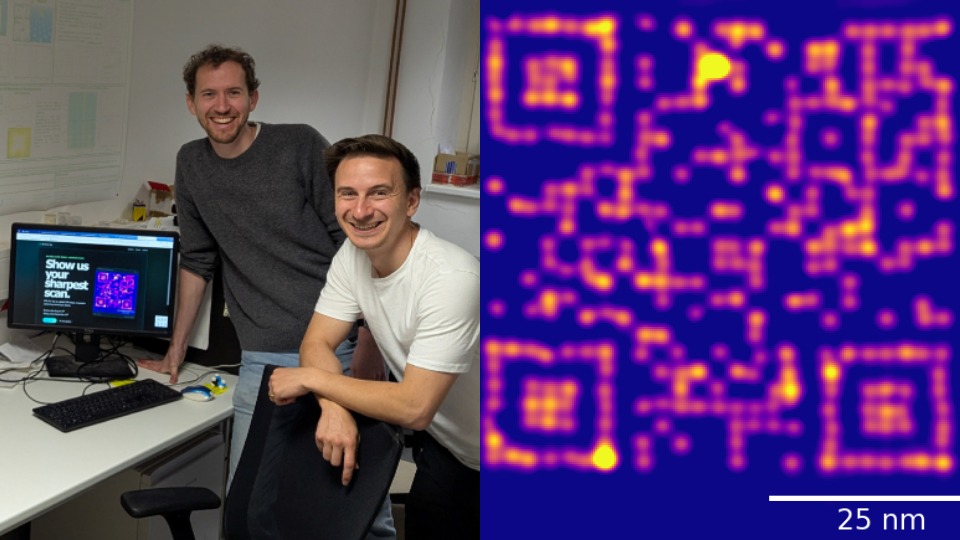

An Australian physicist has codeveloped what he and his collaborators say is the world’s smallest scannable QR code – at roughly a thousandth of the width of a single human hair.
Their QR code measures just 50 x 50 nanometres and was created by arranging individual atoms of silver using an advanced microscope.
Monash University researcher Dr Julian Ceddia collaborated on the project with scientists at the Czech Academy of Sciences.
Ceddia, who is also a co-founder of QR code platform QRdrly, told Information Age that while the researchers’ atomic-scale QR code “is far too small to be seen with the naked eye”, it is also too small to be magnified using regular microscopes “because its features are significantly smaller than the resolution limit imposed by visible light”.
“To read the QR code, we first image it using a scanning tunnelling microscope, which can resolve individual atoms,” he said.
“Then it can be scanned using a mobile phone after displaying the image on a screen.”
Building atom by atom
Dr Oleksandr Stetsovych from the Czech Academy of Sciences said the process of creating the QR code involved using a scanning tunnelling microscope with a needle-like probe which can move individual atoms.
“We very gently brought our probe, coated in silver atoms, into contact with a silver surface,” he said.
“With the right conditions, we can leave behind a single atom exactly where we want it.”
Computer code written by Stetsovych was used to automate the process of forming around 90 per cent of the QR code, which took “about 15 minutes”, Ceddia said.
“We then all spent the next several hours manually inserting the last 10 per cent of the atoms and nudging any that were out of place until the QR code scanned reliably with our phones,” he said.
Ceddia called the project “a playful demonstration of the extraordinary level of control these microscopes give us at the atomic scale”.
“But the same techniques are also being used by researchers around the world to build entirely new materials atom by atom, structures that simply don’t exist in nature,” he said.
Is it a new world record?
The current Guinness World Record for smallest QR code is held by researchers in Austria, who in December 2025 created a code measuring 1.977 square micrometres by using a beam of charged particles to carve into a thin material.
Researchers involved in the new record attempt heard about this record and “thought it would be fun to see whether we could push the concept even further to an atomic QR code”, Ceddia said.
The atomic QR code is almost 800 times smaller in area than the current Guinness World Record holder, the researchers said.
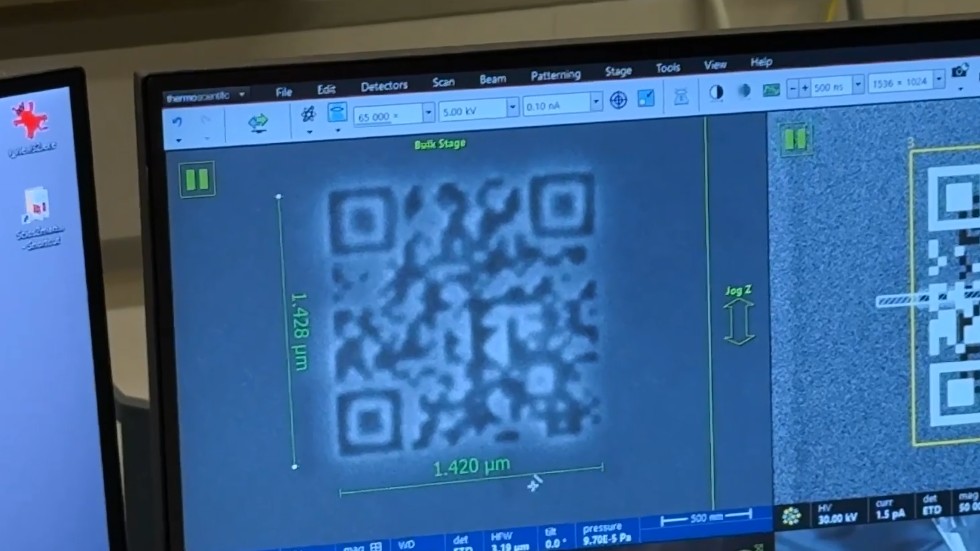
The current Guinness World Record for smallest QR code was achieved by researchers in Austria in 2025. Image: Guinness World Records
When magnified and scanned by a mobile phone, the code takes users to the website of a global microscopic imaging competition called SPM Pro Tips, of which Ceddia is a co-organiser.
“The goal is to showcase both the beauty and the scientific importance of these techniques, while giving the public a glimpse into a field that has had an enormous impact on modern nanoscience,” he said.
“In that sense, the record itself was never the end goal.
“The record was a fun and attention-grabbing way to start a conversation about scanning probe microscopy and the discoveries it enables.”
“... These instruments routinely contribute to research in areas ranging from quantum materials and nanotechnology to energy-efficient electronics and molecular-scale engineering, yet most people never encounter the remarkable images they produce.
“We realised there was a natural connection between the visual appeal of scanning tunnelling microscopy and the idea of an atomic QR code that people could actually scan.”
Ceddia said the researchers had not yet asked for formal Guinness World Records verification of their creation, due to its associated costs.
“We would rather direct limited research funds toward the lab and outreach work,” he said.
“So for now, we are treating it as an unofficial record.”
Guinness World Records was contacted for comment.