
Some 10.5 million Australians use ChatGPT, but that doesn’t mean we trust it.
Amid growing concern about AI tools’ privacy and ethics, OpenAI has plunged into the ranks of Australia’s 20 least trusted companies – joining other tech companies that account for seven of the bottom ten.
Fresh from its court battle with Elon Musk – who openly questioned the profit motivations and integrity of the company he co-founded and now competes with – OpenAI dropped seven spots to 19th place on Roy Morgan’s latest quarterly survey of trusted Australian brands.
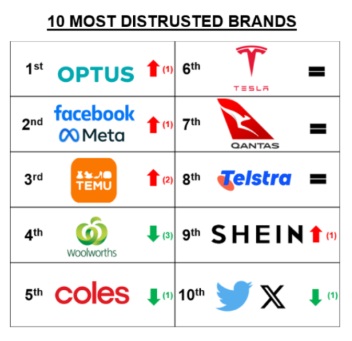
Perennial underperformer Optus reclaimed its position at the bottom of the ladder, with the 17,310 surveyed Australians ranking it as the country’s least trusted company.
Other tech firms were not far behind with Facebook/Meta, Temu, Tesla, Telstra, Shein, and X/Twitter all in the bottom 10.
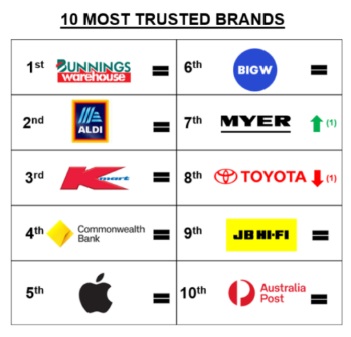
Uber dropped 10 places to 34th while Amazon bucked the trend by improving its ranking to 12th most trusted company – still well down from fifth-placed Apple.
And while OpenAI’s slide put it in the bottom 20 for the first time, Google – which was already there – slid two spots to be named Australia’s 15th most distrusted company.
The decades-old tech giant – which Roy Morgan said “has consistently been more distrusted than trusted” because “people worry that Google does not respect or protect their privacy” – was already distrusted long before its Gemini genAI tool was released.
According to new Roy Morgan figures, Gemini is used by around 5 million of Australia’s 13.6 million AI users.
That places it well behind ChatGPT, which has 10.5 million users, but ahead of Microsoft Copilot (4 million), Canva Magic Studio (1.4 million) and Anthropic’s Claude (777,000).
Both Google and OpenAI “experienced rising distrust,” Roy Morgan CEO Michele Levine said, yet “that doesn’t mean everyone stops using Google tomorrow… [It] means the brand has lower forgiveness and greater vulnerability as alternatives – like AI – become available and more useful.”
Highlighting the broader scepticism surrounding generative AI, even chip giant Nvidia – a company largely disconnected from end users – dropped 11 places to become the 51st most distrusted.
It was hit by what Levine called “a surge in distrust, driven by concerns around ethics and anti-competitive behaviour.”
Distrust in AI is rising across the board
Despite AI’s rapid integration into work, education, home and even social spheres, Australians remain wary of the companies developing it.
A major survey, released in late May by the Office of the Australian Information Commissioner (OAIC), suggests those concerns are far from fading.
Fully 87 per cent of respondents to the OAIC’s latest three-yearly Australian Community Attitudes to Privacy Survey (ACAPS) survey said they are more concerned about privacy now than they were five years ago.
Just 4 per cent believed AI companies were worthy of their trust.
“Expectations about privacy continue to sharpen as the information ecosystem becomes more complex, data-intensive and difficult to navigate,” Australian privacy commissioner Carly Kind said, noting the findings coincide with a 73 per cent rise in privacy complaints so far this financial year.
The survey also found just 3 per cent of respondents trust social media companies, and that 68 per cent would be more likely to use digital services requiring personal information if they knew their data was handled “fairly and responsibly”.
Together, the findings underscore the challenge facing technology companies.
“Community concern continues to grow at an alarming rate,” Kind said, adding that “trust is uneven across sectors and wariness of emerging technologies is increasing, particularly in terms of fairness, accountability, and the practical ability to exercise rights.”