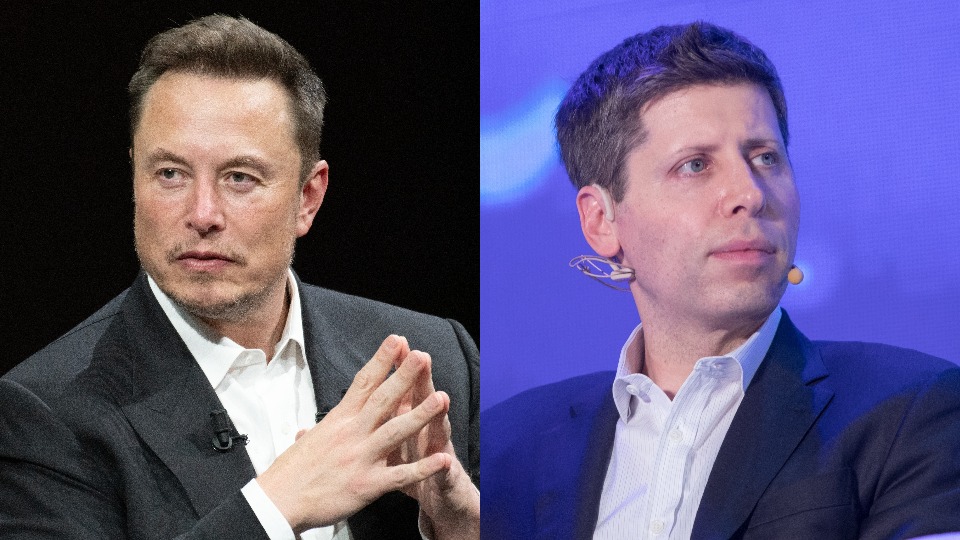

A long-running feud between Elon Musk and Sam Altman has finally reached the courts, in a trial that could alter the trajectory of ChatGPT-maker OpenAI.
On Tuesday, AI titans Musk and Altman passed through security about 15 minutes apart on their way into a federal court in Oakland, California.
Inside, Musk reiterated his long-held view that OpenAI chief executive Altman and company president Greg Brockman had abandoned OpenAI’s early non-profit, altruistic mission to instead favour profits.
“If we make it okay to loot a charity, the entire foundation of charitable giving in America will be destroyed,” Musk reportedly testified.
“That’s my concern."
Judge Yvonne Rogers told jurors the trial would not be a very technical one.
With OpenAI explicitly rejecting Musk’s claims, it would instead focus on “promises and breaches of promises” made over OpenAI’s decade-long corporate history.
The background
Musk initially filed his lawsuit against Altman, Brockman, and key OpenAI investor Microsoft in 2024 – about a decade after the three men co-founded OpenAI with the help of numerous others.
In his initial filing, Musk said he’d contributed more than $61.7 million ($US44 million) to OpenAI between 2016 and 2020.
Musk resigned from the OpenAI board in 2018 following a round of failed discussions about who would run a potential for-profit entity to reach untapped markets.
Some 13 months later, Altman and Microsoft formed a for-profit entity at OpenAI – a move Musk characterised as a betrayal of OpenAI’s original mission.
Musk’s attorney Steven Molo held firm to this allegation – arguing Altman and Brockman were aided by Microsoft to effectively steal “a charity whose mission was the safe, open development of artificial intelligence”.
Notably, Microsoft announced on 27 April the company would stop paying OpenAI a revenue share, and had made its license to OpenAI’s models and products non-exclusive.
Musk seeks damages
Musk claimed in court on Tuesday that OpenAI was initially his “idea”, that he’d recruited its “key people”, provided “all of the initial funding”, and even conceived the company’s name, according to Reuters.
“Without Elon Musk, there would be no OpenAI, pure and simple,” said his attorney.
Musk’s claims include breach of charitable trust and unjust enrichment.
He is seeking for OpenAI to effectively revert from its hybrid structure to a non-profit, with Altman and Brockman removed from their senior roles and Altman ousted as director of OpenAI's non-profit board.
As for damages, Musk wants some $210.4 billion ($US150 billion) from OpenAI and Microsoft directed to OpenAI's charitable arm.
“I could’ve started it as a for-profit, and I specifically chose not to,” Musk reportedly said on the stand.
Scam Altman and Greg Stockman stole a charity. Full stop.
— Elon Musk (@elonmusk) April 27, 2026
Greg got tens of billions of stock for himself and Scam got dozens of OpenAI side deals with a piece of the action for himself, Y Combinator style. After this lawsuit, Scam will also be awarded tens of billions in stock… https://t.co/R27ZeG9nNR
OpenAI remembers things differently
OpenAI attorney William Savitt gave a markedly different telling of Musk’s tenure at OpenAI.
Savitt’s opening statement reportedly asserted AI safety wasn’t a priority for Musk, and the tech billionaire had slandered employees who focused on it.
"’Jackasses’, is what he called them," Savitt said.
He claimed Musk used his lofty investments to “bully” his co-founders, and wanted to merge OpenAI with his automotive company Tesla.
“When they refused to let OpenAI be absorbed, [Musk] took his marbles and went home,” Savitt said.
OpenAI has publicly stated that in 2017 Musk agreed a for-profit entity would be necessary for fundraising, and that Musk’s lawsuit was ultimately “motivated by jealousy” and “regret for walking away”.
“We are here because Mr. Musk didn’t get his way with OpenAI,” Savitt said.
Microsoft’s counsel, Howard Ullman, said the tech giant had been "a responsible partner every step of the way”.
Altman and Microsoft CEO Satya Nadella are yet to testify.
Will this shape the future of AI?
Notably, OpenAI has reportedly laid plans to go public later this year at a valuation of up to $US1 trillion.
Nate Elliott, principal analyst of market research firm Emarketer, said it was “impossible to ignore the fact that Musk's companies compete with OpenAI in both consumer and enterprise AI”.
“[This makes] his suit – ostensibly in defence of the public interest – far from altruistic,” said Elliott.
Emarketer forecasted that in 2026, some 74.9 per cent of US generative AI users engaged ChatGPT at least once per month.
For Musk’s xAI chatbot Grok, this figure was 10.7 per cent.
“If Musk wins… it could also mean the end of OpenAI's business, and give xAI and Grok the fighting chance they now lack,” said Elliot.
Diana Bowman, Dean of the School of Law at RMIT University, said while the case may appear to be a “personal grievance” as much as a “legitimate claim against OpenAI”, it was “clear” OpenAI was no longer a traditional non-profit.
Whether or not Musk succeeds in ousting Altman, however, Bowman noted the OpenAI chief would not be out of work for long.
“I would imagine there are a number of competitors who would be very quick to give him a significant board or leadership position,” she said.
Bowman said the case also demonstrated a lack of AI regulation under the current US administration.
“It seems that there are very few avenues for government to hold these AI giants to account,” she said.
“And so now, the industry is really self-regulating, and using the courts to do that.”