





Australian students may be growing up immersed in smartphones, social media and AI tools, but new national testing suggests many are failing to develop the digital skills needed to critically and safely use technology.
Testing found a “troubling” 30 per cent drop in digital literacy scores since the first testing in 2008 – just before the iPhone changed everything.
According to the newly released results of ACARA’s 2025 National Assessment Program – ICT Literacy (NAP-ICTL) found that despite being immersed in digital technologies, nearly two-thirds of Australia’s Year 10 students still aren’t good at using them.
Just half of Year 6 students were ‘proficient’ with digital technologies last year and only 37 per cent of Year 10 students met the same standard.
The 5,498 Year 6 and 4,753 Year 10 students, from 641 schools nationwide, struggled with NAP-ICTL’s 11 online modules that lay out “authentic ICT activities” like creating digital presentations, analysing data, designing algorithms, and responding to scenarios on online safety and ethics.
It’s the seventh time the tests – which evaluate how students use digital tools to access and evaluate information; communicate and collaborate; apply computational, design and systems thinking and more – have been administered since 2008 and scores have never been lower.
The proportion of Year 6 students judged as proficient with digital technologies dropped from 55 per cent in 2022 to 50 per cent last year, while the proportion of proficient Year 10 students dropped from 46 per cent to 37 per cent.
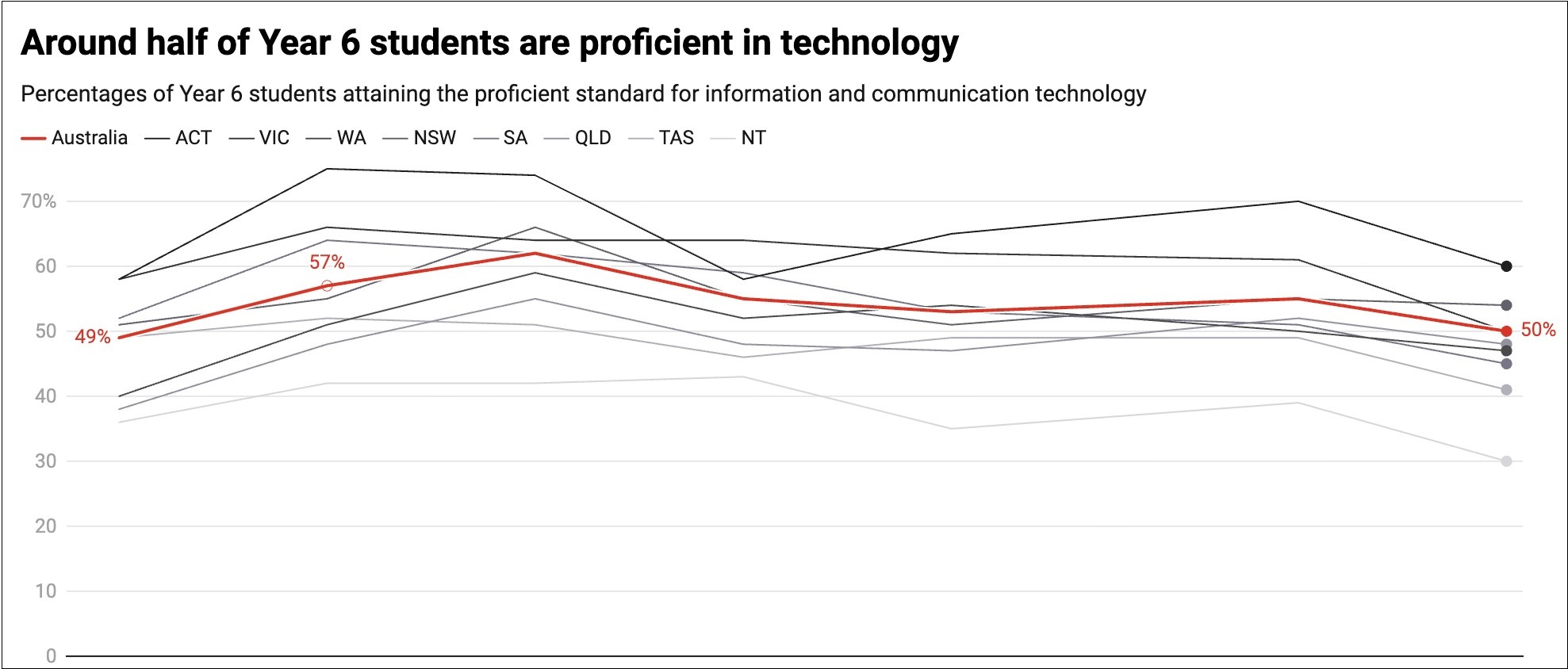
Year 6 students showed a significant decline in digital skills over the past three years. Source: ACU
Female students outperformed males in both age groups, with a “significant and persistent gap” between indigenous and non-indigenous students that ACARA said is equivalent to the “average learning growth over at least two academic years”.
Year 6 students who speak a language other than English “significantly outperformed” their monolingual peers, while parental occupation and education were tied to higher ICT literacy – as was living in a major city, where ICT literacy rates are over twice those in regional or remote areas.
And while younger students learn to use digital tools from a variety of sources including school, family, friends and self-directed learning, ACARA found that by Year 10, most students were mainly figuring out ICT by themselves – with those most confident with digital tools scoring the highest.
Students who frequently use productivity applications like word processing and spreadsheet apps generally delivered higher ICT literacy scores while those using specialist applications – for example, concept mapping or simulation tools – were less proficient with ICT overall.
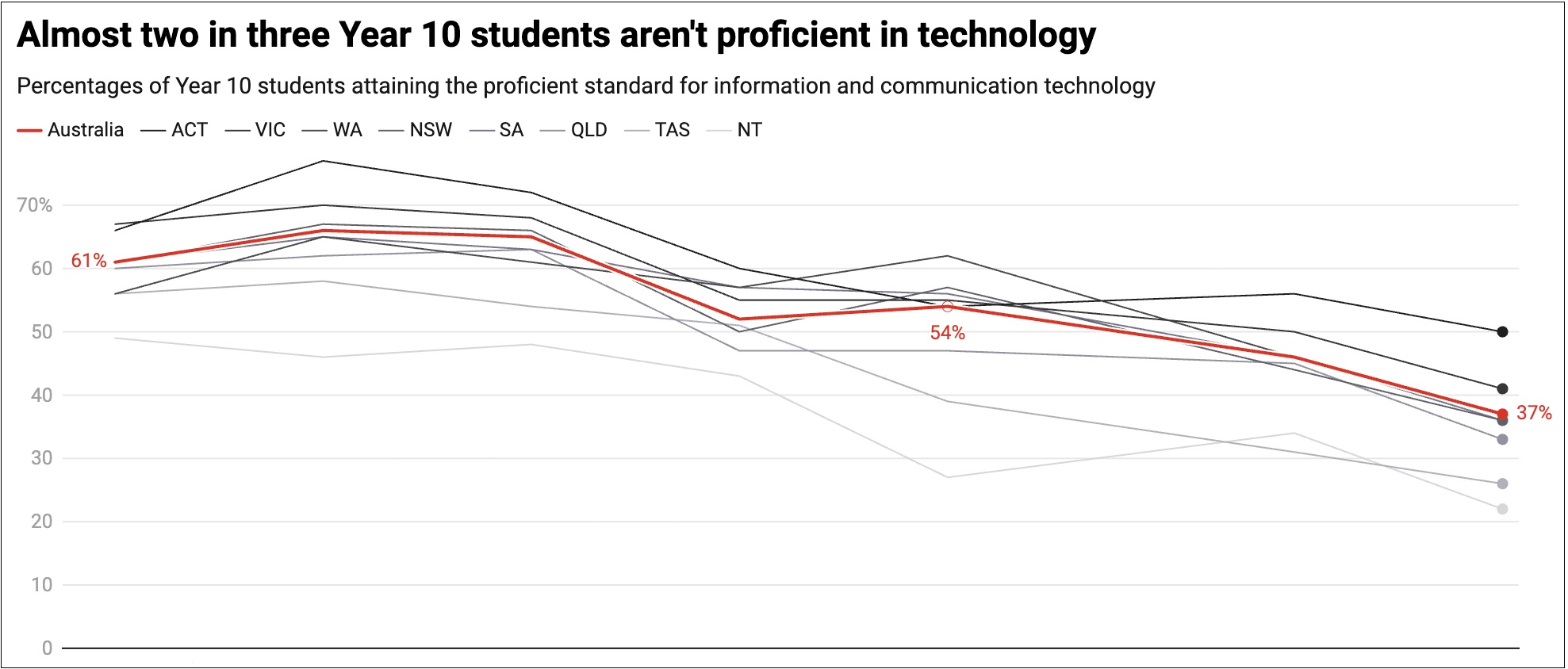
The digital literacy of Year 10 students is continuing to slide despite ubiquitous access to ICT. Source: ACU
he results “show a decline in student proficiency in ICT literacy and continuing gaps between different groups of students,” ACARA CEO Stephen Gniel said, noting that the figures “contrast with most students reporting extensive experience using digital tools.”
Australia lagging the world… again
The results are a counterpoint to the Australian Digital Inclusion Index (ADII), which measures access, affordability and digital ability and increased from 67.5 in 2020 to 73.2 in 2022 – and that those aged 18 to 34 were Australia’s most digitally included group.
While Australian students ranked highly in 2009, smartphones’ ubiquity has amplified the impact of social media and other apps, exacerbating a digital divide that led the UN to warn “digital literacy, skills, and divide must be clearly defined to support learning within evolving tools.”
The effects of inadequate proficiency were laid bare as the UK’s peak medical body recently warned social media “ranks alongside smoking and wearing seatbelts” in terms of endangering the health of young people – validating Australia’s under-16 age ban as the UK considers following suit.
Weighing the AI effect
The new results mark the first time students’ digital literacy has been benchmarked since the 2022 introduction of Open AI’s ChatGPT generative AI (genAI) tool pushed educators into a headlong rush to integrate genAI in schools where students were already flocking to it.
Administrators spent the next three years wrestling with the best way to safely integrate AI into schools, even as the likes of NSW’s NSWEduChat, South Australia’s EdChat and Queensland’s newly introduced Corella genAI tools normalised genAI.
By the time of the 2025 NAP-ICTL testing, use of AI was “widespread” in schools – with around a quarter of Year 10 students frequently using it to help with schoolwork and over 60 per cent said they were using AI tools to “generate written content” at least once a month.
The analysis doesn’t speculate how much increased use of AI contributed to overall declines in digital literacy, but plummeting Year 10 results since ChatGPT was introduced are hard to ignore – with states reporting drops of anywhere from 5 per cent (Tasmania) to 12 per cent (Queensland).
“Students are using digital tools but not building digital literacy skills at the same time,” a team of Canberra University and Australian Catholic University academics said in analysing the “troubling” NAP-ICTL results, warning “literacy is a far more complex capability than simply using technology.”
“If we are serious about improving digital literacy, we need to rethink how we teach and how we assess it.”